Online Reporter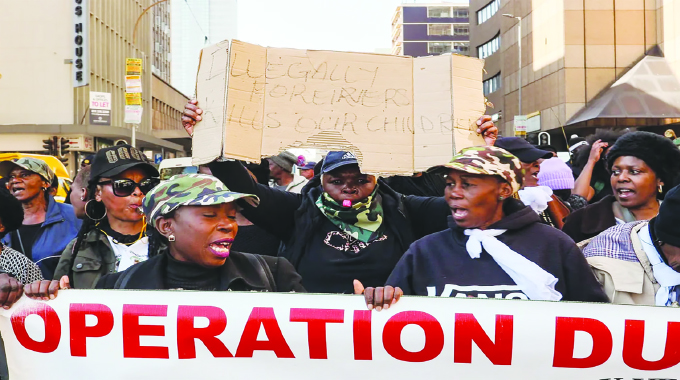
Mphumudzeni Siphuma
THE South African Rainbow dream is steadily fading, with the country now regarded as one of the most unequal societies in the world. Leaders of Operation Dudula have seized on this reality, directing their anger towards African immigrants. As Imraan Buccus wrote in The Sunday Times, “Operation Dudula has brought fascism to South Africa.” In truth, Operation Dudula serves as a distraction from real challenges facing South Africans such as unemployment, poverty and poor governance.
Operation Dudula is a splinter group that originated from the Put South Africa First Movement, the organisation that popularised anti-migrant campaigns on social media before taking action on the ground. It was established in Soweto, a few months after the July 2021 riots that followed the imprisonment of former President Jacob Zuma. The group gained attention on June 16, 2021, when it organised a march in Soweto to mark the 45th anniversary of the Soweto Uprising. Soweto, once a historic centre of anti-apartheid resistance, has since become an epicentre of tense clashes between Operation Dudula supporters and black African foreign nationals.
Until July 25, 2022, Operation Dudula was led by Nhlanhla “Lux” Dlamini, who has since left the organisation as it is now led by Zandile Dabula. The word Dudula means “force out” or “knock down” in Zulu, reflecting the group’s objective of removing African immigrants in South Africa. The movement claims to target foreign nationals engaged in drug trafficking or businesses that hire undocumented migrants. In a democratic society like South Africa, it is necessary to raise issues of national interest, but the question remains: why should Operation Dudula take the law into its own hands? Justice should take its course for anyone engaging in illegal activities.
South Africans are battling unemployment, rampant corruption, lack of accountability, hunger and broken trust. For those who feel disenfranchised, turning their anger on vulnerable immigrants is not a solution. In 2022, a Zimbabwean national, Elvis Nyathi, was burned to death in Alexandra after failing to present proof of identity, one of several acts of barbarism linked to the movement. Just recently, members of the movement denied a one-year-old Malawian child health treatment — the child later died. In other instances, members of Dudula have been barricading the gates of public healthcare clinics and preventing what they call “undocumented foreigners” from accessing health facilities. In addition, Operation Dudula has vowed to stop foreign nationals’ children from enrolling in public schools, citing high demand and limited resources and calls for immigrant children to be enrolled in private schools instead of public ones. The World Bank’s 2022 report Inequality in Southern Africa describes South Africa as “the most unequal country in the world”. Inequality in per capita consumption is about 50 percent higher than the average for upper-middle-income countries. Race and disparities in education remain key drivers of inequality. In 2024, 13,2 million South Africans were living under the international absolute poverty threshold of US$2,15 per day. The May 2025 Statistics South Africa report indicates an unemployment rate of 32,9 percent in the first quarter of 2025. South Africa’s Gini coefficient of 0,67 reflects one of the world’s highest levels of inequality. Unemployment and poverty are therefore the greatest sources of discontent fuelling Operation Dudula. Many members believe that undocumented foreigners are responsible for job losses and strain on social services. This perception, however, is misguided and misinformed.
Based on World Bank data, 10 percent of South Africa’s population controls 80 percent of the country’s wealth. This should be the real point of contention — not poor black illegal migrants. Illegal migration should be addressed through proper law enforcement and humane procedures. Killing or harassing undocumented foreigners will not solve unemployment or hunger, nor will it reduce pressure on public systems, which seem to be failing. Such actions only deepen social division and distract from structural issues like corruption, mismanagement and economic inequality.
Operation Dudula can be seen as an outcome of Government failure. In March 2022, then-Minister of Home Affairs Dr Aaron Motsoaledi acknowledged that about 3,95 million foreigners live in South Africa. The Government’s inability to manage migration has created fertile ground for vigilante movements such as Dudula. President Cyril Ramaphosa condemned Operation Dudula in 2022, calling it a “vigilante-type” group that must be stopped. His condemnation followed pressure from civil society organisations warning of possible xenophobic violence.
However, some politicians have glorified or supported the group for political gain while others are critical of the movement. The leader of ActionSA, Herman Mashaba, argued that such movements misdirect public anger by focusing on immigrants instead of the Government’s failure to address corruption and unemployment. Recently, the Economic Freedom Fighters condemned the actions of Operation Dudula, a stance long taken by its leader Julius Malema. In contrast, the leader of the Patriotic Alliance, Gayton Mackenzie, who is known for his anti-migrant slogan “Mabahambe” vows to unashamedly offer his support for Operation Dudula. Similarly, the Inkatha Freedom Party President, Velinkosi Hlabisa calls for deportation of illegal immigrants. Likewise, reckless comments by public figures like Thandi Modise and Faith Mazibuko have fuelled xenophobic sentiment.
These actions are irresponsible for leaders who should be guiding public opinion positively. It is my position that Operation Dudula must be publicly and urgently discouraged to preserve social stability. At the same time, the Government must act decisively against illegal migration and protect job opportunities for South Africans through lawful means. At this juncture, it is critical that the South African national leadership do the right thing and address the real issues of those affected. This includes addressing unemployment and basic services rather than waiting for more helpless and baseless acts of barbarism in our streets as portrayed in Soweto, Alexander and Diepsloot in recent times.
If the Government does not address these heinous acts, the rainbow nation’s dream becomes a very thin one. This is not what
Nelson Mandela envisioned for South Africa. From xenophobia to Dudula, it is just a change of names with the same misguided imaginations. There is a hatred of fellow black nationals, which is against the spirit of Ubuntu that we as Africans are known for. It is necessary that we treat illegal migrants with dignity and take necessary measures like tight border controls to minimise their influx. If we leave it to misguided elements like those who lead Operation Dudula, we could be in for the establishment of terrorist groups.
If the South African Government does not rein in Operation Dudula, South Africa faces dangerous times. We have seen how unrest affects economic progress. South Africans must wake up and stop the barbaric acts. In a democratic country like South Africa, people have the democratic right to express their grievances through protest but let us not leave it to barbaric groups acting as a registered entity while causing death and destruction. It is important for the government to address the fundamentals that cause unemployment and hunger, as these are well-known causes for fascist movements but Operation Dudula must stop now!