

 Online Reporter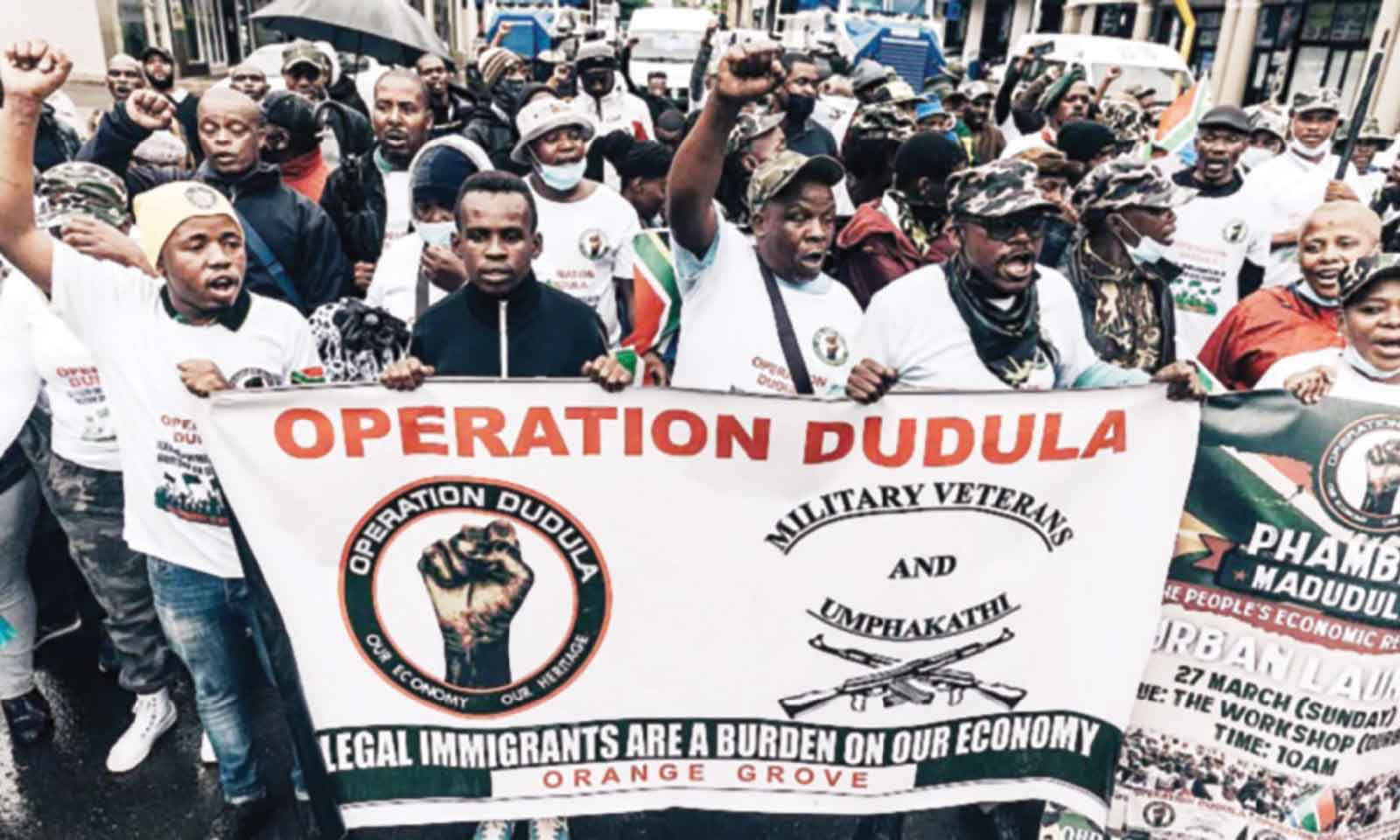
Lonias Rozvi Majoni
Herald Correspondent
The rise of Operation Dudula across the South African political landscape has been marketed as a gritty, “citizens-first” reclamation of national sovereignty. Its proponents wrap themselves in the flag, claiming to protect the local economy from a perceived foreign “invasion.”
Yet, beneath this veneer of patriotic fervour lies a movement that is not only hollow and historically illiterate but fundamentally self-contradictory. Operation Dudula is an exercise in “xeno-racism”, a toxic mimicry of the very Apartheid-era segregation it claims to despise.
It is a movement lost in the fog of a misunderstood past, tilting at windmills while ignoring the foundational pulse of the very region it claims to protect.
The most glaring irony of the Dudula movement is its claimed devotion to the “rule of law” while systematically operating outside of it. In a landmark 2024 ruling, the South African High Court laid bare the movement’s illegality, interdicting its leaders from taking the law into their own hands. By demanding identity documents and conducting illegal evictions, Dudula members have placed themselves above the very Constitution they claim to defend.
Under the Immigration Act 13 of 2002, only a police or immigration officer has the authority to demand identification. When private citizens play “border patrol,” they are not enforcing law; they are practicing vigilantism. Furthermore, by targeting individuals based on nationality, the movement violates the Promotion of Equality and Prevention of Unfair Discrimination Act, which prohibits harassment based on social origin.
Dudula’s “war on crime” is, ironically, one of the greatest contemporary threats to the South African legal order.
To understand why Dudula’s mission is a “lost cause,” one must look at the function of the nation. South Africa is the metropolis of Southern Africa. Just as London serves as the hub for the UK, South Africa is the gravity well of the subcontinent. This is not a recent phenomenon, but the result of millennia of Bantu migrations, a massive demographic shift that saw people flow across the Limpopo and Orange Rivers long before European surveyors arrived.
In the same vein, the Mfecane (The Crushing) of the 19th century further unified the region through upheaval. The historical ties are inescapable, for instance,the Ngoni people of Zambia and Malawi are the direct descendants of those who fled the Zulu wars.
More so, the Gaza Kingdom of Soshangane in Mozambique was an extension of the Ndwandwe power structure from present-day KwaZulu-Natal. Additionally, the Khumalo (Ndebele) under Mzilikazi moved from the Zulu heartland to settle in modern-day Zimbabwe.
These are not separate peoples; they are branches of the same tree, severed only by the surgical and often nonsensical lines drawn at the Berlin Conference (1884-1885).
By treating these artificial colonial boundaries as sacred, Dudula perversely validates the “Scramble for Africa,” choosing to fight for the scraps of a divided house rather than the unity of a continental home.
At its core, Operation Dudula is a betrayal of Ubuntu, the cornerstone of South African social philosophy. Ubuntu, the belief that “a person is a person through other people” (umuntu ngumuntu ngabantu), is a normative framework recognised by the Constitutional Court as a source of law and dignity.
To treat a fellow African as a “pest” is to forfeit one’s own humanity according to this indigenous code. Furthermore, the centuries of intermarriage and shared cultural alliances, symbolised by the exchange of lobola (bride-wealth) between kinship groups across modern borders, make almost everyone in the region biologically and culturally connected to South Africa. You cannot “dudula” (push out) a neighbour whose blood flows in your own veins.
If the architects of Operation Dudula were truly serious about economic empowerment, they would not be chasing street vendors; they would be working to ensure the continued success of Broad-Based Black Economic Empowerment, a legislative strategy designed to redress the systematic exclusion of the black majority from ownership and management of the economy.
It focuses on ownership and management control, moving the majority from labourers to shareholders. It also promotes growing the small businesses that form the economic backbone, among other issues.
If Black Economic Empowerment continues to flourish, Dudula would not be fighting over a shrinking pie. South Africa will continue to grow and succeed to become an industrial powerhouse capable of lifting the entire SADC region. A thriving South African economy, integrated with its neighbours, creates a regional market of hundreds of millions. When the “metropolis” succeeds, the “influx” becomes a demographic dividend, not a source of friction.




Quote: “Yet, beneath this veneer of patriotic fervour lies a movement that is not only hollow and historically illiterate but fundamentally self-contradictory”. Unquote. “Illiterate” being the defining word.