

 admin
admin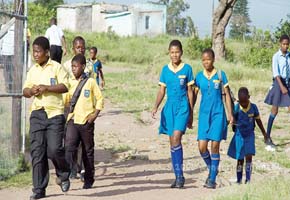
The privilege of boarding the bus was restricted to particular days when the bus passes through the area. This also depended on other factors; the bus has to pass through the area a few minutes after school lessons have ended — usually after 4pm. If the bus arrives earlier than expected or develops a mechanical fault causing it to be delayed, then there is no transport for the pupils. The pupil who lives furthest from school walks for more than three hours to get home.
A closer look at this condition shows the fact that the rural pupil, in comparison with his/her urban counterpart, is heavily disadvantaged, despite the fact that they both write the same Zimsec papers and are subjected to the same examination conditions.
A normal schooling day for rural pupils is not a rosy one. They wake up a little after 3am to prepare for the journey to school, probably a bit earlier to prepare a meal. They are already on the long journey to school by 4am and arrive at school after 7am, if not later. With weariness and hunger taking its toll, they commence their daily lessons, their concentration heavily compromised.
Break time and lunch hour are never a respite from hunger and exhaustion for most of them as many will be having nothing to eat. For primary schools with feeding schemes championed by World Vision, Care International and other NGOs, the dire condition is pacified, but the situation remains critical for the secondary school pupil.
Studies resume after lunch time, usually from 2pm, and are normally interrupted by inevitable chores of cleaning the school compound, sporting activity and fetching firewood and water for teachers before the day ends at 4.30pm. The laborious return journey commences, and the student arrives home just before 8pm.
For those who arrive earlier, livestock must be gathered for the night, water and firewood need to be collected and for the girl child, meals have to be prepared to feed the whole family. The pupil is tired after the day’s responsibilities and retires for sleep, not having absorbed even some few phrases from a History or Science textbook. The unenviable cycle is repeated the following day.
In short, rural pupils hardly have time for their studies. Most of the rural obligations like building kraals, fencing the farms using branches, ploughing and chopping compound poles are labour intensive. They tax the body and mind.
Although the Unicef-led Educational Transitional Fund (ETF) has managed to create a pupil-book ratio of 1:1 in most critical subjects especially for the rural pupil, the programme is dealt a heavy blow as many rural pupils do not have time to read the donated books. The pupils now have the learning resources but no time to learn.
It’s very difficult for teachers to give homework to rural pupils. A child who arrives at home at 8pm and wakes up at 3am cannot be trusted with fulfilling school tasks at home, and justifiably so. With a poor lighting system, coupled by a weary mind and exhausted body, the combination is indeed against any meaningful engagement in study work.
As the farming season begins, most pupils will temporarily suspend lessons to help with tilling the land and productive learning time is lost. In the event of a humanitarian NGO delivering food handouts in the community, rural secondary schools record an absenteeism rate of more than 50 percent as pupils help with offloading tonnes of food-aid from haulage trucks and ferry it home on scotch carts and wheelbarrows.
Most rural pupils in Matabeleland are confined to their rural backgrounds from infancy until they complete O-level, a major contributor to the poor career choices they make later in their lives. The majority don’t know what industry is nor realise the possibilities that are brought about by education. They have often heard about doctors, engineers, architects, artisans and lawyers but have never seen one or had an experience of seeing any of them at work.
The only inspiration they get is from their brothers from South Africa who come home carrying lots of disposable cash, driving sleek cars and narrating the perceived glamour of life in South Africa. It is therefore not surprising that most of the pupils in the region end up in South Africa, doing menial jobs because of lack of academic and technical experience.
Government efforts of electrifying rural institutions through the Rural Electrification Agency and the launch of the National E-Learning Programme by President Mugabe are major strides towards the amelioration of the plight of the rural pupil. This follows the Presidential Computerisation Programme which has seen the President donating hundreds of computers to different secondary schools throughout the country. Undoubtedly, this goes a long way in increasing exposure of rural pupils to the requirements of today’s world.
It is also needful for the Government to prioritise improving mobility constraints of rural pupils to complement its computerisation and electrification programmes. An educational scheme focusing on the procurement of a minibus or a truck for each school will go a long way in easing the burden rural pupils carry.
The vehicle in question will be for transporting pupils to school in the morning and ferrying them to a place nearer home after school. Educational trips to the country’s industries, resort areas, open-day tertiary functions, and career guidance events and to other employer-meet-student activities become possible to plan and implement. Rural pupils will therefore be exposed to the ever-changing demands of the global climate, enabling them to productively craft their destinies.
Undeniably, this initiative needs to be supported by rural district councils by ensuring that the existing rural dirt roads are constantly maintained to minimise travelling hassles. A sound transport system has the potential of attracting qualified personnel, a reprieve to a region manned by temporary teachers.
In addition to building more secondary schools to lessen walking distances, the Government can also champion the setting up of boarding facilities, makeshift or permanent, or lease a few blocks from primary schools (which are usually strategically located) for secondary education to complement the vehicle scheme.
Rural pupils need all the assistance they can get from different stakeholders. Concerted efforts in this regard will minimise poor pass rates, early school dropouts and early marriage which will translate to an improved level of awareness and academic worth among rural pupils in the region.
* The writer can be reached on 0774 027218 or [email protected]


 Online Reporter
 derick.khumalo