Chronicle Editor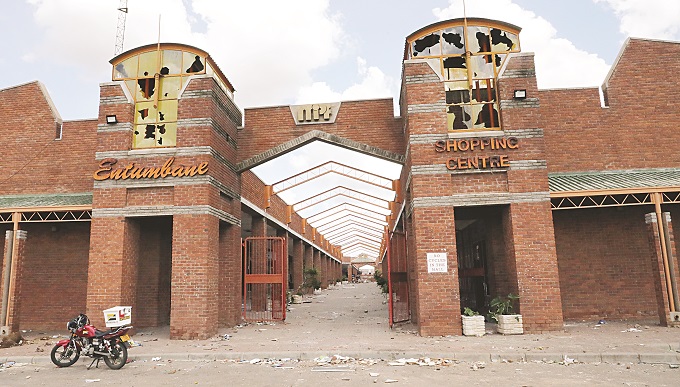
PARTS of the western suburbs of Bulawayo resemble a war zone. In the aftermath of Monday and Tuesday’s terror attacks which left a trail of destruction, debris lines the streets. Burnt out tyres, rocks, litter and all manner of garbage is strewn all over the place. Shopping malls are shells. Windows are broken, doors are non-existent, stock has been looted, some shops have been burnt down while fridges and even cash registers were stolen.
Some looters had the audacity to destroy compressors of big freezers they couldn’t seize and carry. At Entumbane Complex, a shopping mall built at a huge cost, most infrastructure was vandalised and it will take a miracle for the businesses there to recover. Smaller shopping centres serving residents of Luveve, Lobengula, Magwegwe, Nkulumane, Sizinda, Tshabalala, Nketa and Emganwini were looted extensively.
Nothing remains in those shops leading us to wonder — Were those looters thinking of the future? Where will they buy their groceries now? Do they have the financial muscle to hitch a ride into the Central Business District to do their grocery shopping on a regular basis? We wonder.
Yesterday we published pictures of shopping centres such as Chicken Corner in Tshabalala. It’s a sorry sight. Elsewhere, innocent people lost their cars which were burnt down by drunken youths — some as young as 15 and 16. Stories are told of marauding gangs of youths, women and old men rampaging through the western suburbs where they raided shop after shop in broad daylight.
Their orgy of looting knew no bounds. Take whatever you can carry appeared to be the slogan. Is this what we have become as a nation? A nation of looters who pillage other people’s blood and sweat. Where is the Ubuntu? The Bulawayo City Council is counting its losses. A stretch of street lights and robots along Siyephambili Drive were vandalised and uprooted. To whose benefit, we ask?
The Town Clerk, Mr Christopher Dube, tells us it will require foreign currency to repair the damage. Where will it come from? Who bears the cost of repairs? Does the Zimbabwe Congress of Trade Unions, the opposition Movement for Democratic Change and civil society who organised the stayaway and protests have the financial muscle to carry the cost?
Some feel they should be made to pay and who can begrudge them? Hundreds of people have lost their jobs as a result of the protests. Who is going to feed their families? Which investor is going to want to come to cities such as Bulawayo where their investment is not safe?
Critical services such as Fire and Ambulances were not spared. After torching buildings, protestors would attack the Fire Brigade as they responded to the fire alarm. They had to be escorted by the police to put out fires. The human cost was immense. A police officer from Entumbane was stoned to death in cold blood.
Some of his colleagues from Pumula were attacked in their vehicle which was later overturned and burnt to a shell. At Emagetsini at the intersection of Siyephambili Drive and Luveve Road, a police officer survived death by a whisker after he was abducted by a mob which was about to throw him into a raging fire before the timely arrival of the anti-riot squad which rescued him.
Clearly some of these protestors were high on something very strong — possibly drugs and spirits. The police — who were extremely stretched to the limit as they had to respond to numerous distress calls simultaneously — should be commended for exercising restraint.
Most of them were armed but remained calm in the face of extreme provocation and immense danger to their lives. This begs the question. Should the rules of engagement remain rigid in a terror situation such as the one we just witnessed?
Are the law enforcement agents expected to reason with louts and other intoxicated anarchists on a clear mission to wreak havoc and spread fear, alarm and despondency in the country? While having to contend with mobs of marauding looters, the police also had to deal with petrified shop owners some of whom took matters into their own hands in a bid to protect their businesses.
Faced with a charging mob intent on looting and burning their premises, some businesspeople shot into the crowds, injuring some of the people. Who can blame them? While we don’t encourage vigilante justice, in such a charged and tense environment, anything can happen.
The cost to the economy has been immense but Bulawayo has suffered the brunt of the just ended protests. Given the parlous state of the city on the economic front, the carnage wrought by the destruction of property, infrastructure and businesses will take years to recover from.
We posit that the people of Bulawayo should take time to reflect on these terror attacks. They should never allow their city to be the hotbed of opposition political agendas because there is nothing to be gained from it — only pain and suffering.



 derick.khumalo