Online Reporter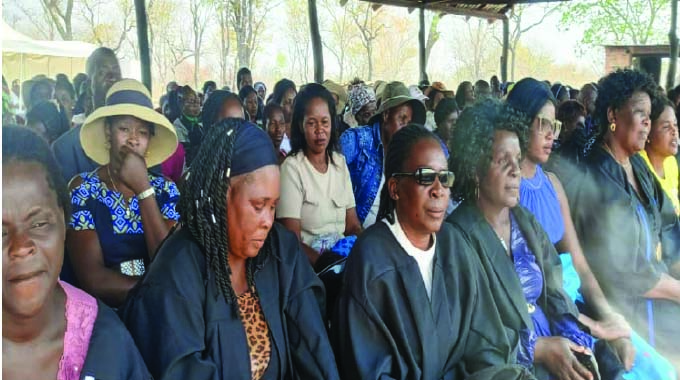
Rutendo Nyeve recently in Matetsi
MORE than 1 500 budding entrepreneurs from across Matabeleland North Province recently graduated after completing critical business skills courses designed to strengthen their enterprises and position them as key players in Zimbabwe’s economic transformation agenda.
The graduation ceremony, the second of its kind in the province, was held at Matetsi Secondary School last Saturday, marking another milestone in the Government’s thrust to build a culture of entrepreneurship, innovation and self-reliance.
Minister of State for Provincial Affairs and Devolution for Matabeleland North, Cde Richard Moyo, commended the initiative’s alignment with the national development agenda.

In a speech read on his behalf by Zanu-PF Central Committee member, Cde Fati Mpofu, Minister Moyo highlighted the strategic role of small and medium enterprises (SMEs) in achieving an upper-middle income economy by 2030.
“Embracing the Vision 2030 national mantra of leaving no one and no place behind and at the same time achieving a middle-income economy, the Entrepreneurs4ED are proponents of the national Vision 2030,” he said.
Minister Moyo said small and medium enterprises are the backbone of the local industrialisation drive. “We forge ahead with entrepreneurship skills training in MSMEs growth trajectory by feeding into the strategic vision 2030 mainstream in both private and public sectors in the province because SMEs are crucial for job creation and inclusive economic growth,” he said.
Minister Moyo urged the graduates to put their new skills to use.
“To this, I say to all graduates today, apply, formulate and use the skills you gained during training to improve your livelihoods by economically empowering yourselves,” he said.
The head co-ordinator for Entrepreneurs4ED (E4ED) in Matabeleland North and South, as well as a national executive member for training and development, Mr Simeon Tembo provided details on the programme’s scope and philosophy.
“The training is the second one for Matabeleland North Province. The first one, we did it at number two, in Hwange, where we had 600 graduates. On this particular one, we had 1 500 graduates,” said Mr Tembo.
He said the initiative aligns with Vision 2030.
“The issue underlying this is that we are proponents of the 2030 vision, which is championed by President Mnangagwa. What we are doing is equipping entrepreneurs with skills to improve their businesses,” said Mr Tembo.
“We are entrepreneurs for ED, which means that we are the backbone of entrepreneurship.”
Mr Tembo said the training’s objective is to ensure participants improve the running of their enterprises.
“The training is about empowering people to understand how they can improve, exploit, optimise and utilise the resources around them so that they create businesses that are sustainable, businesses that are also graduating from small scale, medium sizes to what we call international companies or global companies,” he said.
Mr Tembo said the comprehensive curriculum is designed for easy understanding.
“The model of the module itself contains four aspects, which are basic business strategy, business literacy as well as cost accounting and public relations,” he said.
Mr Tembo said a key component of the programme is formalising businesses.
We also urge individuals to formalise their companies by registering them so that they have access to benefits such as business loans.
For the graduates, the ceremony marked a transformative step in their business journeys.
One of them, Mrs Alice Dube, spoke passionately about the gains from the programme.
“Before this training, I was just running my small poultry project using basic business skills but now I understand accounting and how to separate my personal finances from the business,” she said.
“I have already registered my business and I am confident that I can now grow it sustainably, employ others, and truly contribute to my community and the province’s economy. This is more than a certificate; it is a tool for economic freedom.”