admin
admin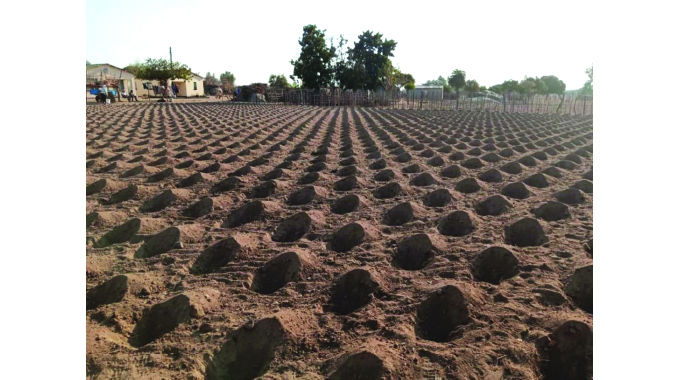
Precious Manomano Herald Reporter
Preparations for the forthcoming summer farming season are at an advanced stage with over 50 000households already finished preparing their first plots of Pfumvudza as the country gears for food security.
Currently these households are working on the other remaining four plots while majority are still working on land preparations.
The distribution of Pfumvudza inputs is currently underway in all provinces and the programme will be extended to 3,5 million households.
This season the programme will support five Pfumvudza plots per household with an agro-ecological region-specific crop input package for maize, sorghum, pearl millet, soya beans, sunflower, groundnuts, vegetables and African peas.
Under Pfumvudza programme Soyabean is targeted at 6 230ha, Sunflower 100 000ha, Sorghum 250 000ha, Pearl millet 126 577ha, Cotton 180 000ha giving a total of over one million ha of crops under Pfumvudza this summer season.
According to the recent update by the Ministry of Lands, Agriculture, Fisheries, Water and Rural Development,Midlands has so far prepared 2 880 plots equivalent to 180 ha and 51 households have gathered mulch.
Matabeleland North has so far prepared 1 579 plots equivalent to 99ha. About 352 households have limed and 173 have gathered mulch.
Mashonaland West has so far prepared 2 234plots equivalent to 140ha and 131 households have gathered mulching.
Mashonaland Central has so far prepared 19 400plots equivalent to 1 213ha. Forty five households have limed and 4 558 have gathered mulch.
Mashonaland East has so far prepared 29 163 plots equivalent to 1 823ha. About 225 households have limed and 5 439 have gathered mulch.
About 30 343plots were so far prepared in Manicaland equivalent to 1 896ha. In this province 1 533 households have limed and 91 948 have gathered mulch.
In Midlands 2 880 plots were so far prepared equivalent to 99ha. 352 households have limed and 173 have gathered mulch.
Statistics from all provinces indicate that 85 799 plots were so far prepared.
This year as last year, Government is distributing agricultural inputs under the Pfumvudza/Intwasa programme to match the agro-ecological regions to ensure optimum production and guarantee food security and an income for all families.
In an interview, Tobacco Farmers Union Trust president, Mr Victor Mariranyika, urged farmers to diversify and take up Pfumvudza training in large numbers so as to ensure food security and boost household incomes by selling the surplus.
“I recommend farmers to take up this training. Pfumvudza is the only way to go in terms of ensuring food security and sustainability.
“The increase in farmers’ participation is a great sign which symbolises that the nation will be self-sufficient in terms of food crops,’’he said.
Mrs Maggy Murambiwa of Marondera thanked the Government for timeous distribution of Pfumvudza inputs adding that this has benefited vulnerable groups who struggled to make ends meet.
“We are grateful for this noble initiative which will go a long way in sustaining families. Government has rescued many households. We are grateful for this support.
Getting inputs on time will mean a good harvest ahead of us,” she said.
Mrs Babara Mataire of Mazowe said she is grateful to receive inputs on time adding that she is hoping to increase hectares so as to achieve a bumper harvest the following season,” she said.
Mr Chamunorwa of Banket said Government’s commitment needs to be appreciated as it symbolises great hope in the next season.
“This is a commendable effort made by the Government. We are likely to achieve a bumper harvest in the following season since we get our inputs on time,” he said
Pfumvudza, the climate-proofed Presidential Input Scheme, introduced in President Mnangagwa’s Second Republic, has been hailed as an inclusive game changer benefiting vulnerable households in communal, A1, small scale commercial farming and old resettlement sectors in producing cereals, oil seeds and legumes.
Government upgraded the scheme when it decided what were appropriate crops to be grown in the different natural regions



 Online Reporter