Online Reporter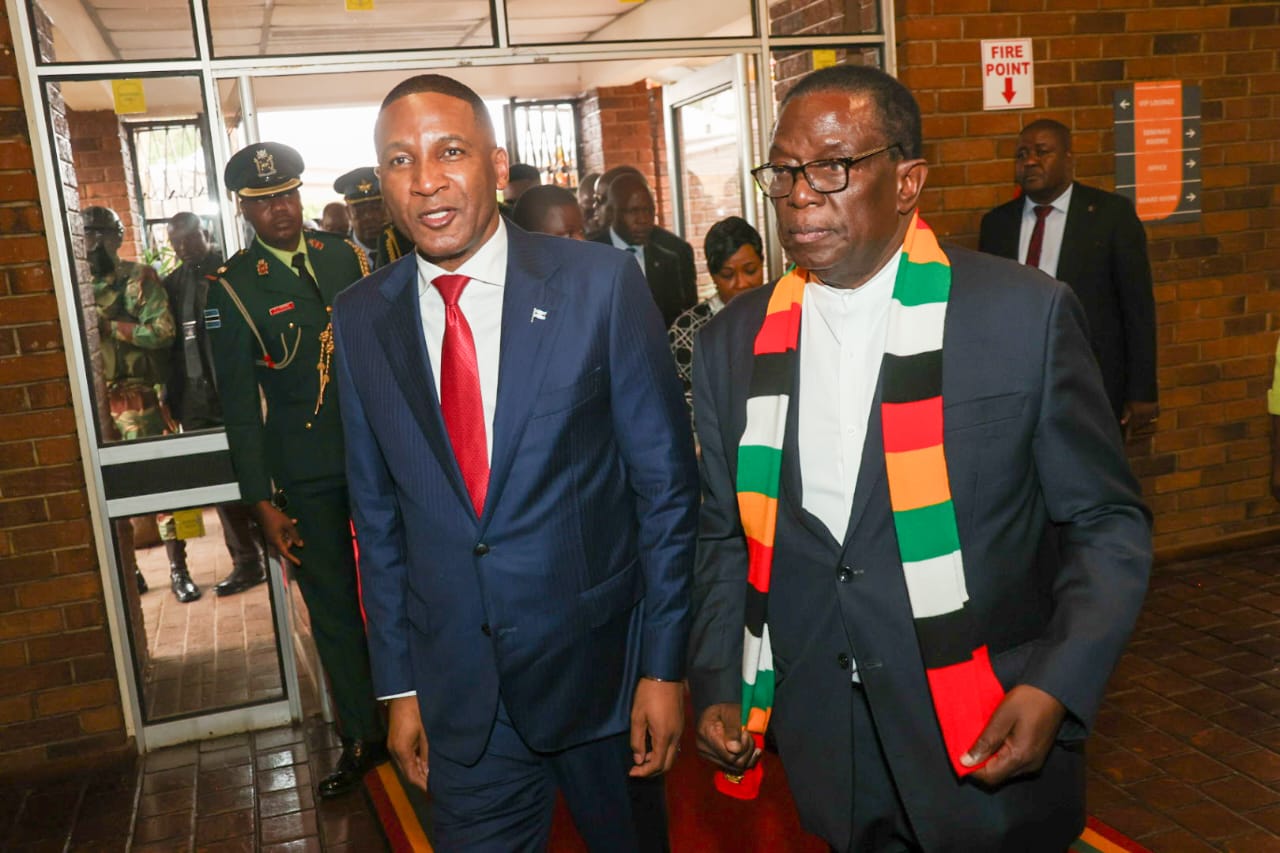
Mashudu Netsianda, [email protected]
ALL is set for the official opening of the 66th Zimbabwe International Trade Fair (ZITF), which will be shortly presided over by visiting Botswana President, Advocate Duma Boko.
Earlier, President Mnangagwa and his Botswana counterpart toured various exhibition stands at the Zimbabwe International Conference and Exhibition Smart City.
Zimbabwe’s premier trade showcase has drawn exhibitors, investors and business leaders from across the region and beyond.
Running from April 20 to 25 under the theme: “Connected Economies, Competitive Industries,” ZITF continues to position itself as one of sub-Saharan Africa’s leading multi-sectoral exhibitions.
This year’s programme has been anchored on business engagement and regional integration, with key events including the Rural Industrialisation Indaba, the ZITF Innovators Forum, the Connect Africa Symposium, the Youth in Business Festival and the Diplomats Forum.
Zimbabwe and Botswana share long-standing economic ties, underpinned by a bilateral trade agreement first signed in 1988, with Zimbabwe remaining one of Botswana’s key trading partners.
President Boko’s visit comes at a time when Zimbabwe and Botswana are scaling up cooperation across strategic sectors following the signing of 10 Memoranda of Agreement (MoUs) at the State House, Harare on Wednesday.
The agreements, sealed during the 5th Bi-National Commission (BNC) co-chaired by President Mnangagwa and President Boko, are expected to unlock new opportunities in trade, industrial development and cross-border collaboration.
President Mnangagwa said the MoUs must go beyond formalities and translate into tangible economic outcomes.
“The agreements and Memoranda of Understanding signed today (Wednesday) must now serve as instruments for accelerated trade, enhanced investment flows, industrial collaboration and sustainable development. The task before us is clear, we must move with urgency from agreement to implementation,” he said.
The agreements span a wide range of sectors, including trade and investment promotion, development of micro, small and medium enterprises, and the strengthening of cooperatives.
They also cover security and institutional cooperation, with provisions on defence training, policing, particularly in combating livestock theft and cross-border crime, immigration and prisons and correctional services.
Further areas of cooperation include civil aviation safety, transfer of sentenced persons, search and rescue coordination, as well as cultural collaboration through the Museum of African Liberation.
The BNC followed a high-level tête-à-tête between the two leaders, during which they reviewed bilateral relations, before engaging in closed-door deliberations with senior delegations from both countries.


 Bongani Ndlovu