admin
admin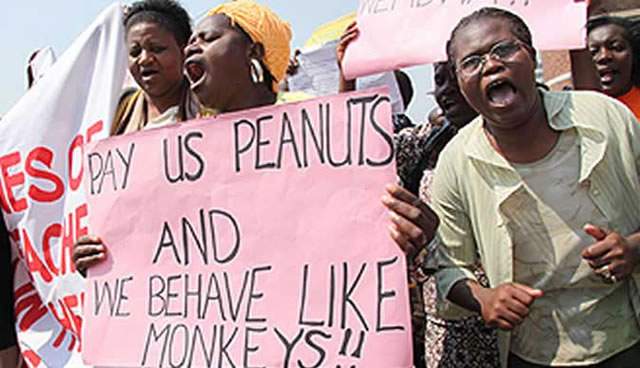
 Perspective Stephen Mpofu
“MAKE us crack a smile or else you’ll sing the blues at the year-end”.
This appears to be a signature tune in vogue among teachers today and directed to both the government and parents. The educators are like farm workers who tell their employer: “Give us good money or else we’ll allow the weeds to tussle together with the crops”.
Or like a domestic worker who tells the master or his wife: “Pay me a bonus every month; otherwise I’ll leave behind riff-raff encrusted in every corner of the house”.
To be sure, teachers in many schools have been ‘saying’ to their employer and to parents: “Pay us more cash over and above our wages, or else we shall walk ‘naked’ in public and you’ll be sorry for it.”
Indeed, countless numbers of Zimbabwean teachers are walking their profession bhunyumunyu, the stark ‘nakedness’ exposing serious deformities in their commitment to duty, witness zero pass rates in some schools at worst, and at best symbolic passes.
In response to the shoddy performances, government officials and parents have angrily lambasted the poor performing teachers with: “thou sluggards, pull up your socks”.
However, the chorus of admonition and abetment, shrill though it was, has apparently fallen on deaf ears, like seed sown on rocky ground.
As a result, the educational path into the future remains strewn with failures, the dead wood threatening the life of the fledgling blueprint, ZimAsset and any of its sequels.
Thus, with no better indicators to the contrary, the system of education in our country has lost it, or continues to do so, thereby threatening a crash of the country’s top literacy rate on the continent so much so millions of functional literates — people taught only how to read and write in order to relate their miserable knowledge to practical work — might be churned out of our schools in future.
Such people cannot, by any stretch of the imagination, be expected to provide sound, national political leadership, or leadership in commerce and industry and in their families for that matter.
Such, therefore, seems to be a gloomy picture of the future of education in this country unless something very, very radical is done by the powers-that-be to reverse the current trend with teachers baying for a Shakespearean “pound of flesh” to be loaded onto their pay, in hopes that, by soldiering on, they will finally wring the government’s arm in their favour.
But where has the pride associated with their profession gone, along with the joy elevated by 100 percent pass rates in our schools?
Why, one might ask, do teachers shamelessly behave as though they were conscripted into forced labour and must say: “We shan’t continue to dofora for nothing”.
But slog it they must; otherwise let them throw in the hat and gracefully quit the profession to leave room for committed men and women to fill the vacuum in order for the nation to move on resolutely in to the future.
Perhaps the time has long come, first for end of year performance appraisals on the basis of which teachers will earn more pay and hierarchical promotions.
The private sector conscientiously goes about this exercise to reward deserving workers and more often than not the result is higher, quality productivity by which the companies sustain themselves.
News that the Zimbabwe Schools Development Association (ZSDA) will reward best performing teachers as part of their incentive packages following the scrapping off of the motivational payments by the government recently appears to be the antidote to the mediocre in the performance of teachers at some schools across the country.
ZSDA will obviously base their reward on a pro-rata methodology in order for the worker bees to earn that which is commensurate with their industry.
But perhaps additional action is necessary here to augment ZSDA’s better pay for a better performance scheme. This pen suggests a re-introduction of a no-nonsense schools or educational inspectorate.
Old guards in our schools today will no doubt remember such inspectors who visited schools, at times without prior notice, in colonial Rhodesia, and sat in to observe teachers at work.
That monitoring system, coupled with an unflinching determination by blacks to work harder and transcend their oppression by racist rulers, produced high performers in schools, some of whom proceeded to train as teachers after standard six, or used the knowledge and skills gained in high or primary school to become full fledged brick-layers or carpenters or trained as agricultural demonstrators.
Schools were fewer then than they are today with a phenomenal expansion in the education that came soon after independence in 1980, so that a stricter supervision of teachers becomes more imperative.
What is more, independence and freedom may have created a lackadaisical, attitudinal culture among school children for whom too much freedom makes them not worry about what lies ahead for them in future.
This pen strongly believes things might continue to fall apart in our schools if discipline is not reinforced among both the teachers and their charges — and the onus to do that falls squarely on the shoulders of both the government and parent-teacher associations.
The work-to-rule culture that appears to be the teachers response to the government’s cancellation of incentives parents had to struggle to raise is an evil spirit that must be exorcised if teachers must earn their keep as they ought to so that the general public may continue to be proud of the teaching profession.
But, of course, those teachers, and they are many of them, not bracketed with the sluggards among them about whom this discourse is penned, should feel proud of their work and, as such, celebrated by this pen.
This article will not be complete without a huge pat on the government’s shoulder for abolishing fees levied by schools for Form One entrance examinations – money that in all intents and purposes qualified to be called extortion.
The government deserves a good measure of laudation for steadily but effectively tiding up things in our system of education to make it clean, robust and effectively utilitarian in emancipating Zimbabweans from ignorance and into a formidable force for the sustainable social economic development of the motherland.
And those teachers responsible for shameful failure rates in schools should walk with their heads hung and not thrust in the air as might be the case with those possessed by an I-don’t-care-attitude, as if by a demon.



 Online Reporter