daniel chigunwe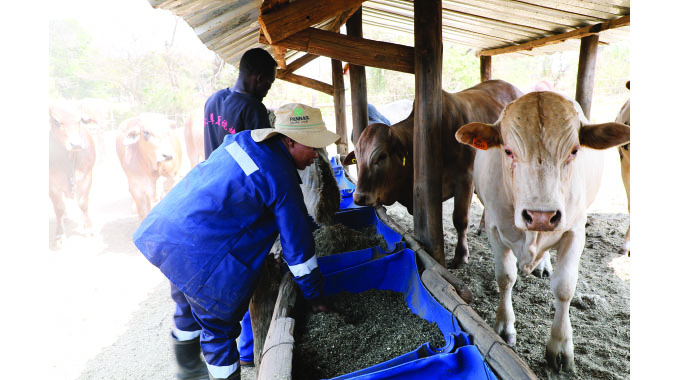
Precious Manomano
Herald Reporter
Farmers are taking up cattle fattening programmes to beat the adverse weather conditions and earn money from their humble livelihood.
Cattle pen fattening involves the feeding of beef cattle with a protein-balanced, high-energy diet for a period of 45-90 days under confinement to increase live weights. Pen fattening meals are also complete with a diet of high-quality sources of protein and fiber which improves the degree of finish to obtain better grades of beef.
Poor nutrition affects the ability of animals to reproduce and like human beings makes them susceptible to diseases.
Nyawata farm General manager Mr Godwin Kondo Mawire who is successfully engaged in a cattle fattening programme in Bindura indicated that the programme is generating a lot of money adding that he makes supplementary feed to enhance quality of the herd.
“I earn almost US$800 per cow if it ranges to 450kg. That is a lot of money. Markets are there. We grow Katambora grass for our cattle. So far we have local markets but we used to export to Europe but now we cannot because of the barn. Each cow eats 24kg per day so feeding is so far a challenge because we cannot grow maize which is critical in making feed formulations because we have limited space to grow crops such as maize,’’he said.
Currently there are over 300 breeding herds at the farm and 107 cattle under pen fattening programme.
Every month he sells 40 cattle under the pen fattening programme.
Recently,Sixteen villagers in Ward 19, Nemangwe area in Gokwe South were grateful that they started a cattle pen fattening programme in 2015 as their livelihoods have improved through proceeds from the programme.
The villagers belong to the Mlalazi cattle pen fattening club which is under Headman Ndlalambi, Chief Nemangwe. They are now getting over US$40 per month each from fattened beef sales.
Pen fattening enables the animals to express fully their genetic potential for growth. The fattening is mostly done in winter when there are little or no pastures, especially in rural areas.
The 200hactare farm enables the farmer to venture in crop production such as seed maize, seed soya, seed sorghum and seed wheat.
The farmer also keeps 1000 chickens and gets about 60 crates per day.
He is also doing well goat production adding that dipping is the way to handle livestock
“We have a market that is ready especially for the Muslims. They buy goats every year here. We also make feed because the grazing is now low this time. So far we have 243 goats. We mix hay and salt for our goats,’’he said.
There are also 63 hectares under winter wheat and the early crop is expected to be harvested next month.
Mr Mawire indicated that quelea birds are threatening the production of the crop.
“I was expecting eight tonnes per hectare but now l can produce around six tonnes per hectare. We are preparing to harvest next month,’’he said.
Two students who are doing their attachment programme at the farm said the experience they so far get will provide opportunities for them to engage in livestock adding that this will lead to betterment of the agricultural sector.
Junic Mujaji from Esigodini agricultural college said after completing her studies , livestock production is her passion.
Memory Madanhire of Mlezu agricultural college also said livestock is not difficult to manage adding that there is less labour involved.



 Online Reporter