admin
admin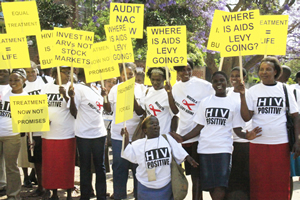
yesterday stormed National Aids Council offices protesting against Aids Levy expenditure and drug shortages.
Security personnel at the NAC offices prevented the demonstrators from getting inside the premises by locking the gates.
The demonstrators came from Chitungwiza, Mabvuku, Glen View and Epworth.
They were donning white T-shirts inscribed: “Where is Aids Levy going?”
Some of the demonstrators waved placards with messages protesting against the use of Aids Levy and drug shortages.
NAC operations director Mr Raymond Yekeye said he was surprised by the demonstrations as they came barely a week after a meeting with the group’s representatives on the same issues.
“We thought we were working with them because just last week we had a meeting in Kadoma with representatives of all groups of people living with HIV and Aids where we explained the drug stock status,
Aids Levy expenditures and our challenges,” Mr Yekeye said.
He took a swipe at unnamed organisations he accused of spearheading the demonstrations in the name of advocacy.
“Honestly, the money they have used to print T-shirts for these demonstrators, placards and the organising process, would have been better if it had been channelled towards treatment?
“I think it is unfair because some organisations are making money out of these people. We know there are organisations getting funding from donors for advocacy,” he said.
Also see
He promised to look into the demonstrators’ petition to see if NAC could address some of the issues.
Chairperson for the Harare advocacy province Mr Joao Zangaroti said all they wanted from NAC was accountability and transparency, including uninterrupted supplies of treatment.
“We stand here to demonstrate the depth of support there would be for Government if it begins to provide uninterrupted access to ARVs to people living with HIV and Aids,” he said.
In a petition handed over to NAC, the activists demanded that an independent commission be set up to investigate NAC over a report by the Comptroller and
Auditor-General.
“The report revealed that there are some unused budgetary allocations when the country is experiencing Aids drugs shortage owing to financial constrains,” said Mr Yekeye.
According to the 2011 Comptroller and Auditor-General report on the Management of HIV Care and Treatment programme:
“In 2010 the Ministry of Health and Child Welfare was allocated US$1.2 million, (for ARV procurement), of this $1 164 672 was not used for the acquisition of ARVs.
“It was used as follows: US$739 000 was used to fund Harare Central Hospital operations, US$240 672 funded head office operations and US$185 000 funded the Zimbabwe National Family Planning Council operations. The other US$35 325 was not used.”
The report further states that when questioned about this, the Ministry of Health and Child Welfare officials pointed that “funds for 2010 were viremented, or transferred to other areas that were considered critical”, implying ARV procurement was not.
The demonstrators also demanded clarity on the loan facility at NAC.
They demanded to know how it is managed and why it is not mentioned anywhere in the NAC financial statements.
They said Government should implement a framework agreement on national prevention and treatment plan.
The agreement, they argued, should see the restocking of critical anti-retroviral drugs with effect from this month.
The demonstrators claimed that people are still given drug supplies that only last them for two weeks instead of a whole month.
They said adults were getting cotrimoxazole syrup meant for children owing to the limited supplies.
Cotrimoxazole is an antibiotic used by PLHV to prevent opportunistic infections.
The drug is in short supply and the director of Aids and TB in the Ministry of Health and Child Welfare Dr Owen Mugurungi recently attributed the shortages to challenges faced by a company that had won a tender to supply the drug.
He said the situation had been rectified and cotrimoxazole supplies had resumed.
The activists further castigated the NAC Act, which they said allows the council to engage in non-core activities like lending trust funds to employees and investing funds on the money market.
They also accused NAC of overstaffing saying it has since become one of the biggest and most rewarding employers in Zimbabwe.
The demonstrators charged that people were developing drug resistance due to the unavailability of drug combinations.
They said NAC should stick to 30 percent expenditure on administration guidelines.
According to the Ministry of Health and Child Welfare, ARV supplies are expected to resume to normal in a few weeks as shipments of procured drugs with funding from the Global Fund to Fight Aids TB and Malaria Round 8 phase 11 are expected in Zimbabwe.
The Global Fund provides ARVs to the majority of the nearly 400 000 people on ARVs in the country.
NAC’s board has approved expenditure of the Aids Levy as follows: prevention (10 percent), treatment (50 percent), monitoring and evaluation (six percent) advocacy (five percent), programme logistics (25 percent) and assets (four percent).
Aids Levy collections have significantly risen since dollarisation in 2009.



 Online Reporter