admin
admin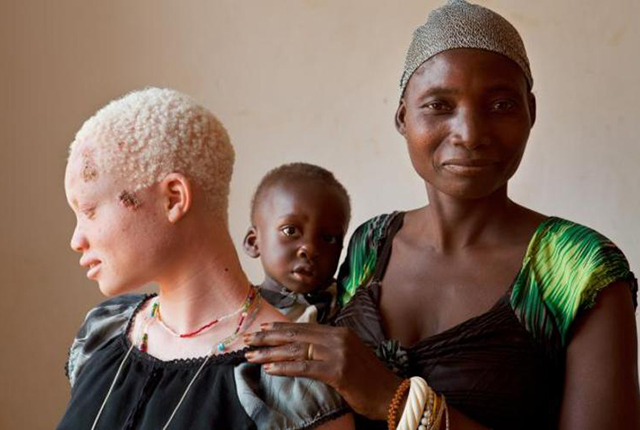
Dr Christine Peta Disability Issues—
She has albinism, a condition that is characterised by a lack of skin pigment, eye problems and may lead to skin cancer.
| Danai is a 37-year-old woman who was born in a family of five. She was raised by both her parents who at the time were living in one of the high density suburbs of Harare, in Zimbabwe. |
Her birth did not make life easy for her mother, who was accused by her father of breaking traditional taboos when she was pregnant.
“My father said my mother was eating some forbidden wild fruits and some crabs when she was pregnant, that is why I got albinism”.
However, Danai’s brother argued that Danai’s albinism was caused by witchcraft, because some members of their extended family were known to be practicing witchcraft. Either way, Danai’s family believed that she could be cured of albinism by traditional healers.
Whilst her family was trying to work out a traditional treatment plan for Danai, she started school (Grade 1) at a city primary school at the age of six.
However, her poor family could not afford to provide her with spectacles which she needed because of her poor eyesight and sunscreen for her skin.
“I developed a cancerous lump on my upper lip and then I had an operation to remove it. After that I went to boarding school for high school when I was 13 years old.”
Danai struggled through school until she sat for her Ordinary Level exams at the age of 16. Due to poor eyesight, she failed all her exams and she left boarding school to go and live with her brother in the city.
Rape
At the age of 17, Danai was raped by an older man who lived in her neighbourhood. He is a civil engineer.
“I met Munopa on the road and he said let’s go this way, it’s a shorter route to your house. I didn’t realise that he wanted to take me via a maize field for rape until we got there. He raped me and I got pregnant.”
When Danai realised that she was pregnant, she informed Munopa who got very angry with her and told her to leave him alone.
Although Danai’s family could not afford to hire a lawyer, Danai’s brother assisted her to pursue prosecution.
However, Munopa hired one of the top legal brains in the country and was not prosecuted.
When Danai’s pregnancy got visible and her father heard that she was pregnant, he summoned her to the rural village where her parents had moved to.
After delivering her baby boy at a rural clinic and nursing the baby for one year in the village, Danai’s father sent her back to the city so that she could live with her sister and go back to school.
“But now my sister’s husband wanted to love me also. I said, ‘No!’ But my sister still kicked me out of her house because she saw that her husband liked me and he was going to rape me.”
When she left her sister’s house, Danai went back to her brother’s residence. By then she was 20 years old and her brother sent her to a local rehabilitation institution for a dressmaking course, where she also repeated her O- Level studies.
At the rehabilitation institution, Danai noted that there was a male counsellor who was resident at the centre and she decided to seek counselling because she was still traumatised by the rape incident perpetrated against her by Munopa.
Sadly, after narrating her story to the professional, believing that she would be counselled, the counsellor also attempted to rape Danai during the counselling session.
Danai successfully completed her dressmaking course and she also passed five ordinary level subjects before she left the rehabilitation centre, heading back to her brother’s house. Danai’s lifestyle took a different turn when her brother got married.
“My brother loves me, but his wife came and gave me one cup and plate and said this is for you Danai. She was afraid that if we share things, I would give her albinism. My life changed for the worse.”
As time went on, Danai started to befriend Kuda, a young man who lived in the neighbourhood. However, some able bodied girls who lived in that community stigmatised her for the friendship.
“These girls who call themselves ‘normal’ and black were making fun of me saying ‘Kuda ari kutaura nemurungudunhu’ (Kuda is talking to a quasi-white person). They made me feel cheap.”
Tired of loitering around the streets of the high density suburb, Danai decided to apply for a place to train as a primary school teacher.
At age 26, she enrolled at a local teacher training college on the strength of her Ordinary Level certificate.
Whilst she was on the programme, Danai and Kuda agreed to change their relationship from that of ordinary friendship to an intimate love relationship. But Kuda’s family opposed the union.
“They said we cannot have such a ‘muroora’ (daughter-in-law), she is an albino.”
However, Danai got pregnant and eloped to Kuda’s place of residence and they started to live together. She delivered a baby girl with black skin. Later on she got pregnant again and she also gave birth to another baby girl with black skin.
“I was happy that I had given birth to two daughters with black skin because people had been saying I would give birth to albinos.”
Bride price
Whilst Danai is happy that she has children of her own, she is unhappy with the fact that Kuda has not made an effort to pay “lobola” (the bride price) for her.
“He has not paid the bride price for me but we have been living together for 10 years and we have two children together. I feel that even if I have albinism, he should pay the bride price for me so that my parents can feel that they have a son-in-law and not that I am just living with a man. I asked Kuda why he doesn’t want to marry me but he has not given me an answer.”
Hats and suncreen
In future, Danai intends to fundraise for the procurement of impairment aids for people who have albinism in Zimbabwe.
“I appreciate the few boxes of sunscreen that are offered at once-off events by local companies but I would like to urge such companies to consider long-term donations. What happens to the albinos when that one tube of sunscreen is finished? They begin to suffer again. So life is not easy, especially for poor people who cannot afford to buy hats and sunscreen. They develop skin cancer and they die.”
Way forward
As noted by Boylan (1991), “there is a great responsibility upon us all, whether in international, or local service, to help disabled girls and women to acquire a sense of self-worth and achieve a sense of dignity.
Regardless of our limitations, we are all members of the human race to which we can, in our own way, make a contribution given appropriate skills and support.
People with disabilities can play an important role in a nation’s economy and in society as a whole.”
Dr Christine Peta is a Public Health Care Practitioner who among other qualifications holds a PhD in Disability Studies. Be part of international debate on how best to nurture a society which is more accessible, supportive and inclusive of disabled people. Partner with Disability Centre for Africa (DCFA): WhatsApp; 0773-699-229, Website; www.dcfafrica.com; E-mail; [email protected].


 Online Reporter