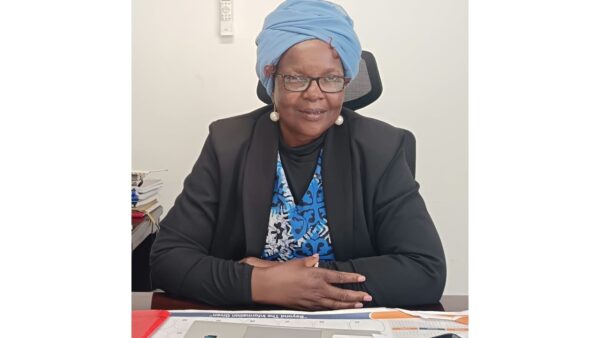
Welcome to Personal Brand: Executive Perspective with Michelle Madziva, a weekly column dedicated to the art and strategy of personal branding.
Imagine two executives with similar qualifications, experience and responsibilities. Both are ambitious, they work hard but one deliberately improves how they communicate, make decisions, lead people and solve problems. The other relies on the skills and habits that brought them this far. After a year, the difference may be noticeable. Not necessarily because one made a dramatic breakthrough, but because one kept improving.This is the power of the 1% principle, and it has an important lesson for personal branding.
In today’s competitive environment, being good at what you do is important but when everyone appears qualified, experienced and capable, what makes you distinctive is the 1% advantage.
The concept is not about working longer hours, collecting certificates for the sake of it or trying to outperform everyone around you. It is about deliberately developing the capabilities that make your contribution more valuable.
Consider a finance executive who understands the numbers but also takes time to learn how customer behaviour affects revenue. Suddenly, their contribution extends beyond reporting what happened. They can help explain why it happened and what the business should do next.Also, consider a human resources director who understands recruitment but also studies workforce analytics and emerging technology. They can contribute to conversations about productivity, talent planning and organisational performance, not just hiring. Neither professional abandoned their expertise. They strengthened it by developing an additional perspective. That is how differentiation begins.
Your personal brand is shaped partly by what people associate with your name. Are you the person who understands the market? The executive who can simplify complex problems? The professional who consistently brings commercially useful ideas to the table?These associations become powerful when they are supported by real capability.
So, how do you develop your 1% advantage?
First, identify the gap between what you currently offer and what your market increasingly needs. Pay attention to the problems clients are struggling with, the skills your industry is demanding and the conversations taking place at leadership level. Your next area of growth may be hiding in a problem you have not yet learnt to solve.
Second, develop one differentiating capability. A sales professional, for example, can go beyond traditional selling by learning how to use Artificial Intelligence to analyse customer behaviour, identify promising leads and personalise sales approaches. I recently explored this intersection when I facilitated Sales and Marketing Meets AI for accomplished women business leaders from the Women Presidents’ Organization (WPO) Zimbabwe. The conversation centred on how AI can strengthen sales and marketing when applied strategically. The lesson is simple, you do not have to abandon your expertise to stand out. Sometimes, your greatest advantage lies in combining what you already do well with a new capability that creates greater value.
Third, turn your learning into visible value. Apply what you learnt to a real business challenge. Share a useful insight with your team, offer a better recommendation to a client, write about a lesson that others in your industry can apply. Knowledge becomes a stronger professional asset when people can see how it improves outcomes.
Remember, the goal is not to know everything. It is to develop a combination of skills, insights and experience that makes your contribution increasingly difficult to substitute.
You do not need to become exceptional at everything. You need to become particularly valuable at something that matters.
In a crowded professional marketplace, your qualifications may earn you consideration, but your distinctive contribution gives people a reason to choose you.
Your 1% advantage is the difference you deliberately develop before the market demands it and the value people eventually learn to associate with your name.
Michelle Madziva
Founder & CEO, Grand Curations
Corporate Strategist | Personal Branding Consultant