dyton mupawaenda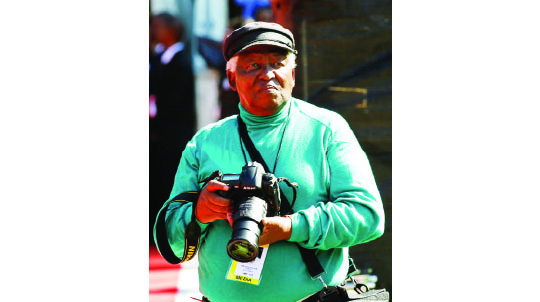
JOHANNESBURG. – Peter Magubane, the renowned artist-photographer who shed light on the everyday struggles of black South Africans for decades under apartheid, died on Monday. He was 91.
After joining Drum magazine in 1955, Magubane gained prominence as one of the few black photographers covering the repressive era.
One of his landmark images, taken a year later in a wealthy Johannesburg suburb, showed a white girl sitting on a bench with a sign reading “Europeans Only” while a black worker sat behind her combing her hair.
In the 1960s, amid a surge in anti-apartheid activism, he covered Nelson Mandela’s arrest and the banning of the ANC.
A decade on, he was winning international accolades with his coverage of the Soweto student uprising.
He was regularly harassed, assaulted, arrested and, starting in 1969, locked up for 586 days of solitary confinement.
But Magubane kept taking photos and, in the 1990s, was appointed as newly-released Mandela’s official photographer.
He was “someone who made very big sacrifices for the freedom that we enjoy today,” his granddaughter Ulungile Magubane said.
“Luckily he was alive to see the country change for the better.”
Born in 1932 in the Johannesburg suburb of Vrededorp — now Pageview — Magubane grew up in Sophiatown, once a hub to famous black artists that was eventually destroyed under apartheid.
He died peacefully around midday, his daughter Fikile Magubane said. He would have turned 92 on January 18.
President Cyril Ramaphosa led South Africa in paying tribute to Magubane.
He said as South Africa commemorates 30 years of democracy this year, Magubane’s photography will be an important part of the country’s reflections.
In a post on X – formerly Twitter, Ramaphosa said Peter Magubane’s prosaic passion was powered as much by what he felt from the heart as what he saw through his lens.
“As we revisit our journey to freedom and the progression of our democratic dispensation, Magubane’s imagery will be an important part of our reflections”.
Political parties including the governing ANC and the GOOD party paid homage to the icon and his remarkable life’s work.
Arts and Culture Minister Zizi Kodwa, meanwhile described him as a freedom fighter as well as a masterful storyteller and lensman.
The South African National Editors’ Forum (Sanef) lauded Magubane as a giant in the field of photojournalism who will forever be remembered as one of the courageous journalists who defiantly opposed the apartheid regime in South Africa.
“Throughout the oppressive years of apartheid, he faced harassment, beatings, buckshot wounds, and prolonged periods of interrogation and detention. Remarkably, he survived being shot 17 times at a student’s funeral in Natalspruit, Gauteng.
“Magubane’s resistance was not only evident in his actions but also in his creative methods of capturing the truth. He ingeniously hid his camera in a hollowed-out Bible, firing with a cable release from his pocket. On other occasions, he covertly took shots with his camera concealed beneath his jacket, inside a milk carton, or half a loaf of bread, pretending to eat while documenting crucial moments.”
Internationally, Magubane showcased his photographic talent in London during the early 1960s and worked as a correspondent for Time magazine between 1978 and 1980. In 1980, he temporarily left South Africa for New York.
His contributions extended to major publications such as National Geographic, Life, New York Times, Washington Post, Paris Match, and Sports Illustrated, Sanef said.
Additionally, the UN benefited from his lens through commissions from the UN High Commission for Refugees and Unicef.
“After the dawn of democracy in South Africa,” Sanef said, – Sowetan.


 Online Reporter