admin
admin
ZIMBABWE is moving towards achieving Vision 2030 which entails the country becoming an upper middle income society. The Herald will be serialising the Vision 2030 document every Thursday for the benefit of our readers.
Introduction
- The ushering in of a new Dispensation on 24 November 2017 marked the dawn of a new era of renewed hope for a better life for all Zimbabweans premised on a Vision for realisation of rapid economic growth and development.
- This came against the background of a declining economy, a toxic political environment, endemic corruption, scant foreign direct investment inflows and a prolonged state of the country’s isolation from the global community.
- The New Dispensation has its work clearly cut out, with Vision 2030 spelling out Zimbabwe’s aspirations.
- Their realisation will be anchored on:
- National unity;
- Broad based citizenry participation in national socio-economic development programmes;
- Political and economic re-engagement with the global community;
- Creation of a competitive and friendly business environment;
- Pro-private sector led rapid economic growth and development;
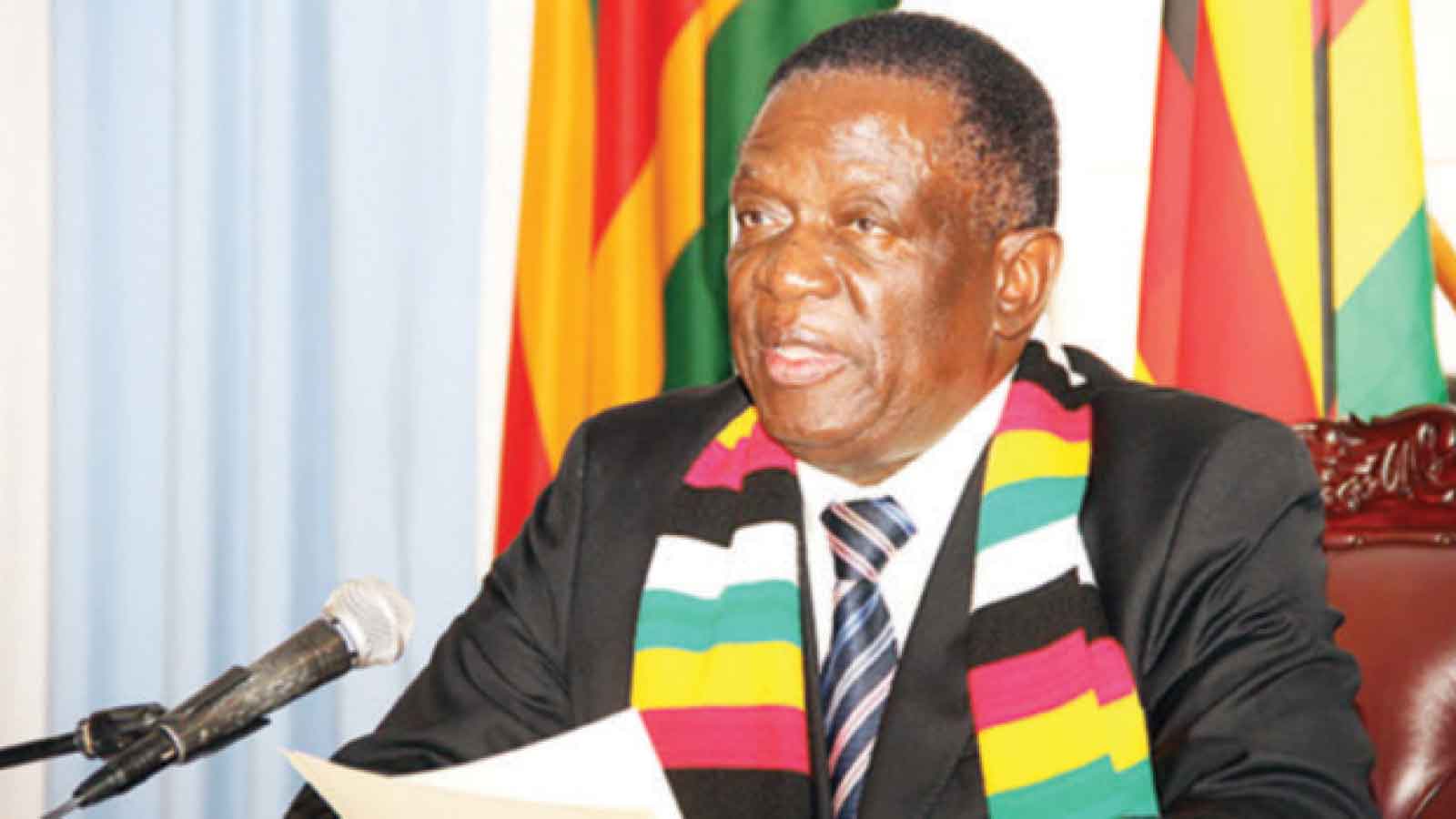
- Enhanced domestic and foreign investment, as eminently encapsulated in His Excellency, President E. D. Mnangagwa’s mantra “Zimbabwe is open for business”; and;
- An aggressive fight against all forms of corruption.
- The task of re-uniting the people and re-kindling their hopes and confidence is critical, given the trauma arising out of political polarisation, prolonged economic meltdown, and a state of general uncertainty the nation has endured over the last two decades.
- The opening of new horizons under the New Dispensation requires that Vision 2030 guides the revival of Zimbabwe’s developmental process, benefitting from the economy’s rich human skills base, and abundant natural resource endowment.
This includes a diverse mineral deposit base, arable tracts of land, flora, fauna, sunlight and water.
- The predication of Zimbabwe Vision 2030 on creation of an open, efficient and effective business environment that fosters entrepreneurship and attracts higher flows of foreign direct investment ensures sustained value addition and export led growth.
- This, coupled with investor confidence, is a prerequisite for generation of increased employment opportunities.
- Confidence building measures will be developed around policy coherence, consistency, clarity and predictability, and not subject to arbitrary reversals.
- In this regard, the sustained implementation of fiscal and monetary policy discipline is central to the attainment of Vision 2030.
- The realisation of the aspirations of Vision 2030 also envisages full use of Zimbabwe’s strong human resource comparative advantage, an outcome of a deliberate educational policy instituted by Government at Independence in 1980.
- Vision 2030 aims to foster inclusive economic growth and address poverty resolutely, thereby transforming Zimbabwe into an industrialising, knowledge based upper middle-income country that provides a high quality of life to all its citizens by 2030.
- To this end, the Vision is “Towards a Prosperous and Empowered Upper Middle Income Society by 2030, with Job Opportunities and a High Quality of Life for its Citizens”.
- High economic and social impact flagship projects, by both Government and the private sector, are envisaged to take the lead in generating increased business activity or Vision 2030 rapid and inclusive growth.
- This resonates well with the aspirations of the African Union’s Agenda 2063 for the continent’s 50-year strategic framework for socio-economic transformation, as well as the full realisation of Sustainable Development Goals for 2016–2030 under the United Nations.
- Vision 2030 will be realised through implementation of the Transitional Stabilisation Programme (2018-2020), and successive Five-Year Medium-Term Development Strategies (2021-2025) and (2026-2030), centring on provision of key public infrastructure and services delivery.
- Annual National Budgets will operationalise the Five-Year Medium-Term Development Strategies, anchoring complementary private sector investments.
- Vision 2030 is focused on promoting innovation, entrepreneurship, equitable development and prosperity for all, under a market economy that leverages on Zimbabwe’s natural resources and abundant human skills.
- Vision 2030 encapsulates unity, freedom, democracy, equal rights, national peace, reconciliation, economic development and prosperity.
- Strengthening of institutions will be prioritised to foster transparency, accountability as well as combat corruption and slothfulness in the provision of public services.
21.This requires a very facilitative and effective civil service, as well as strengthened law enforcement, upholding the rule of law and property rights.
- Given the knowledge base and productive resource endowments of Zimbabwe, the country is well positioned to register phenomenal economic growth and development by 2030.
- Fundamentally, the effective exploitation of these comparative advantages place Zimbabwe on a pedestal for robust economic growth, development, and prosperity, as well as social cohesion.
- Vision 2030 is for Zimbabwe to join the ranks of other knowledge-based economies of the world by 2030.
Major challenges in the economy
- Over the years, the economy was saddled by challenges that impeded economic growth and development.
- These include the following:
- Corruption and rent-seeking behaviour;
- High unemployment;
- Decaying infrastructure;
- Foreign currency and cash shortages;
- Uncompetitive business environment;
- Uncompetitive exports;
- Under-performing State-owned enterprises;
- Sporadic outbreaks of Typhoid and Dysentery;
- Shortages of medical drugs; and
- Internal and external macro-economic disequilibria.
Vision Goals & Targets
- Vision 2030 seeks to fundamentally transform Zimbabwe to an upper middle income economy, with a per capita Gross National Income of over US$5000 in real terms by 2030, from the current US$1 440.
- The upper middle income economy, with less income disparities, will be underpinned by the development of a middle class.
- Employment Rates will be raised upwards by 80 percent, defined to cover all those in formal employment.
- Further, there will be a progressive reduction in the Poverty Rate, initially to under 25 percent of the population by 2030, from 62.5 percent in 2012, consistent with upper middle income economies. The country will have achieved the SDGs, well on its way to achieving Agenda 2063.
- Vision 2030 targets increasing the number of households accessing electricity from 52.2 percent in 2017 to over 72 percent by 2030. Rural households’ access to electricity will increase to 60 percent from 27.7 percent, while urban households’ access will increase to 95 percent from 86 percent.
- By 2030, it is envisaged that Zimbabwean households will have universal access to improved sources of water, up from 81 percent in 2017.
- Further, it strives for an average Life Expectancy of over 65 years from the current 60 years, and scoring in the upper echelons of the Happiness and Prosperity Indices.
- Noticeable improvements will also be in the areas of awareness, knowledge adoption, food security, affordable and accessible education and health services, infrastructure development, and economic empowerment.
- To realise the above targets, it is critical that sustainable double digit economic growth rates of between 7 and 12 percent per annum be attained.
- Fundamentally, this requires a stable macro-economic environment and economic transformation sustained by high productivity levels as pre-requisites.
Savings & Investment
- The resource requirements for re-building the economy are large, hence, the need to prioritise investment, a key ingredient for powering the economy.
- Vision 2030 is anchored on a fiscal policy framework that allows for realisation of Budget savings, supportive of re-orienting expenditures away from consumption towards development.
- The expenditure rationalisation measures announced in the 2018 National Budget mark the onset of the fiscal consolidation reforms under Vision 2030.
Private Sector Led Growth
- Vision 2030, however, recognises that the private sector remains the engine of sustainable future growth.
- In this regard, to facilitate domestic private sector investment, the New Dispensation is speeding up the ongoing Ease of Doing Business Reforms to reduce the cost of doing business.
- Domestic investment, both public and private, will benefit from foreign investment inflows in the form of access to capital, technology and markets
- Hence, priority is being accorded to engaging the international community at large for investment and technology transfer under the dictum — Zimbabwe is Now Open for Business.
- In this regard, the review of Zimbabwe’s indigenisation legislation as part of the 2018 Budget measures allows for increased foreign investor participation in the domestic economy.
External Debt Resolution
- Vision 2030 is, however, conscious that the magnitude of the required resources for economic reconstruction will require augmenting domestic efforts with catalytic bilateral and multilateral financial injections.
- Hence, Zimbabwe’s quest for final resolution to its external payment arrears.
- Successful re-engagement with the international community and implementation of a sustainable debt and arrears clearance strategy that will improve the country’s risk profile will be pursued.
- This will address the current debt overhang challenges, thereby enabling the economy to attract investment and access new lines of credit.
- This would pave way for review of Zimbabwe’s external indebtedness of over US$11 billion, all with the objective of attaining debt sustainability and access to new financial flows.
To be continued…



 Online Reporter