Rumbidzayi Zinyuke-Health Buzz
For many women, the discovery of a lump in the breast can feel like the moment everything changes.
The first reaction may be fear, followed by a long list of questions. Is it cancer? How advanced is it? Will I need surgery? Will I survive? What will happen to my family?
And, perhaps most frightening of all, will I still be the same person when the treatment is over?
These fears are understandable because breast cancer is still widely associated with death.
But October, which is observed as Breast Cancer Awareness Month, should remind us that breast cancer is not automatically a death sentence, particularly when it is detected early and treated promptly.
The difference between detecting breast cancer early and discovering it after it has spread can be enormous.
Breast cancer remains the most commonly diagnosed cancer among women globally. The World Health Organisation estimates that 2,4 million women were diagnosed with the disease in 2024, while about 694 000 died from it. In Zimbabwe, it is the second most common cancer among women after cervical cancer.
The disease can affect women at any age after puberty, although the risk increases with age. Importantly, about 80 percent of breast cancers occur in women who have no specific risk factor apart from being female and getting older.
This means that waiting for a woman to fit the traditional picture of someone who is “at risk” can be dangerous.
A woman does not have to have a mother or sister who had breast cancer before she takes changes in her breasts seriously. She does not have to be elderly, and she does not have to be experiencing severe pain.
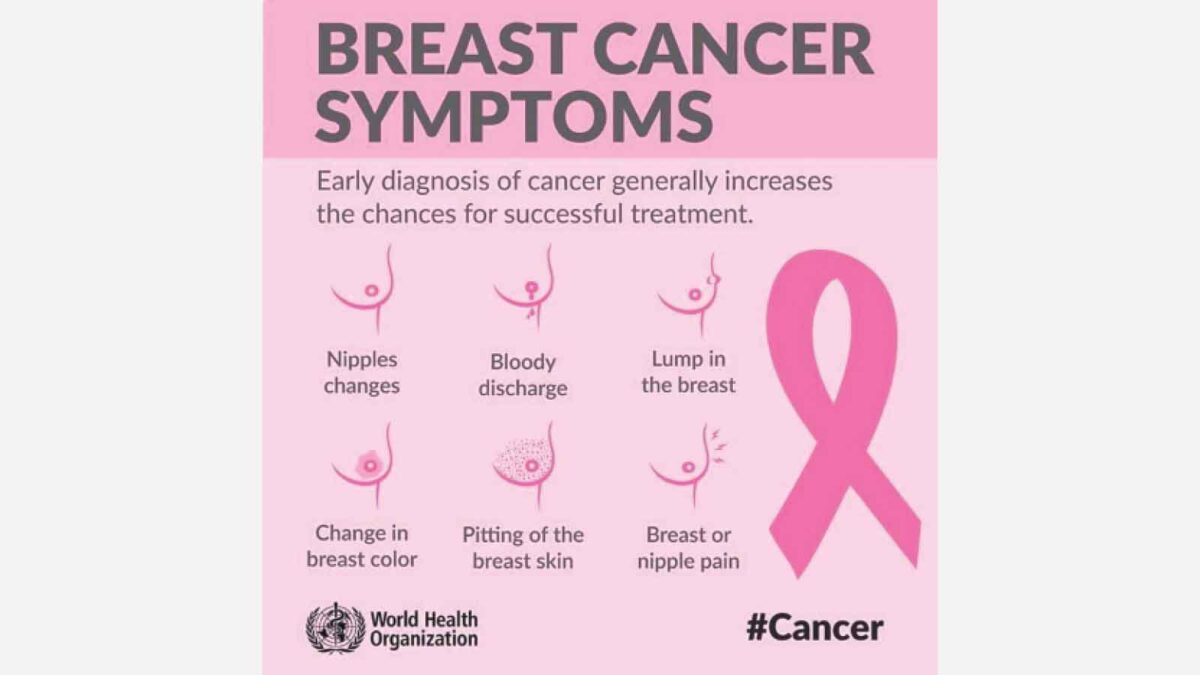
A new lump, a change in the size or shape of the breast, changes to the skin or nipple, unusual discharge or any other persistent change is enough to prompt a visit to a health facility for proper assessment.
Experts say finding a breast abnormality does not mean that a woman has cancer. Many breast changes are caused by conditions that are not cancerous. The important thing is not to spend weeks or months trying to determine the cause at home or hoping that a lump will disappear on its own.
It needs to be checked.
The World Health Organisation says early detection has two important components: recognising possible signs and symptoms and seeking medical care promptly, as well as screening apparently healthy women where appropriate.
Early diagnosis allows health workers to investigate an abnormality, confirm whether cancer is present and, if it is, determine the most appropriate treatment.
This is particularly important in countries where many women still arrive at health centres when the disease is already advanced.
The latest WHO estimates show just how much the stage at which breast cancer is diagnosed matters. For women diagnosed between 2017 and 2021, the median five-year survival was 77,8 percent globally, but it was only 39,1 percent in the WHO African Region.
These figures are not simply about the biology of breast cancer. They also tell a story about access to healthcare.
This is why breast cancer awareness cannot simply be about wearing pink ribbons every October.
Awareness must lead to action.
The WHO Global Breast Cancer Initiative has set what it calls the 60-60-80 targets: at least 60 percent of invasive breast cancers should be diagnosed at stage I or II; patients should receive a diagnosis within 60 days of first presenting with symptoms; and at least 80 percent of people diagnosed with breast cancer should receive the recommended complete treatment.
But the conversation should not end when treatment begins.
Nor should it end when a woman completes her last chemotherapy session, undergoes surgery or is told that there is no evidence of disease.
This is why survivors are important during Breast Cancer Awareness Month.
Their stories challenge the idea that a breast cancer diagnosis automatically means the end of life.
They demonstrate what is possible when cancer is detected, diagnosed and treated, and when patients receive the emotional and social support they need along the way.
Breast cancer does not affect only the woman who receives the diagnosis. It affects spouses, children, parents, siblings, friends and colleagues.
So their support can make the journey less difficult.
This October, therefore, should not only be about reminding women to “check their breasts”.
It should be about creating a culture in which women feel comfortable seeking help when something does not look or feel right, health workers respond quickly to suspected cancer, diagnostic services are accessible and treatment is available without unnecessary delays.
It should also be about remembering the women who are living beyond breast cancer.
Some are still undergoing treatment. Some have completed treatment. Others have been survivors for many years. Their experiences remind us that behind every cancer statistic is a person with a family, dreams, responsibilities and a future she wants to live.
The most important message this Breast Cancer Awareness Month is action.
A lump in the breast should not be ignored because it does not hurt. A change should not be dismissed because there is no family history of cancer.
And a diagnosis should not automatically be interpreted as a death sentence.
The earlier breast cancer is found, the sooner treatment can begin and the better the chances of controlling the disease. WHO notes that countries that have achieved sustained reductions in breast cancer mortality have generally had a high proportion of cancers diagnosed at an early stage.
October may come with pink ribbons, campaigns and awareness events, but the real measure of Breast Cancer Awareness Month should be what happens after the campaign ends.
It should be more women seeking help early, more cancers being diagnosed before they spread, more patients completing treatment and more women living long, healthy lives after cancer.
Because the goal is not simply to detect breast cancer.
It is to give every woman who develops it the best possible chance to survive and to ensure that those who survive are supported to live fully beyond the disease.