admin
admin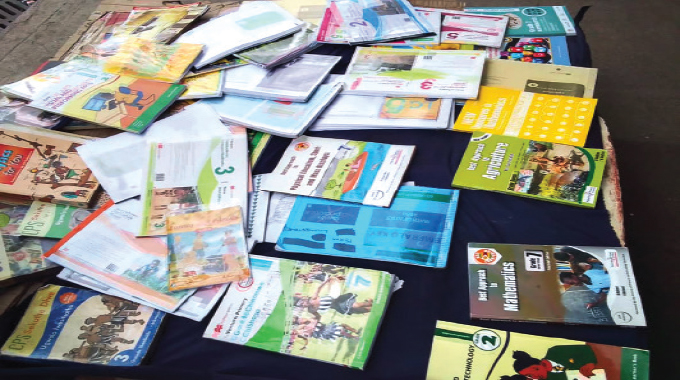
AUTHORS and publishers are being fleeced of their dues through piracy as some unscrupulous individuals are now involved in the business of replicating copyrighted literature through scanning, photocopying, printing and electronic duplication of books.
Pirated copies usually cost less than half the original work, sounding a potential death knell to the formal sector as most people are now resorting to buying replicated textbooks.
In Bulawayo, pavements are inundated with cheap quality editions significantly marked down from bookshop prices.
A week-long investigation by the Chronicle revealed that there is an unconventional book value chain that has emerged in the city.
The pirates are replicating copyrighted works in large volumes and taking them to the streets where they are sold at almost half the price in bookshops.
The news crew established that most book vendors who have flooded the streets of Bulawayo are being supplied by a piracy kingpin operating from the second floor of the Cabs building in the city centre, a stone’s throw from Bulawayo Central Police Station.
Most pirated textbooks are those published by major publishers such as CPS, Longman and College Press.
The news crew visited the offices where the nefarious electronic duplication of books is taking place and observed long queues as parents and guardians jostled to buy the pirated books.
On the ground floor, there is an employee who will be issuing clients with small pieces of paper containing names of the books on offer with a price list.
Clients are given the list through a small window opening after which they then proceed to the second floor to make payments.
The office is staffed with employees, each tasked with different duties which include designing, binding, distributing and accepting cash.
On the streets, books such as an original Visual and Performing Arts for Grade Three published by CPS are being sold for US$8, which is negotiable.
The price for the same book in the bookshop is US$12. Abaseguswini leZothamlilo, authored by the late Phineas Ngobiwa Mnkandla, is going for US$5 in the informal market while in the bookshop it is sold for US$10.
The Chronicle news crew managed to buy some of the copies to make a comparative analysis of the prices both the formal and informal markets.
A Step Ahead New General Mathematics textbook for Form Three pupils was bought for US$4,70 at the Cabs Building shop and US$27 in a bookshop.
For a set of Grade Four books which include Mathematics, English, Indonsakusa, Science, Heritage, Agriculture, VPA (Plus One), ICT, and Physical Education, one needs to part with US$24,85 and a receipt is issued.
“These people are working with employees of registered printers who are getting business from publishers who outsource the printing order. Once they have the soft copies for these books they then sell that to the pirates and the rest is history,” said a source.
“These people are making a killing and its good business for them, my brother.”
A vendor, who was unaware he was speaking to a journalist, revealed that he was sourcing the books from the same shop at the Cabs Building.
He later confessed that in the past, he used to sell books stolen from schools.
“This is the reason why these days stamped books are no longer found in the streets. Why would I risk it when I can get the same book and sell it at a cheaper price? Previously we used to get stamped books from school children or librarians,” said the vendor operating on the pavement along Jason Moyo Street.
Zimbabwe Publishers Association president Mr Tinashe Madondo said book piracy is depriving them of their economic and social benefit, and threatening the survival of the conventional book value chain.
He said it was worrying that there is a downstream market that is benefiting from the illegal sale of intellectual property at the expense of the rightful owners.
“We are struggling as publishers because of this scourge, which seems to go unabated. We are having a hard time dealing with this criminality as publishers,” said Mr Madondo
He said all the relevant authorities must act to save authors from these insolent parasites.
“What is worrying is that perpetrators are well known, but they don’t get arrested. What we need from our stakeholders is the support, especially the police. We also need the support of our parliamentarians who should discuss it in Parliament and craft tough laws which will deter piracy,” said Mr Madondo
He said the Ministry of Primary and Secondary Education must make it an offence for any school to allow pirated textbooks to be used in schools.
“Even the Ministry of Education needs to make it abundantly clear to schools that accepting pirated books has serious consequences for both the school and the parents or guardians of such learners. I think it will help us in a big way,” said Mr Madondo.
“What we need is to cut the lifeline of this belt by ensuring that schools do not allow such books so that we starve the market. We also urged police to conduct routine raids in the streets targeting book pirates.”
Other centres of book piracy include a townhouse along Jason Moyo Street near the vegetable market while some are operating from a flat opposite Food4Less Supermarket between 12th and 13 Avenues along Herbert Chitepo Street. – The Chronicle



 Online Reporter