Andrew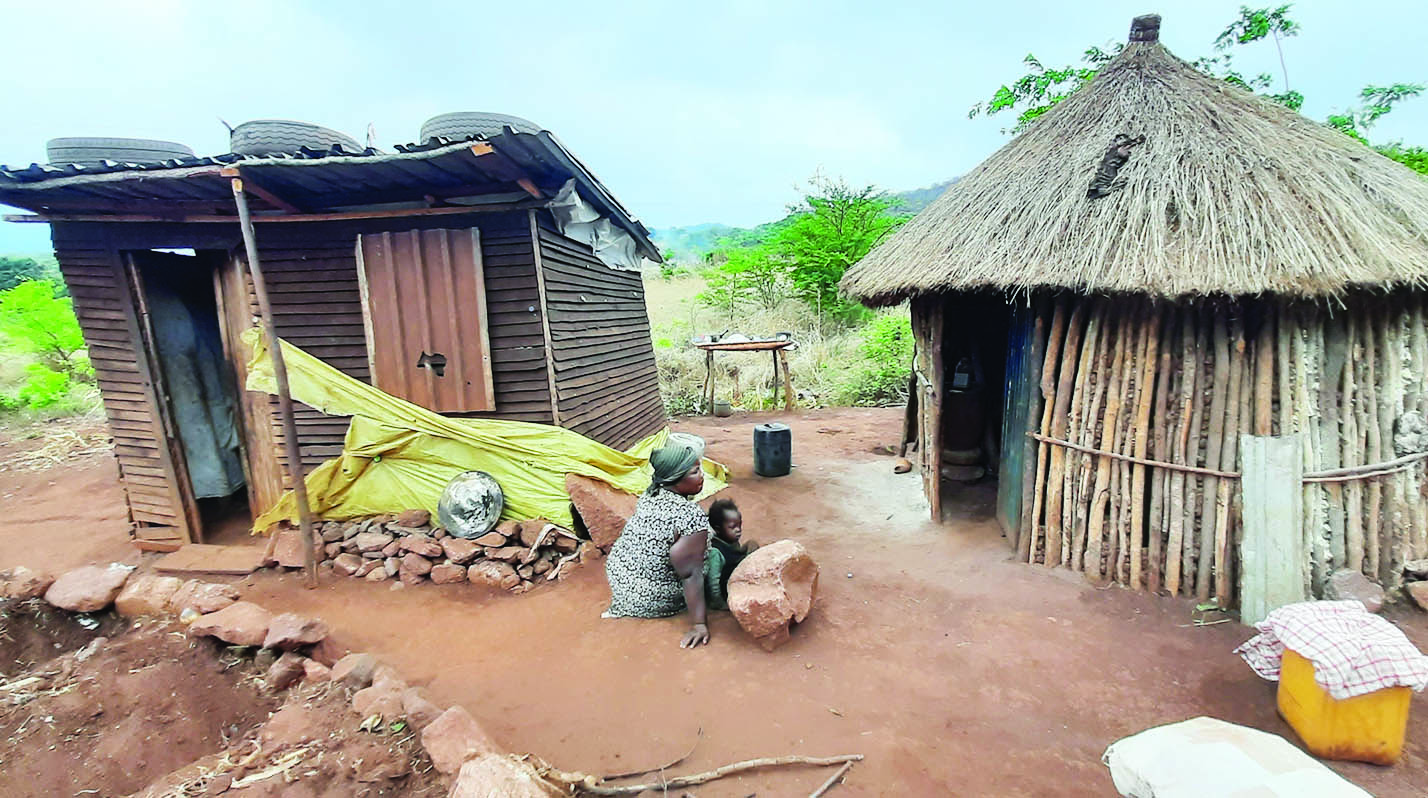
Veronica Gwaze recently in Mutare
FOR the past 12 years, Sekai Dhliwayo and her eight children and four grandchildren have literally been living in the wilderness.
Her home, which is made up of two tiny and dilapidated wooden structures, is tucked between mountains in Mutare’s Nyakamiti area.
Last week, The Sunday Mail Society visited Mai Dhliwayo in an attempt to find out how the family ended up living in this isolated place.
The home is located in a mountainous and heavily wooded area, where there are no other signs of life nearby. All one can hear are weird sounds emanating from the mountains. One catches the sight of smoke billowing from the industrial area, far from Mai Dhliwayo’s home.
When this crew arrived at the homestead, late in the morning last week, there were no indications that the family was going to have breakfast.
They had not even made the fire, despite the fact that lunch time was fast approaching. Upon arrival at the home, Mai Dhliwayo’s youngest granddaughter, aged four years, burst into a loud cry. She ran into her grandmother’s arms for cover.
“She is not used to new faces. We never get company here,” explained a smiling Mai Dhliwayo as she welcomed us.
The home surroundings tell a story of acute poverty, yet Mai Dhliwayo tries hard to conceal the situation with a plastic smile.
However, it is not long before emotions get the better of her, as she bursts into tears, and starts narrating her sad story.
Cursed childhood
The 47-year-old was born an only child in Chirinda, Chipinge, where her mother was married off to an elderly man at the age of 10.
Before turning two, her father died.
As fate would have it, her mother also died. She was four years old at the time. As such, Mai Dhliwayo had to be taken in by her maternal grandmother.
However, at around the age of six, her grandmother also died, forcing her to move back to her paternal family.
Life, she recalls, was tough as she faced all forms of abuse and often had to go to bed on an empty stomach.
“I remember one day, when we prepared chicken, and suddenly one of my cousins said, ‘Your mother did not leave behind any chickens, so you will not have it,’” she reminisced.
Despite her tender age, Mai Dhliwayo feared for her safety and had to hatch a plan to escape.
At 11, through a friend, she secured a job as a domestic worker in Bulawayo.
She travelled to Bulawayo by train, hiding under a seat. The journey, she said, was a painful one.
However, she soldiered on since she wanted to get away from the bleak situation at home.
After being touched by her plight, her boss gave her a lifeline by enrolling her in school.
This meant that she would work after school and during weekends.
For two years, she had no challenges balancing school and work.
However, as she was about to sit her Grade Seven examinations, she started having weird dreams, with a voice instructing her to go back home, in Chipinge.
“The more I resisted, the worse it got, until my boss had no choice but to ask me to leave,” said Mai Dhliwayo.
On returning home, she was taken in by one of her sisters, who was now married.
A few months later, she, however, started abusing her before she allegedly attempted to kill her.
“One day, she took me into a nearby bush, gave me a garden pick and shovel, and asked me to dig my own grave,” she alleged.
“I looked into her eyes. It was as if she had turned into a monster and out of fear I dug the grave, silently saying my last prayers.” Just as the sister was about to allegedly strike her with an axe on the head, she is said to have heard some voices nearby, prompting her (the sister) to go into hiding.
Taking advantage of the disruption, Mai Dhliwayo ran for dear life.
She had to seek refuge at a shopping centre before boarding a bus to Mutare after explaining her ordeal to the conductor, who then offered her a free ride.
For weeks, she was a vagrant in Mutare.
Later on, she got a job as a maid in Dangamvura suburb, where she worked for two years. Just when she turned 16, her widowed boss died and she had to look for another job.
Unfortunately, for three months, her new boss never paid her and she had to quit the job.
At this point, she eloped with Emmanuel Kachitigu, who was a gardener in the neighbourhood. The two had, however, dated for only a few weeks.
Mai Dhliwayo was to become a full-time housewife. Baba Kachitigu later on lost his job and had to resort to menial jobs.
The couple had 10 children in 13 years.
Moving into the woods
As the family expanded, life also became tough, forcing the couple to move out of their rented high-density home and live in the mountains in 2010.
“The first days were tough, but we had no choice. Our relationship was founded on love, so we were there for each other,” she said.
The couple became scavengers to feed their family. For two years, they grew maize at their homestead but thieves frequently visited the isolated area to steal their produce, forcing them to give up on farming.
Mai Dhliwayo still vividly recalls how her husband had literally resigned to the fact that nothing good would ever come his way. Life for him had just become nothing but a ticking clock, counting down to his last breath. In 2017, Baba Kachitigu succumbed to a short illness. As Mai Dhliwayo was trying to come to terms with the death of her husband, another disaster struck.
Her second-born child died mysteriously in 2018. As if that was not bad enough, the following year, her first-born child died in a car accident, leaving her in deep anguish. Even to this day, Mai Dhliwayo has not yet gathered the courage to talk about that tragedy.
“I feel hopeless and cursed. Sometimes I even wish I could die. However, I ask myself if the children will be able to carry the burden. Some people look at me and think I am mentally challenged,” Mai Dhliwayo said, as tears rolled down her cheeks.
“My husband was a foreigner and I don’t know his relatives. Going to Chipinge is not an option. I am just helpless,” the distraught Mai Dhliwayo said.
Risk
One of Mai Dhliwayo’s dwellings is a tiny hut made out of twigs.
From outside, one can have a clear view of what is inside, as most of the mud plastering has long fallen off.
“This is where the six boys sleep and they share the one blanket that was left when thieves stole most of our belongings,” she said.
In the other structure — an insecure cabin — six girls share two blankets with Mai Dhliwayo. During the rainy season, the entire family shares the tiny cabin, though it also leaks. The family also battles for space with wild animals.
“Wild animals, including snakes, frequent the compound and it is only through God’s grace that we are still alive. I cannot leave the children alone here at any time. I have to be here to protect them,” said a visibly worn-out Mai Dhliwayo.
The family survives from hand to mouth and fetches water from the industrial areas, which is faraway. One of Mai Dhliwayo’s biggest fears is death. She still wants to be around for the family, who have become her friends and helpers.
Hope
A local school recently came to Mai Dhliwayo’s rescue by giving her children access to free education. Another good Samaritan bought school uniforms for the kids. The children are sometimes forced to take turns to skip school to provide security at their home, when their mother gets menial jobs elsewhere.
“The children are now in school and I feel relieved. My wish is for them to have a proper roof over their heads. I wish I could get capital or seed and fertiliser so that I can sustain the family.”
“I despise begging, but for now, I have no choice,” concluded Mai Dhliwayo.
As Mai Dhliwayo and her kids soldier on with each passing day, they hope to have a normal life one day.



 Online Reporter