Online Reporter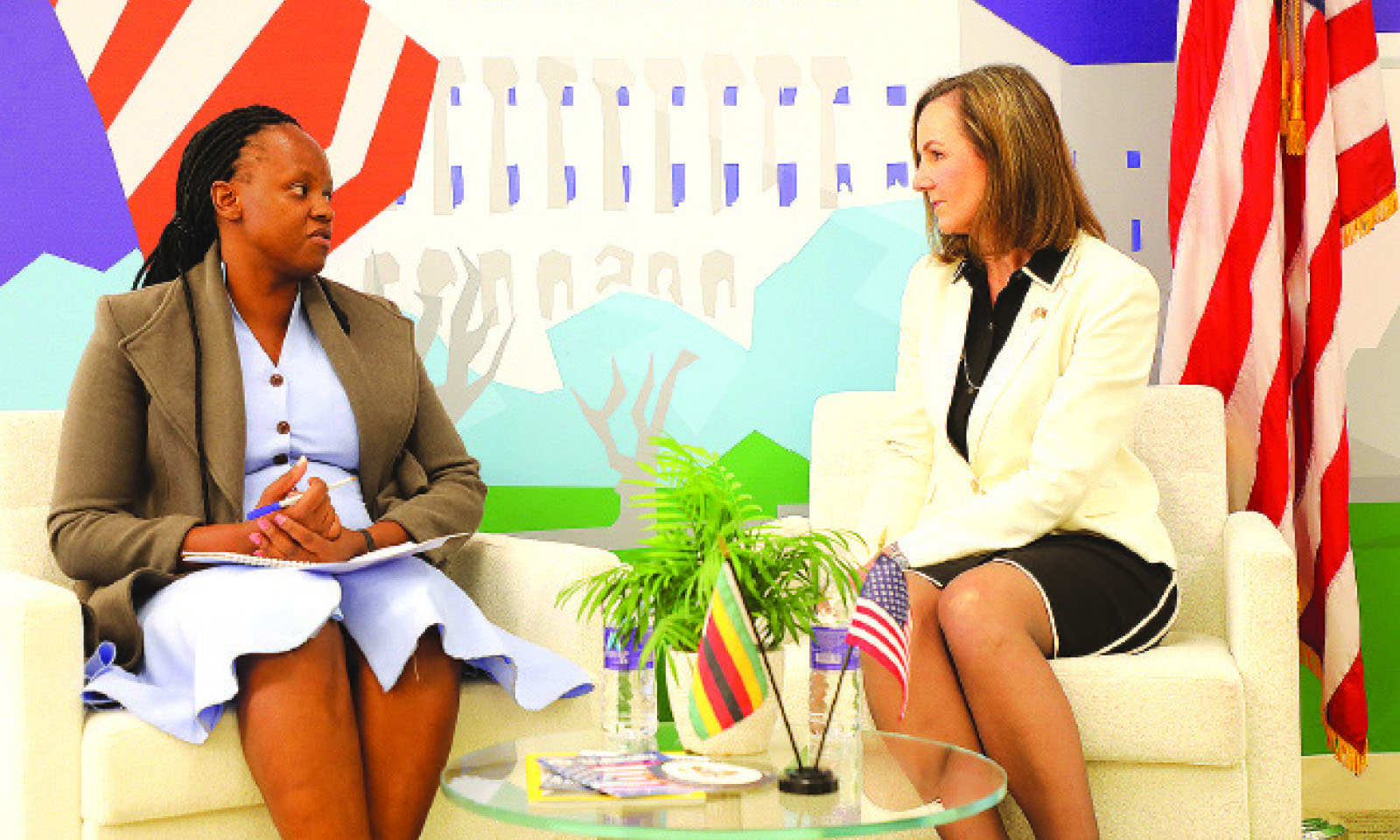
One of the Second Republic’s foreign policy thrusts is to build and rebuild relations with the international community through engagement and re-engagement efforts. Our reporter DEBRA MATABVU recently interviewed United States Ambassador to Zimbabwe MRS PAMELA TREMONT to explore the state of bilateral relations between the two countries; and the evolving US approach towards Zimbabwe, particularly the shift from an aid-led to a trade and investment-driven engagement; as well as her assessment of Zimbabwe’s re-engagement thrust.
*********************
Q: How would you characterise the current state of Zimbabwe and US relations?
A: Well, I think we have a very normal bilateral relationship. There are things that we agree on and things that we disagree on. That is completely normal in any relationship, diplomatic or otherwise, right? But our goal for Zimbabwe remains consistent throughout; that is, we want Zimbabwe to be a self-reliant, self-sufficient country that we can partner with in advancing our mutual goals and confronting global challenges.
So, that remains consistent throughout. And we very much look forward to having any sort of frank and respectful conversations with the Government of Zimbabwe, where we can narrow our differences. We welcome even more opportunities to do that.
Q: What is your assessment of the Zimbabwean Government’s new engagement efforts, particularly in terms of their effectiveness in strengthening ties with the US and the broad Western community?
A: Well, I am not sure what is entailed in the engagement process. We feel like we have always been engaged, always open to have these conversations, so that we can work to narrow our differences. That is what diplomacy is all about and what we are here for.
So, we are eager to have as many conversations with the Government of Zimbabwe as possible, so that we can narrow our differences, as I said, and work together on things of mutual concern, like climate change, like reducing poverty, like increasing trade investment. And in our new administration, our policy will be led by trade and investment, rather than development. So, that is a really important aspect of the relationship going forward.
Q: You indicated a shift from an aid-heavy approach to one led by trade and investment. What prompted this strategic change in the US approach to Zimbabwe?
A: Well, it is not Zimbabwe-specific. It is a worldwide change under our new administration.
(US) Secretary (of State Marco) Rubio, at President Trump’s guidance, has instructed us that everything that we do should be making America safer, stronger and more prosperous. So, we are in the midst of a historic realignment of our priorities, and particularly our development assistance. We are continuing much of our humanitarian and life-saving aid for Zimbabwe for the time being.
But in the future, our relationship with Zimbabwe will be led by opportunities for trade and investment to drive economic growth, rather than aid.
Q: Does this signal a move away from the US values-based foreign policy under the previous administrations in Washington towards a more pragmatic transactional form of engagement with Zimbabwe?
A: Well, Secretary Rubio and President Trump have both underscored that human rights remain at the core of our foreign policy. We see that in other places around the world. So, I do not think that our values-based foreign policy can be completely divorced from the new alignment towards promoting more trade and investment in our commercial diplomacy goals.
We know that strong democratic institutions support strong economies and economic prosperity.
So, those two things cannot be completely divorced. And that’s a message that I have been giving since I arrived, and I am sure my predecessors have, too, about the interconnectedness of strong, transparent institutions and anti-corruption in achieving those economic goals.
And that is one of the reasons the AfDB (African Development Bank) process is so wide-ranging and not just about debt.
Q: What specific measures or frameworks are the two governments putting in place to improve trade and investment?
A: Well, we have been working on this really actively; again, like I said, since last summer when I arrived here. But we have been working closely with the Ministry of Finance (Economic Development and Investment Promotion); the Ministry of (Foreign Affairs and International) Trade; the Ministry of Industry and Commerce; and Zida (Zimbabwe Investment and Development Agency), to talk about where there are areas we can improve the investment climate to make Zimbabwe a more attractive destination for not just US businesses, but businesses around the world, and frankly, for Zimbabwean entrepreneurs as well.
We want good-quality investment here in Zimbabwe to drive the country’s growth.
We also host trade delegations. We participated in ZITF (Zimbabwe International Trade Fair). So, we are doing a lot of things to try and work on that. But it is important to remember that I cannot tell US companies where to invest. US companies will make those decisions based on what they see as an attractive investment climate. And so, my role here is to work with the Zimbabwean Government in figuring out what those impediments are so that when US companies are looking for opportunities overseas, they think of Zimbabwe first and think of it as a really promising opportunity.
Q: Are there any particular sectors or industries that are showing interest in coming to Zimbabwe?
A: Well, we get maybe a dozen or so calls a year to our commercial diplomacy assistant from US companies and Zimbabwean companies looking for partners on both sides, trying to make connections and find opportunities.
And our role is to try and help them find those things. And we get calls on everything, from energy infrastructure to mining, to art and showing a sculpture and all sorts of things. So, people are exploring all opportunities.
We just need to make it a little bit easier for them to navigate their way through the investment procedures in Zimbabwe. But one of the sectors that I think has grown and has been quite successful is business processing, such as outsourcing. There is a very successful US company here.
It is a great investment opportunity just because you don’t have to import anything, you don’t have to export anything. You are just using the amazing, talented Zimbabwean people who speak great English that Americans easily understand to help with business processing in the US. So, that has been a really successful sector that we think has a lot of growth opportunity.
Q: Maybe you can briefly outline the current state of bilateral trade between Zimbabwe and the US, in terms of volume and key exports and imports.
A: Well, unfortunately, the trade volume isn’t very large. It was only about US$112 million last year, or something like that. But the good news is that it means there is a lot of room for growth.
The US imports mostly agricultural products and ferroalloy, which is obviously a mining export. And Zimbabwe mostly imports machinery and some processed foods from the US. But there is obviously a lot of room for other trade and investment opportunities in such a small number.
Q: Recently, Washington imposed an 18 percent tariff on Zimbabwean goods, which has been paused for 90 days. Can you walk us through the rationale behind this decision in Washington?
A: Well, the US has had one of the most open economies in the world for some time, and we often offer preferential trade access to US markets that are not reciprocated. So, under President Trump, he is trying to level that playing field and make it a little bit more fair.
And so, at the moment, the 18 percent is paused. We have received an offer from the Government of Zimbabwe on how to come to a deal that will benefit both of us, and we are exploring exactly the details of that deal so that we can hopefully find a more even-handed solution for both of us. But there is a lot more to tariffs than just the import tariffs.
For example, in Zimbabwe, to import a vehicle involves import charges, surcharges, tariffs, taxes and import duties. And to import a vehicle here can be 60 percent on top of the purchase price. So, by that standard, even 18 percent is quite a generous offer, I think.
So, we need to have discussions about how we can make that more reciprocal for both of us.
Q: Do you think this charge will have an impact on trade and economic relations between the US and Zimbabwe?
A: Well, I mean, perhaps this is an area where a small trade volume is a good thing because we are not a huge partner. Zimbabwe is not a huge partner for us, so hopefully it will not have devastating consequences. But we do think it will catalyse a good conversation about how to improve trade, overall.
Q: Zimbabwe responded to the US tariffs by removing all tariffs on American goods. How has Washington received this move?
A: Well, Washington is intrigued, and we are open to having discussions with all countries on how to find a more reciprocal balance of trade tariffs, among other charges. But, as I said, there is a long line of countries that have made offers, and so it is going to take some time for us to really dig into the details and come to a conclusion on this one.
Q: What is the US’ view on Zimbabwe’s ongoing arrears clearance and debt resolution programme?
A: Well, we think this is a really great opportunity for Zimbabwe to make the reforms necessary, that will get it out from under its unsustainable debt.
The dialogue offers various reforms that will help ensure that Zimbabwe doesn’t find itself back in the same situation if it took on more concessional financing. So, we are happy to support those reforms, happy to have discussions with the Government about how to take that forward. But these are reforms the Government offered to make and agreed to make, and so the ball is really in Zimbabwe’s court to take it forward.
Q: What would a successful debt restructure mean for US and Zimbabwe economic relations and international investor confidence?
A: Well, it is less about US trade relations; it is more about getting Zimbabwe out from under this debt because it is paying a disproportionate amount of its revenue towards debt servicing — an unaffordable amount. And Zimbabwe needs to get out from under that so that it can divert more of those resources to productive investments here in Zimbabwe, as well as access concessional financing that it can invest in its people and infrastructure to grow the economy organically.