Online Reporter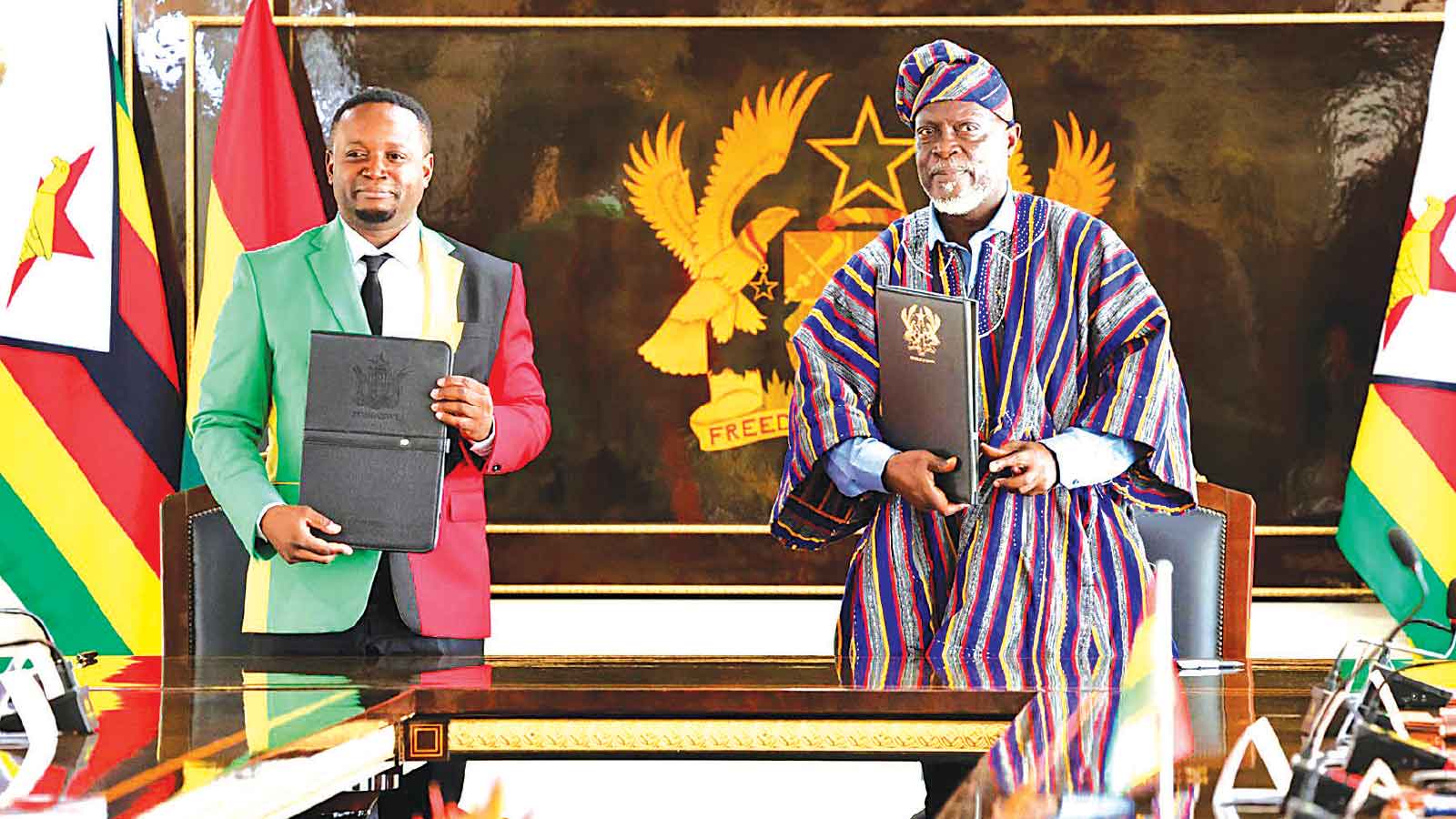
The Institute of African Knowledge (INSTAK), a Pan-African think tank, is currently pushing for redress of historical injustices rooted in slavery, colonialism and long-standing distortions about Africa’s place in the world at the International Court of Justice (ICJ) and the European Court of Human Rights (ECHR). This comes as INSTAK deepens continental partnerships, with its chief executive officer, AMBASSADOR KWAME MUZAWAZI, visiting Ghana as part of President Mnangagwa’s delegation for crucial related engagements. In an interview with The Sunday Mail, Ambassador Muzawazi speaks on the visit, INSTAK’s growing continental footprint and the thinking behind the organisation’s legal actions.
*****************
Q: You were recently in Ghana as part of President Mnangagwa’s delegation. What was the significance of that visit for INSTAK?
A: Ghana occupies a very special place in Africa’s historical and intellectual landscape. Being part of His Excellency President Mnangagwa’s delegation gave INSTAK an opportunity to engage its counterparts on areas that go beyond diplomacy — culture, history, knowledge systems and heritage projects.
Q: What specific engagements did you hold in Ghana relating to INSTAK’s work?
A: Ghana has been deliberate in preserving and projecting its history, especially around the transatlantic slave trade and Pan-Africanism.
For INSTAK, this aligns very closely with what we are doing, particularly with the Museum of African Liberation. So, discussions focused on how we can share experiences, collaborate on exhibitions and deepen research linkages.
It is about building a continental network of institutions that are telling Africa’s story from within. And none of this is possible without the unstinting support we have been getting from President Mnangagwa and the Government of Zimbabwe.
Q: INSTAK has also been engaging Ghana at diplomatic level here in Harare. Could you shed light on that?
A: Yes, earlier this year — in January — we met with the Ghanaian Ambassador to Zimbabwe, His Excellency Bonaventure Adjavor. Those discussions were along similar lines: cooperation, cultural exchange and strengthening institutional ties.
What you are seeing now is a continuation of that engagement. It is not a once-off interaction; it is part of a broader relationship we are building.
Q: Why is Ghana such an important partner for INSTAK? Which other countries have you signed memoranda of understanding (MoUs)or similar agreements with?
A: It has consistently positioned itself at the forefront of Pan-African thought and action. Historically, it has played a leading role on issues of African identity and liberation.
Even in contemporary terms, you can see that leadership — including its role in pushing conversations around slavery and colonialism at the United Nations (UN).
For INSTAK, that makes Ghana a natural partner, especially given our work at the Museum of African Liberation and the broader Liberation City Project, which seek to tell the story of Africa’s struggles and achievements in a comprehensive way. But it’s not just Ghana. INSTAK has several operational MoUs.
For example, there is an agreement with Mozambique, which is facilitating construction of the Samora Machel Monument inside Liberation City; there is another with Cuba for the exhibition of relics and memorabilia from the Battle of Cuito Cuanavale at the Museum of African Liberation, as well as for cooperation in other areas; and agreements with Russia and China.
Much of this is being achieved through the work of the special envoy on the Museum of African Liberation Project, Ambassador Simbarashe Mumbengegwi. The special envoy was appointed by President Mnangagwa to specifically advance international cooperation on this project. To date, Ambassador Mumbengegwi has engaged more than 20 countries and enlisted their participation in the Museum of African Liberation.
Q: To take you back a little, Ghana recently initiated a UN resolution on slavery and colonialism. Does that reinforce INSTAK’s current approach as announced in 2025 to seek legal redress on matters relating to colonialism and racism?
A: Very much so. What Ghana has done at the UN level speaks to a growing consensus that these issues must be addressed in a structured way.
For us, it reinforces the point that this is not an isolated effort by one institution. There is a broader continental and global movement towards confronting historical injustices.
Our legal work is part of that ecosystem — contributing from a research and institutional standpoint.
Q: Could you outline what the specific legal actions that INSTAK is pursuing are?
A: We are seeking two advisory opinions from the International Court of Justice and a definitive ruling from the European Court of Human Rights.
The first action relates to Africa’s right to reparations for slavery and colonialism. This builds on a substantial body of research, including work we have done through The Africa Factbook and other studies.
The second concerns the distortion of Africa’s landmass in global cartography, which has had long-term psychological and geopolitical implications.
The third is a case before the ECHR focusing on racial bias in Poland’s education and cultural sectors.
Q: What is informing this move? How does it align with INSTAK’s core mandate?
A: It comes from the work we have been doing over many years. INSTAK has always focused on knowledge — producing it, organising it and ensuring it reflects Africa accurately.
What we are doing now is taking that body of work into a space where it can be legally endorsed.
Documenting history is one step; having it acknowledged within international systems is another.
So, this is very much in line with our mandate.
Q: How far have you gone in terms of structuring these legal challenges?
A: A considerable amount of groundwork has been done. The legal arguments are in place, the documentation has been assembled and consultations have been undertaken.
We are now moving through the appropriate procedural channels.
These processes take time, but we are clear on the direction.
There is the question of reparations and the historical economic impact of slavery and colonialism.
There is also the issue of representation — even in something as basic as maps — and how that has shaped perceptions of Africa.
And then there are the educational and cultural narratives, particularly in Poland, which continue to reflect outdated and harmful stereotypes. In particular, there is a poem by Julian Tuwim titled “Murzynek Bambo”, which teaches young Poles that Africans are dark skinned because they don’t bath.
Q: Why are you pursuing this now?
A: There is a shift taking place. There is more openness globally to discussing historical accountability, and within Africa there is growing confidence in putting forward our own perspectives.
At the same time, this aligns with our ongoing work — from the Museum of African Liberation, the Africa Factbook and the Book of African Records, to initiatives like the recent Black History Month exhibition.
It is all part of a broader effort to restore historical truth.
Q: One of your legal actions targets the Polish education system. You studied in Poland. Did that experience shape your perspective?
A: It gave me insight into how Africa is perceived within certain systems. But this is not just about personal experiences; it is about a deeper, documented pattern.
There is a significant body of evidence showing how Africans are represented in some educational and cultural contexts.
The intention is to address that constructively and firmly.
If Polish authorities take this personally, so be it. Truth demands we face whatever consequences may come. Mind you, I have personally been persecuted before by Polish authorities. As a student there, I was detained for 13 months in that country because of academic work that exposed deep-seated and widely accepted racism in Poland.
But this is bigger than Muzawazi the student in Poland. It is about Africa and people of African descent today, tomorrow and through the ages.
Q: Some may say issues like cartography are symbolic. Why give such prominence to how Africa’s size is depicted on world maps?
A: Because symbols shape perception.
If a whole people and its continent are consistently presented in a diminished way, that has long-term effects on how others see it and how these people see themselves.
So, correcting that is not academic; it is necessary.
Q: How do these legal efforts tie into projects like the Museum of African Liberation?
A: They are part of the same continuum. The museum focuses on memory and identity, while the legal work focuses on recognition and justice.
Q: What would success look like for INSTAK in these legal processes?
A: Success can take different forms. Even elevating these issues to that level is significant.
But ultimately, it is about restoring balance — ensuring that Africa’s story is told fully and on its own terms.