admin
admin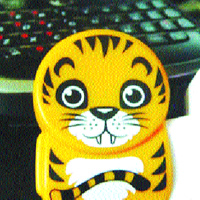
last week when they introduced, for the first time, an ingenious product called the poken.
Poken is your “Social Business Card”.
It is the easy way to share your contact details and online social networks in the real world. Just hold two Poken palms together, something product designers like to call- High 4! – and you are connected.
The writer gave away less than 10 paper business cards as with this gadget one needs not carry a whole bunch of cards and then cry when they finish with this 2gig memory carrying gadget you can keep on collecting cards. It has been popular at conferences such Indaba because of the large amount of interactions that take place.
Poken is a technology that utilises a proprietary Near Field Communication (NFC) technology to allow the exchange of online social networking data between two keychain accessories. Each person involved in the exchange must have his or her own poken.
The primary information exchanged via the poken is a “social business card”, a digital replacement for a physical business card. By touching two devices together, a unique ID is exchanged that links to contact information on the Poken website. Contact information acquired by use of the poken can be uploaded to the poken website using a built-in USB connector.
In addition to the contact information found on a typical business card, links to users’ social networks can also be added. Examples include Twitter, Facebook, LinkedIn and over 40 other social net-works. Users of the Poken website can use a “social dashboard” to manage, and interact with their contacts.
Each social network is represented with an icon on the user’s contact card, and is just one click to the user on that respective social network. From there, the standard “friending” or connecting rules apply.
Pokens are used for social networking, personal identification and as a device for loyalty programmes. Bloggers and social media addicts have taken it up for networking event such as tweet-ups. Corporations such as BMW and IBM use pokens at their conferences, to enhance interaction with the conference attendees and to facilitate business networking.
Poken is sold through a network of resellers and web shops in over 40 countries. Early adopter countries have been South Africa, the Netherlands, Japan, Germany and more recently the United States. This makes this product only available for sale in South Africa and by visiting their website www.poken.co.za and one can get a poken of their choice.
The company Poken SA was founded in December 2007 in Lausanne, Switzerland, by Stéphane Doutriaux. The founder had come up with the business idea while doing his MBA at a business school in Lausanne. The development of the technology was done in collaboration with the Berner Fachhochschule, a university of applied sciences situated in Biel, Switzerland.
The project started in July 2008 and ended in December of the same year. The first product range called the “Sparks” was introduced in January 2009. Poken SA launched the poken “Pulse” (with 2 GB memory) in September 2009.
The name “Poken” comes from the initial project which the founder started that sparked the idea for the final version of the project. The project started out as a “Poker” “Token”. The name stuck and became what we know today as “Poken”.
A typical usage scenario consists of:
1. User “high fours” his or her Poken with that of the other user. Essentially holding them against each other (such that the coils inside the token are more or less aligned).
2. The two Poken flashes green to signal that a bond was made.
3. At home, the user plugs in his or her token into the USB port.
4. The token is recognised as a standard (read only) disk.
5. The user opens an HTML file from the disk (either manually, or through the AUTOSTART.INF mechanism).
The user’s poken contact card can contain any information they want to share, for example URLs, mobile number, email address, and location. Unlike paper business cards you can change your info, manage contacts, and export them – anytime, anywhere.
With a core collection of 18 different styles, the Spark is the perfect personal sidekick for networking, meeting new friends, and managing your social connections – no pens, paper, or data entry needed.
For a more practical approach to things the Pulse has all the features of the spark with the added bonus of 2GB flash memory, all neatly packaged in a sleek, black body.
The major drawback the writer sees is that not everyone will buy or have the poken and if there aren’t any people to poken with the device becomes useless and is something you might walk with around your neck and try to look cool.
Secondly there are some people like Chris Wood are who are very much keen on sticking to the old tradition of paper business cards but the gadget remains unique and ideal for large conferences and will probably rule the future of contact exchange in the near future.
The hope is to see it soon in Zimbabwe.
Credit: www.poken.com
www.wikipedia.com
[email protected]



 Online Reporter