Tendai Gukutikwa
Weekender Reporter
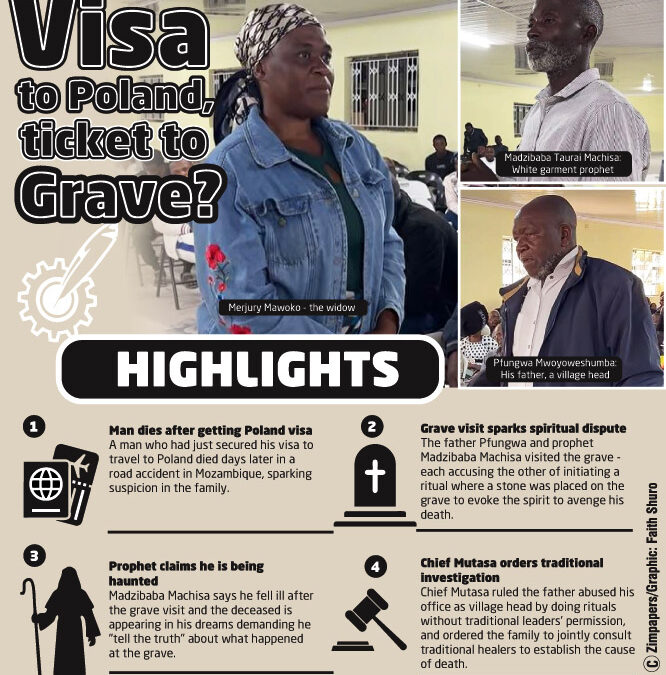
A MAN who died just days after securing a visa to travel to Poland has become the centre of a stormy family dispute, with a white garment prophet claiming the deceased’s spirit is haunting him and demanding answers about a mysterious visit to his grave.
The bizarre matter, now before Chief Mutasa’s community court, has pitted prophet Madzibaba Taurai Machisa against the deceased’s father, Pfungwa Mwoyoweshumba, over allegations of secret rituals allegedly conducted at the gravesite.
Machisa claims the deceased has been appearing in his dreams, making him ill, and demanding that he reveal what transpired when he accompanied the father to the grave.
The prophet said the haunting began after Mwoyoweshumba allegedly insisted that he accompany him to his late son’s grave.
“One day after work, he asked me to go with him to his son’s grave because he wanted to pray and ask his son to avenge his death. I accompanied him, and he placed a stone near the head of the grave,” said Machisa.
He said his health deteriorated soon afterwards.
“I became ill, and another prophet told me my condition was linked to that visit. The deceased is now appearing in my dreams, demanding that I reveal the truth about what happened at the grave. Everywhere I go, prophets tell me the same thing,” he said.
Machisa maintained that he was merely accompanying the grieving father, and insisted that the deceased’s wife and children should be present during proceedings so that he could explain his side of the story before them.
“He says I will only find peace after I tell the truth about what happened at the grave,” said Machisa.
The dispute has revived questions surrounding the deceased’s untimely death in a road accident in Mozambique at a time when he was reportedly preparing to leave for Poland after successfully obtaining a visa.
His widow, Merjury Mawoko, said the family’s growing interest in her husband’s grave had left her deeply concerned.
“My husband had already obtained his visa and was preparing to travel to Poland. The last person who prayed for him was not Machisa, but another prophet. Later, after his death, his father wanted to take my children to the grave,” she said.
Mawoko said she refused the request because she did not understand its purpose.
“I did not know why he wanted to do that. My child had already fallen ill on our way to visit their grandparents, and I was worried about everything that was happening. I keep asking myself why there has been so much interest in my husband’s grave,” she said.
However, Mwoyoweshumba strongly denied the prophet’s allegations and instead accused Machisa of masterminding the grave visit.
“He was not simply accompanying me. He was my prophet and had told me that somebody had killed my son. He is the one who suggested that we go to the grave and evoke my son’s spirit so that he could avenge his own death,” said Mwoyoweshumba.
The deceased’s brother, Allen Mwoyoweshumba, also questioned why Machisa was distancing himself from events he had allegedly initiated.
“Whenever my brother needed prayers, Machisa was there. He even prayed for him a few days before his death. When my brother died, he told us another prophet had opened a spiritual portal that caused his death. He also insisted at the funeral that my brother had not died naturally,” said Allen.
He challenged the prophet’s claims of haunting.
“If he is innocent, why is my brother appearing to him in dreams? Why is he the one who is bedridden? Why is he the one saying he is being tormented?” Allen asked.
Allen said his brother was on the verge of fulfilling his dream of relocating to Europe.
“My brother’s visa had already been approved. Machisa called him and said he wanted to pray for him before he travelled to Poland. My brother went for those prayers and shortly afterwards died. It was the same prophet who later claimed someone had killed him,” he said.
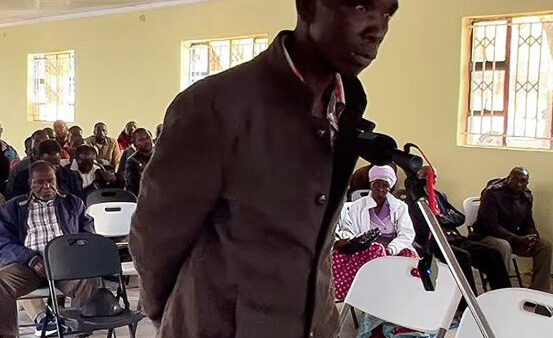
Delivering his remarks before the community court, Chief Mutasa criticised Mwoyoweshumba for visiting the grave under such circumstances without informing traditional leaders.
“You were wrong, and as a village head you abused your office. You cannot conduct such activities at a gravesite without the knowledge and authority of traditional leadership,” said the chief.
Chief Mutasa subsequently directed the family to jointly consult traditional healers in a bid to establish the circumstances surrounding the man’s death and determine why there was growing interest in his gravesite.
The ruling leaves a trail of unanswered questions surrounding the Poland-bound man’s death, the controversial grave visit and the haunting claims that continue to divide his family.
Poland-bound man mysterious dies