Online Reporter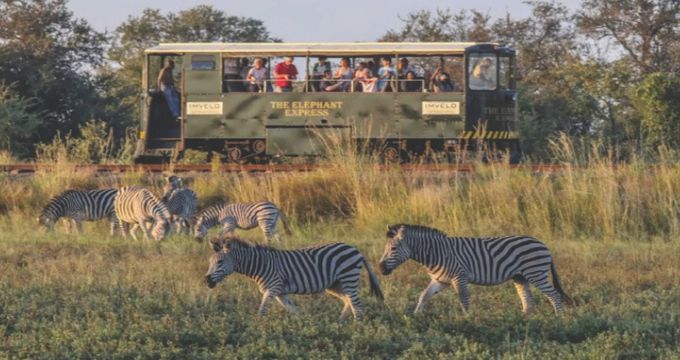
Christian Wolmar
The Elephant Express is the world’s only safari train.
Actually, “express” might be a misnomer, as it’s limited to a maximum of 40km/h, but this is not some miniature toy train on a small purpose-built loop. Rather, it travels an 80km stretch of the main line between Bulawayo and Victoria Falls, a track that happens to run alongside the Hwange National Park, Zimbabwe’s largest reserve and home to no fewer than 40 000 elephants. The train itself is a single, purpose-built carriage with room for 22, powered by two Land Rover engines, one at each end. Its role is twofold — to deliver guests from the town of Dete to Imvelo Safari Lodges’ properties at Camelthorn and Bomani, and also to offer them a unique experience while they get there.
Soon after I got on, the train slowed to a halt to allow us to spend a few minutes alongside a herd of elephants that completely ignored our presence.
They are used to the trains, which appear to them less threatening than normal safari vehicles.
Our driver, Walter Mlauzi, turned off the engine and we sat in awed silence as the elephants chomped away at the trees.
Zimbabwe has the second largest number of African elephants after Botswana.
As soon as we started again along the arrow-straight track (in fact one of the world’s longest straight stretches of railway), other animals came into view.
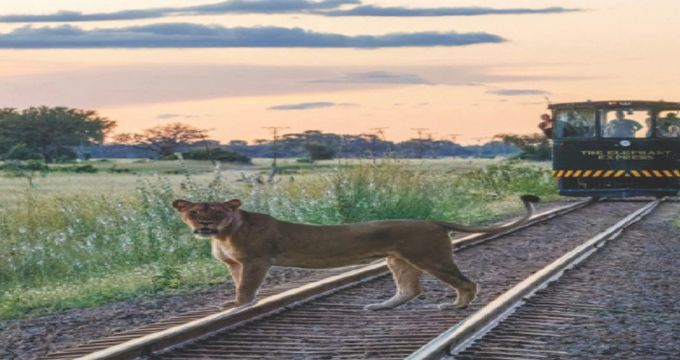
There was a troop of baboons who seem to be permanently based near the line and a herd of wildebeest who provide much of the sustenance for the pride of 23 lions that are also frequently seen from the train.
Indeed, we discovered the next day that they had later killed a wildebeest nearby — its bones, cleaned entirely within a few hours of its death by the lions and then jackals and vultures, glistened in the early morning sun.
For much of the route, the line runs on an embankment, giving excellent views over the surrounding bush.
Further down the tracks, there was a murmur of excitement as, over the crackling radio, Mlauzi was told there were cheetahs nearby, a far rarer sight than the lions.
The train slowed to a crawl, binoculars were used to scour the bush but to no avail. Mark Butcher, Imvelo’s managing director, told me the big coal-carrying freight trains, rather than the little Elephant Express, did sometimes hit wildlife.
“Most collisions occur at night, because of the strong light at the front of the train — the animals are mesmerised by it and instead of running away don’t move.”
It was Butcher who hit upon the idea of using a train so his clients could avoid the worst part of the road journey to his lodges.
“There is no other national park with a railway line next to it, so we thought we would make use of it,” he says.
The Express started operating in 2015, after years of preparatory work to convince the railway and the government that the concept was safe.
Part of that process was an agreement that Imvelo would employ experienced rail staff and ensure that they were in constant contact with the line’s control centres at Dete and Sawmills. Mlauzi told me he had worked on the railways for more than 35 years and was even a fireman on the steam trains that ran until the final years of the last century.
As we continued south, Mlauzi occasionally shouted “pothole!”
These were places where the ballast had been worn away, leaving the rails to bend under the weight of the train, providing something of a fairground ride. Later, to the delight of the train buffs onboard, we were each allowed a turn at driving the Elephant Express, donning the conductor’s cap to do so.
Given that it is powered by a car engine, the controls are the same: three pedals and a gear lever.
One passenger expressed surprise that there was no steering wheel, before quickly realising that the tracks removed the need for one.
Finally, after about two-and-a-half hours, the conductor got out to change the points and the Express coasted into a siding at Ngambo, safely out of the way of the mainline trains.
There is no platform, so we stepped down on to the tracks and walked to waiting 4x4s that would drive the remaining 15 minutes or so.
Cheetahs or no, the guests around me seemed thrilled by their safari — before they’d even arrived. – Financial Times