

 admin
admin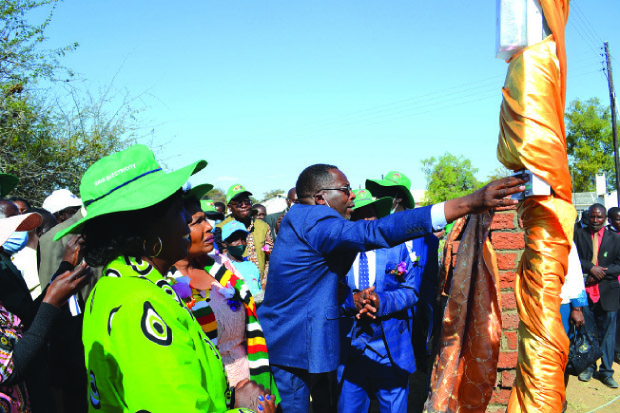
Samuel Kadungure
Senior Reporter
ACCESS to adequate and reliable electricity is fundamental to development and Government is undertaking initiatives to scale up expansion of alternative sources and the generation capacity on the national grid, Energy and Power Development Minister, Honourable Zhemu Soda has said.
Minister Soda, who was represented by his deputy, Honourable Magna Mudyiwa at the commissioning of the US$650 000 Madzivire-Bangure Electrification Project in Buhera last week, said access to electricity was crucial, whether through on or off-grid sources, since no meaningful development could take place without access to power.
The Madzivire-Bangure Electrification Project, which was funded by the Rural Electrification Fund (REF), has seven substations.
The project, with a total length of 44,32km, will benefit 25 rural public institutions, among them 14 schools, six business centres, three clinics and two agricultural extension offices.
The project also has the capacity to benefit 6 324 households in four wards across Buhera Central Constituency.
“Government, through my ministry, launched the National Energy Policy (NEP) which sought to ensure that all people in Zimbabwe have access to adequate, reliable, cost effective and environmentally sustainable energy services.
“As you are all aware, President Mnangagwa launched the National Development Strategy (NDS1), which is our cornerstone in achieving Vision 2030.
“My ministry is expected to play a key role in the attainment of Vision 2030through the provision of adequate and sustainable energy services, which is a prerequisite for achieving the desired socio-economic development and growth in line with Government mantra of leaving no place and no one behind,” said Minister Soda.
He said Government continues to invest in infrastructure and generation capacity competences to ensure safe, adequate and quality delivery of energy services.
To that end, Minister Soda said progress has been made in the Hwange Expansion Project, which by this year-end should be fully operation, adding an additional 600MW to the national grid.
“It is critical to note that there is a shortage of electricity in the country and in the region as a whole. There is therefore need to develop other alternative energy sources and improve the generation capacity on our national grid.
“In this regard, Government embarked on the Hwange Expansion Project under which an additional 600MW will be installed at a cost of US$1,5 billion.
This expansion project will bring the total installed capacity for Hwange Power Station to 1 520mwand is scheduled for completion in 2022.
“Furthermore, President Mnangagwa launched the National Renewable Policy (NRP) which outlines action plans for the development of renewable and clean energy solutions to lighting, space heating and cooking. All these measures are meant to ensure adequate supplies of energy to meet the ever increasing demand in both urban and rural areas of Zimbabwe,” said Minister Soda.
He said his ministry will continue exploring ways to create an enabling environment for the provision of power, particularly in rural areas that have been neglected in the past.
Minister Soda said to date, the Rural Electrification Programme has lit 9934 institutions countrywide using both grid and solar technologies.
These include 3316 out of country’s 5324 primary schools (62 percent), 1637 out of 2213 secondary schools (74 percent), 1217 out of 1365 health centres (90 percent), 267 out of 289 chieftainship homesteads (92 percent) and 20 percent of rural households.
Of these, 1882 institutions are in Manicaland.
Rural communities closer to energy infrastructure have also been encouraged to initiate their own electrification projects as they take advantage of existing favourable payment terms.
“The Rural Electrification Programme has potential to improve the quality of life in rural areas. Many schools are now electrified and connected to internet services. Teachers who used to shun working in rural areas before are now happy.
“Similarly in health centres, electricity has brought positive changes. The child mortality rate has reduced and expecting mothers who were being asked to bring their own candles and paraffin lamps are now giving birth in well-lit and conducive environments,” said Minister Soda.
However, Minister Soda expressed concern over increasing cases of theft and vandalism of electricity infrastructure, particularly conductors and transformers.
He said efforts are being made to strengthen existing laws to ensure mandatory sentencing, which will act as a strong deterrent to would-be offenders.
The Minister of State for Manicaland Provincial Affairs and Devolution, Honorable Nokhutula Matsikenyere applauded Government efforts in uplift the standard of living in rural communities through provision of energy infrastructure.
“It is pleasing to note that Manicaland is not being left behind in these development initiatives by Government. The importance of electricity as an enabler for economic and social development cannot be overemphasised.
“Once energy is provided, it can be used in schools, rural health centres and individual homes for the upliftment of lifestyles, improvement of health and education for rural Zimbabweans.
“Irrigation, agro-processing and cottage industry projects can also be successfully implemented for the benefit of rural communities and the country at large,” said Minister Matsikenyere.


 Online Reporter