Chronicle Editor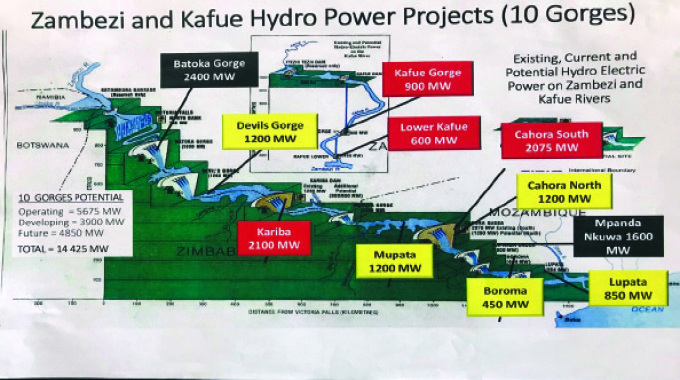
Limukani Ncube, Feature
Energy is the key driving force for all economic activities and industrialisation. For the sustained economic growth, continuous and secured energy and power supply is vital.
The changes in temperature and rainfall patterns due to climate change can have significant implications for the existing and future power plants and power infrastructure.
Weather and climate can affect all major features of the electric power sector, including electricity generation, transmission and distribution systems, and end-user demand for power (Iftekhar Khan etal, 2013).
A report by the International Atomic Energy Agency, which Zimbabwe is part of, says since 2010, there has been a growing interest in impact studies that explore options and their associated costs to reduce the vulnerability of the energy sector to climate change, and the longer term impacts and adaptation options.
“Indeed, the global energy sector faces a double challenge in the next 20–30 years.
Not only does the sector need to be fundamentally transformed into a low carbon energy supply system in response to climate change mitigation and related policies (e.g. the Paris Agreement under the United Nations Framework
Convention on Climate Change), it also needs to adapt to climate change and its effects to ensure that energy supplies remain secure and reliable….Other things being equal, in a warming world, energy demand for heating will decline and energy demand for cooling will increase; the balance of the two depends on the geographical, socioeconomic and technological conditions.
However, there are many other drivers of change in energy demand besides climate and weather. The relative importance of changes in long term climatic and short term weather conditions among the drivers varies across regions and keeps changing over time.
“In the last decade or so, in addition to the increasing abundance of energy demand studies, a growing interest has been observed in assessing the vulnerability of different energy sources and technologies under present and future climatic conditions, and current and possibly changing future patterns of extreme weather situations; the options and costs to reduce vulnerability, and the longer term impacts and adaptation options in various energy systems have also been increasingly assessed.
The emerging picture indicates that the global energy system will face a double challenge over the coming decades: it will be transformed by climate change mitigation requirements and related policies, and it will need to adapt to impacts of emerging changes in climate and weather. Adequate responses to these challenges will be crucial for a secure and reliable energy supply,” says the International Atomic Energy Agency report.
In addition, a number of countries across the world have said they will stop financing coal-fired power plants in a bid to support the greening of the global economy, a move that will impact on plans for more coal-fired power plants in the country that will seek funding from abroad.
The Guardian recently reported that China will step up support for other developing countries in developing green and low-carbon energy, and will not help build new coal-fired power projects. Reuters reported that the stance could affect 44 coal plants earmarked for Chinese state financing.
“Coal is the single biggest contributor to anthropogenic climate change. The burning of coal is responsible for 46 percent of carbon dioxide emissions worldwide and accounts for 72 percent of total greenhouse gas (GHG) emissions from the electricity sector.
If plans to build up to 1200 new coal fired power stations around the world are realized, the greenhouse gas emissions (GHG) from these plants would put us on a path towards catastrophic climate change, causing global temperatures to rise by over five degrees Celsius by 2100. This will have dire impacts for all life on earth,” says endcoal.org climate-change.
However, the new developments on funding will not affect the already agreed upon and operational projects, experts said. Addressing journalists and Zimbabwe Electricity Supply Authority (Zesa) staff during a media tour of Hwange Power Station last week, Zesa board chair Dr Sydney Gata, said the Sadc region was alive to the challenges facing new coal-powered projects and was making moves to tap into alternative sources of energy.
He noted that there was excessive fossil energy dependence with coal being mostly relied upon in Zimbabwe, Botswana and South Africa, while Angola and Mozambique are more into oil and gas. With the shifting patterns of Zambezi Catchment, more has to be done to alleviate the uncertainly that might come to the Zambezi Hydrological power due to climate change.
Dr Gata said, although relying on renewable energy would not be immediate because of technological and funding issues, the region was however, looking at the Central African renewable energy project that focuses on the Zambezi and Kafue Hydro-Electric Power potential. The project will be anchored on ten gorges along the Zambezi and Kafue Rivers.
The ten gorges include Batoka gorge, which is earmarked to produce 2400 megawatts (MW), Devils gorge (1240 MW), Kariba gorge (2100 MW), Mupata gorge (1200 MW), Boroma (450 MW), Lupata gorge (850 MW), Mpanda Nkuwa (1600 MW), Kahora North (1200 MW), Kahora South (2075 MW), Lower Kafue (750 MW), Kafue gorge (990 MW).
The projects will impact on Zimbabwe, Zambia, Mozambique, among others. He said back home, Zesa was implementing a number of projects to increase the supply capacity and meet the demand.
The projects portfolio includes a mix of thermal, hydro and solar power plants to be implemented to meet the Vision 2030 national goal of an upper middle income economy.
In addition, apart from the green field projects, the organisation was also refurbishing its existing plants which are now old.
Some of the key projects being implemented to ensure there is enough electricity in the country are Hwange 7 and 8 expansion to generate an additional 600 MW, and construction was at 72.18 percent.
Works in progress include installation of turbines and generators, boiler erection, transmission towers erection, substation construction, concreting and foundation construction and the works are set to be finished next from August to December.
The initial target to finish this year was disturbed by the Covid-19 induced lockdowns.
Zesa is also working on the Deka Water Pipeline Upgrade and Expansion, earmarked to be finished next year, Gwanda 100 MW solar project, Harare II Repowering, Bulawayo Repowering (all set to be operational in 2023, Batoka Hydro Power, set to be finished in 2028, Hwange Life Extension set to be finished in 2018, Alaska-Karoi 85 km 132 kV line and substation, Atlanta-Mutoko 42 km 132 kV line, Zizabona 400 kV Interconnector 101 km, Emergency Power Infrastructure Rehabilitation as well as distribution infrastructure upgrade and extension which are at various stages.
The projects by the organisation have created employment opportunities for locals with about 5000 people working on the projects in Hwange.
In addition, the installation of transmission infrastructure from Hwange to Bulawayo will see some families being displaced from their homes, and the organisation has already started to build new houses for those affected in districts such as Hwange, Tsholotsho, Lupane, Umguza and Khami. So far, 77 families have been identified.



 Online Reporter