Chronicle Editor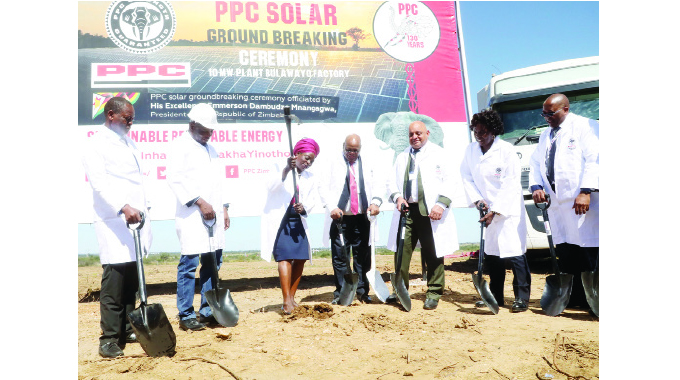
Nqobile Bhebhe, Senior Business Reporter
GIANT cement manufacturer, Pretoria Portland Cement Zimbabwe has unveiled a US$40 million solar power investment for its Bulawayo and Colleen Bawn plants, which will boost the firm’s energy requirements and help reduce supply gap in the country.

The planned projects are expected to yield combined output of 30MW, of which 17MW is for internal consumption with the excess of 13MW set to be fed into the national grid.
The Bulawayo plant will set up a 10MW plant, with 5MW earmarked for internal use while the Colleen Bawn plant will develop a 20MW capacity, 12MW being used internally.
The massive solar energy projects will also reduce the cement industry’s carbon footprint and go a long way in buttressing the Second Republic’s National Development Strategy (NDS1) ideals on increasing energy power supply through broadening the energy mix by promoting independent power production.
The Bulawayo factory will be equipped with a 10MW solar plant set to cover over 22 hectares of land.
Over 20 000 panels will be ground-mounted on this site and will be connected to the Bulawayo milling plant and the ZESA grid.
At Colleen Bawn factory, the plant will have 20MW solar PV plant erected to cover over 45 hectares of land with 18 megawatt-hours of battery energy storage system (BESS) to support the kiln to run for four hours during the night power outage.
Speaking at the groundbreaking ceremony in Bulawayo yesterday, Industry and Commerce Minister Sekai Nzenza, who was representing President Mnangagwa, said PPC Zimbabwe’s contribution to the infrastructure development and growth is commendable.
Over the years, she said PPC has supplied critical inputs on several national projects that include the Gwayi- Shangani Dam construction, Hwange Thermal Power Station’s Unit 7 and 8 and the on-going Beitbridge-Harare Highway, among other projects.

Dr Nzenza said by transitioning to solar energy, PPC Zimbabwe was complementing Government efforts towards climate change mitigation and adaptation and enhancing the sustainability of the country’s energy sector.
“I am informed that the two solar farm projects will help meet the company’s power generation requirement of 17MW with the excess power of 13MW being fed into the national grid,” she said.
“I exhort other players in the cement industry to take a leaf from this initiative and also reduce carbon intensity in their production processes.
“These should include the use of technical solutions such as fuel switching, improved energy efficiency and clinker replacements.
“I further challenge other companies and industries to put in place deliberate measures and targets to boost the consumption of renewable energy towards a thriving economy that positively impacts on the environment and a clean energy future.”
Dr Nzenza said Government was looking forward to the speedy construction of the proposed solar plants and other renewable energy facilities.
In his remarks, PPC head of supply chain and strategic projects, Dr Marvellas Sibanda, said the project will contribute to Zimbabwe’s National Renewable Energy policy, which aims to achieve 26.5 percent of total electricity supply to come from renewable energy sources by 2030 as part of initiatives under Vision 2030.
He said PPC Zimbabwe was the first company in the construction sector to develop large scale solar PV plants.
PPC Zimbabwe is a major cement producer with a milling capacity of over 1.4 million tonnes per annum, he said.
Dr Sibanda said due to high consumption usage in the production process it was critical to have reliable power supply that also address the issues of climate change mitigation.
“The cement industry is a high-level energy consumption sector with energy being a major cost driver accounting for 30 percent of the operational costs.
“Power supply challenges faced by ZETDC and the nation at large result in the destruction of our operations and in certain cases equipment damage,” he said.
Dr Sibanda indicated that the projects bidding process attracted 30 companies worldwide and after several adjudications, a local Independent Power Producer (IPP) named ATC Consortium, who work with Sinohydro from China was selected in 2020.
“The IPP will build, own and operate the solar facilities. A power Purchase Agreement (PPA) has been signed between PPC and the IPP for a 20-year term thereafter the assets will be transferred to PPC,” he said.
“The project cost is estimated at US$40million for the two plants.”
On technical aspects, Dr Sibanda said the solar plant will have two-tier quality 535 watts bi-facial solar panels, which will have single-axis tracking to capture maximum sunlight throughout the day.
Bi- facial maximise the land area by absorbing irradiation from the sun and from the reflectance from the ground.
The solar PV array will be connected to string inverters of 225kw each to convert the solar power into usable AC energy.
Both solar farms will be connected to the grid and excess energy will be banked into the grid.
“The project will create employment during construction and a permanent stall will be employed for the 20-year Power Purchase Agreement for clearing and maintenance of the solar plant,” Dr Sibanda added.
“To demonstrate the high-quality nature of the project, over 40 000 panels will be ground mounted at the site and will be connected to the excess capacity.
“Colleen Bawn will use 12MW of the 20MW produced translating to 35 per cent of the energy produced being fed into the grid and Bulawayo factory will use 5MW for the 10MW produced translating to five percent of the energy being into the national grid.
“The solar PV plants will improve power quality throughout the sits, leading to PPC Zimbabwe being able to operate at maximum capacity to meet current demand and subsequently boosting economic growth through the construction sector.”
The groundbreaking event was witnessed by Matabeleland North and South Provincial Affairs and Devolution Ministers, Richard Moyo and Abednico Ncube, Industry and Commerce Deputy Minister Raj Modi, several Government officials and Umguza Rural District Council councillors.
– @nqobilebhebhe.



 Online Reporter