

 admin
admin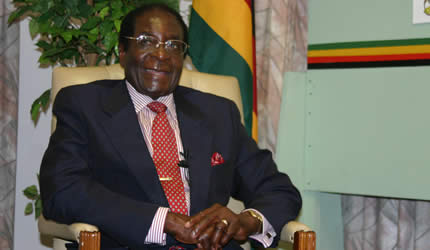

Harare Bureau
PRESIDENT Mugabe yesterday invoked the Presidential Powers (Temporary Measures) Act [Chapter10:20] to amend the Electoral Act as agreed by Cabinet on Tuesday, paving the way for him to set 31 July as the date for holding harmonised elections. The amendments, which aligned electoral laws with the new Constitution, are contained in Statutory Instrument 85 of 2013 published in an extraordinary Government Gazette.
This means the amendments which were endorsed by Cabinet on Tuesday would no longer go to Parliament for debate.
The Statutory Instrument notes that if a situation affecting, for instance, the general public of Zimbabwe, cannot be dealt with adequately in terms of any law and, because of its urgency, it is inexpedient to await for the passage through Parliament of an Act to deal with it, the President is empowered in terms of section 2 of the Presidential Powers (Temporary Measures) Act [Chapter10:20] to make such regulations as he considers will deal with that situation.
It also noted that such a situation has arisen in connection with the decision and order of the Constitutional Court of Zimbabwe made pursuant to the case of (Jealousy) Mawarire versus Robert Gabriel Mugabe and others (Judgement No. CCZ 1/13), delivered on the 31st of May, 2013, the effect of which was to order the President to issue the necessary proclamation for presidential, parliamentary and local authority elections to take place no later than 31 July.
The Statutory Instrument says in respect of political parties fielding both a council and national assembly candidate, they would be allowed three election agents.
One will be inside the polling station and two others are there to relieve him or her.
There would be “roving election agents” who would supplement the functions of chief election agents.
This roving election agent is allowed to hop from one polling station to another in order to confer with the party’s election agents at a polling station to acquaint with any problems that may be reported to him or her.
According to the Statutory Instrument, a candidate may be disqualified from nomination if he or she is not a registered voter in a ward to a constituency in the electoral province.
A candidate may also be disqualified if he or she is nominated or listed as a candidate by more than one party, or as a candidate for election as a senator and also for the National Assembly.
As part of the nomination requirements, the Statutory Instrument states that: “On the day and at the place fixed in terms of section 45C(2) for the sitting of a nomination court to receive nominations for party list candidates, the nomination officer shall hold a public court, commencing at 10 o’clock in the morning, at which an office-bearer of a political party shall present himself or herself before the nomination officer in the electoral province for which such party has nominated one or ordinary candidates and submit a nomination paper containing three party lists of names of party list candidates for the senatorial, National Assembly and provincial council seats allocated to that electoral province in terms of section 45C4.”
The Statutory Instrument prohibits unofficial or false declaration of election results.
“Subject to subsection (3), any person who purports to announce the result of an election as the true or official results, or purports to declare any candidate to have duly elected, . . . shall be guilty of an offence and liable to a fine not exceeding level six or to imprisonment for a period not exceeding one year or to both such fine and imprisonment,” read part of the Statutory Instrument.
Before, on or after nomination day but not later than 12 days before polling day or the first polling day, as the case may be, in the election concerned, a political party that has complied with section 38A (1)(a) or (b) may, through any two of its designated office-bearers at national or provincial, appoint one person for each ward in which it is fielding candidates to be a roving election agent, and shall forthwith notify in writing the full names and address of its roving election agent to the constituency elections officer concerned.
The Statutory Instrument states that after the counting of votes has been completed and an equality of votes is found to exist between two or more candidates and the addition of one vote would entitle any of the candidates to be declared elected, the chief elections officer shall forthwith declare that a run-off by-election shall be held on the same day as the presidential run-off would have had to have been held if it become necessary to hold it.


 Online Reporter
 derick.khumalo