admin
admin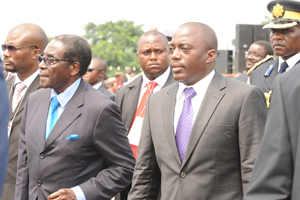
during the election.
President Kabila also thanked Angola, South Africa and Congo-Brazzaville for the financial and technical support they gave to his country in running the election.
“You voted for the continuity of what we have achieved over the past five years,” he said.
“You have given me the chance for the second time. I promise continuity. All the promises I made during the campaign will be implemented. I will work for the benefit of the Congolese people. I do not make a distinction on the basis of race or belief. We heard your wishes. . . . You recognised that we managed to establish peace and stabilised the economy.”
President Kabila was last week confirmed winner of the 28 November elections by that country’s Supreme Court. Opposition leader Mr Etienne Tshisekedi has however, rejected the poll outcome.
He is planning his own inauguration on Friday.
President Kabila won 48,95 percent of the vote, while Mr Tshisekedi of the Union for Democracy and Social Progress got 32,33 percent.
Speaking to journalists after the inauguration ceremony, President Mugabe who is Head of State and Government and Commander-in-Chief of the Zimbabwe Defence Forces said:
“We are one with them (Congolese) as they celebrate the victory and his party and having won, and won thunderously against Tshisekedi. He has won a democratic election.
“This must send a clear message to those who had other ideas. Any attempt to undermine that democratic Government will be resisted by Africa, Sadc and Zimbabwe which has been a partner to the Congolese people.”
The result has been recognised in Zimbabwe, South Africa, Kenya, Tanzania, Uganda, Zambia, Burundi and the Central African Republic.
The South African Foreign Ministry said the Congolese elections were conducted in accordance with the country’s electoral laws, the principles of the Southern Africa Development Community and those of the African Union.
The US government has however, said the polls were flawed.
This was the second presidential election since the 1998-2003 war that claimed over five million people and was seen as key to cementing gains in a country that lies on the bottom of the UN index for human development, a measure of average wealth, education and life expectancy.
President Kabila assumed power after his father, Laurent, was assassinated in 2001. He later won elections in 2006, in polls set by the UN.
Ambassadors and ministers from South Africa, Gabon, Burundi, Botswana, China, Mozambique, Lesotho, Egypt, Cuba, Russia, Togo, Namibia and Chad witnessed the ceremony.
President Kabila promised to further deepen economic stability and peace in the next five years. He said his government would come up with a mining code to compel mining companies to process minerals locally, as opposed to the present situation where they exported ores.
He said: “We must accelerate economic development. We must improve communication, roads to facilitate movement of goods and people. We want to better protect the population and minimise conflict. We want to improve basic services and social lives of citizens, sanitation, improve electricity generation and distribution, water supply and education.”
President Mugabe, who was accompanied by Defence Minister Emmerson Mnangagwa, Secretary for Media, Information and Publicity Mr George Charamba and other senior Government officials flew back home last night.
He was welcomed at the Harare International Airport by Vice-President Joice Mujuru, Media, Information and Publicity Minister Webster Shamu, service chiefs and senior Government officials.


 Online Reporter