Online Reporter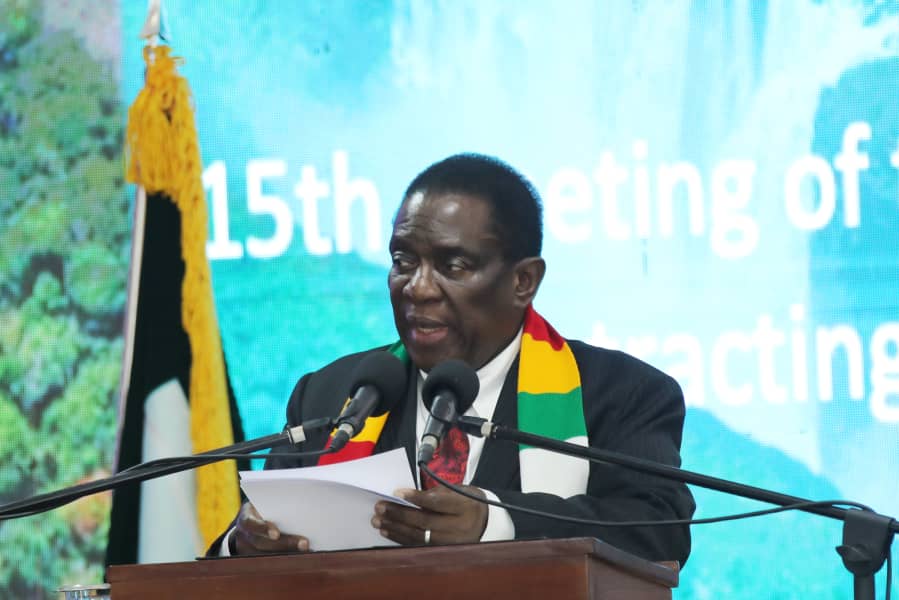
Rutendo Nyeve in Victoria Falls
PRESIDENT Mnangagwa has cemented the critical importance of wetlands in sustaining biodiversity, livelihoods, and climate resilience, calling for urgent collaborative action to protect these vital ecosystems from increasing threats.
President Mnangagwa said this during his keynote address at the official opening of COP 15 in Victoria Falls.
He emphasised the indispensable role wetlands play in supporting life and sustainable development.
“Wetlands, which include swamps, marshes, fens, bogs, estuaries, mangroves, and peatlands, are crucial habitats for about 40 percent of species. They provide a use for more than a billion people. To neglect wetlands would be, or probably, a critical portion of our existence.
“It is in this spirit, therefore, that we think of this contribution across protecting wetlands for our common future, and of course, it is actually timely in its emphasis on the role of wetlands,” he said.
The President said the essential services wetlands provide, such as water purification, flood control, and carbon storage, align with the United Nations Sustainable Development Goals (SDGs).
These benefits, he said, directly address poverty (Goal 1), hunger (Goal 2), clean water (Goal 6), sustainable communities (Goal 11), climate action (Goal 13), and global partnerships (Goal 17).
Despite their significance, wetlands remain among the most threatened ecosystems due to urbanisation, agricultural expansion, and climate change.
President Mnangagwa warned that habitat loss and altered water cycles pose severe risks to both wildlife and human populations.
“In spite of this, wetlands are among the most threatened habitats for nature. They face challenges such as habitat loss and degradation due to urbanization, development, agricultural expansion, and climate change,” he said.
To counter these threats, the President called for a shift in mindset, urging multi-faceted approaches to conservation.
“Now is the time for us to change our mindsets and start implementing collaborative approaches towards protecting our wetlands,” he said.
Key strategies include adopting innovative restoration techniques, strengthening policy frameworks, and enhancing research and monitoring. Sustainable land-use practices, community engagement, and education were also highlighted as crucial steps in fostering stewardship.
Zimbabwe has already taken significant steps by ratifying the Ramsar Convention on Wetlands in 2013, demonstrating its commitment to conservation.
However, President Mnangagwa stressed that more must be done to safeguard these ecosystems for future generations.
“Protecting and restoring these vital habitats is key to achieving sustainable development and ensuring the health and stability of our entire environment,” he said.
.