admin
admin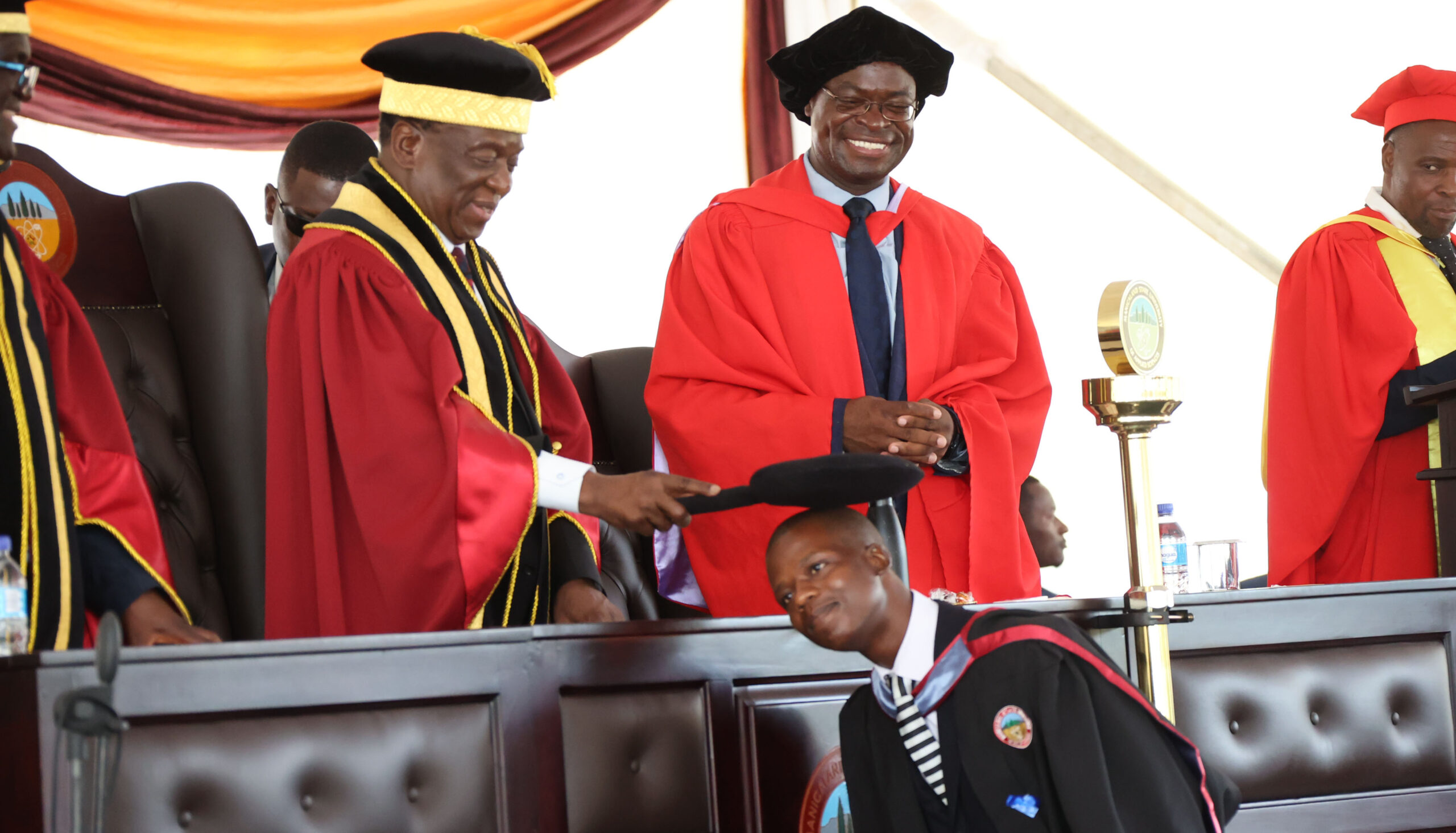
Samuel Kadungure
Senior Reporter
PRESIDENT Mnangagwa capped 172 graduates at Manicaland State University of Applied Sciences’ second graduation ceremony held at its Fernhill Campus in Mutare yesterday (Thursday).
President Mnangagwa was accompanied to the ceremony by Higher and Tertiary Education, Innovation, Science and Technology Development Minister, Professor Amon Murwira, and other ministers.
This year’s graduation statistics depict a 51 percent rise from last year’s 114.
Of the 172 graduates, 48 percent were females.
Thirty-one students graduated with awards, including six with First Class Degrees.
Three of the six were female.
The best male student was Motion Hazvinandawa (Bsc in Applied Statistics Honours Degree) with 33 distinctions, while Joynah Jimias was the best female graduating student (BSc Information Systems Honours Degree) with 25 distinctions.
The two won various awards, including the Dr Emmerson Dambudzo Mnangagwa Chancellor’s Award of US$1000 each.
Other students who graduated with distinctions were Elias Dhliwayo (BCom in Business Management Honours Degree), Prosper Teramai Tsangamidzi (BCom in Accounting Honours Degree), Ishel Basera (BEng in Mining and Mineral Processing Honours Degree) and Jessica Nokwanda Ncube (BSc in Psychology Honours Degree). The four received the Dr Emmerson Dambudzo Mnangagwa Chancellor’s Award of U$500 each.
MSUAS Vice-Chancellor, Professor Albert Chawanda, said 70 percent of their 1225 student enrolment was in Science, Technology, Engineering and Mathematics (STEM) disciplines.
“The university’s vision of being a research-intensive and stakeholder-driven university recognised internationally for its quality and relevance in technological innovation, entrepreneurial endeavours, modernisation and industrialisation is anchored on robust human capital strength.
“Of the 110 members of the teaching staff, 19 are PhD holders, while the rest are at various stages of their PhD studies. Efforts to attract professors and other high calibre staff to beef up the staff complement are underway.
“The university has also embarked on an aggressive Staff Development Fellowship as a strategy to guarantee a steady flow of requisite human capital to man the critical areas such as mining, metallurgy and chemical and processing engineering, among others,” he said.
Professor Chawanda said Zimbabwe Council for Higher Education (ZIMCHE) has accredited various degree programmes that are aligned to the Heritage-based Education 5.0 and the National Development Strategy (NDS1).
“In addition, the following programmes await ZIMCHE accreditation – BSc in Crop Sciences, BSc Horticulture, BSc Agricultural Engineering, BSc Agribusiness Management, Master of Science in Agroecology and Master of Science in Tourism and Hospitality Management and Leisure Sciences.
“These programmes intend to produce cadres capable of fully utilising hospitality and tourism as well as the agricultural wealth endowment and potential in the province and nation at large,” he said.
Professor Chawanda said their staff and students are working on potentially ground-breaking innovations leveraging artificial intelligence and machine learning.
“Some of these projects include (the) Driver Sleep Detection System whose overall aim is to address perennial road carnages; Autonomous Vehicle Assistance Road Detection Signage, to also address road carnage challenges; Curios and Crafts Mobile Application to aid marketing of tourism products; and Smart Home Security System.
“I am happy, Your Excellency and Chancellor, to report that the university has secured a number of grants for various research projects – including the development of percolation leaching process for optimum Gold Recovery Technology with an efficiency rate of 80 percent for artisanal and small-scale gold mining; and the Sawmill Waste Biomass Energy Valorisation Project with U$56 000 support from the Research Council of Zimbabwe,” he said.
Professor Chawanda said the university secured strategic partnerships with the University of the Russian Federation; Heilbronn University of Applied Sciences of Germany; Japan International Cooperation Agency (JICA) on cooperation, knowledge sharing on technology-driven agriculture and innovation, research collaborations, staff and student exchange.
He also gave an update on infrastructural development at multi-campus across the province.
“In line with NDS1 and the need to enhance food security, the university, through your support, is in the process of equipping the Headlands Innovation and Agro-Industrial Park. This is being carried out in phases. Phases One and Two included capacitation through equipmentation to ensure large scale agricultural production, which has resulted in 210hectares being under irrigation.
“Phase Three will involve establishing an agro-processing and value addition plant as well as establishing the Makoni Community Out-growers Scheme to uplift livelihoods in the immediate surrounding community,” he said, adding that construction of two 100-bed residence halls and staff houses has started at the Fernhill campus.


 Online Reporter