admin
admin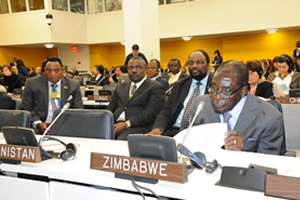
which opened at the UN Headquarters here yesterday. He attended the opening ceremony alongside other world leaders most of whom upheld the lobby for reforming the UN Security.
Zimbabwe is expected to advocate the democratisation of the 15-member organ and the expansion of the General Assembly’s scope. It is also supporting Palestine’s quest for full UN membership.
Earlier this week, Foreign Affairs Minister Simbarashe Mumbengegwi said the country was pushing for all regions of the world to be represented among the permanent members of the Security Council.
Africa, he said, was still eyeing two permanent seats.
“There is the reform of the United Nations, in general, and the Security Council, in particular. This is an on-going debate. We think pressure needs to be exerted to democratise the Security Council. At the moment, it only has 15 countries; so it should be expanded,” he said.
“The total membership of the UN is now 194 (including Palestine). We think a bigger council will, therefore, be more representative. Africa also believes the veto should be done away with. If it remains in place, then the permanent seats have to be reconsidered. The General Assembly is big and, therefore, should be accorded more powers and responsibilities. We believe the proposed reforms must enable it to override some of the decisions of the Security Council. We can’t have 15 countries or, one country, making decisions for 194 nations.”
Addressing the General Assembly yesterday, Brazilian President Dilma Rousseff – who became the first woman in UN history to open the general debate – said the proposed reforms were stalling.
She called for the inclusion of new permanent Security Council members and also expressed her country’s support for Palestinian membership.
“The proposed reform of the Security Council is now in its 18th year. It is no longer principled to postpone it. The world needs new permanent members, especially developing countries,” she said.
“Brazil is ready to co-operate with the youngest member of the UN. Like most countries, we believe the time has come for us to have Palestine represented as a full member.”
Equatorial Guinea President and African Union chair Teodoro Obiang Nguema Mbasogo also proposed the democratisation of all UN organs. He said Africa favoured peaceful conflict-resolution, adding that the continent had become susceptible to neo-colonialism.
“Africa is in favour of the peaceful resolution of conflict through dialogue and mediation. The use of force has never provided a solution to conflict,” he said.
“. . . Unfortunately, we can see that the UN is being used in a fraudulent manner. The use of force in conflict does not unify but brings division and destruction.”
Speaking before the general debate, UN secretary general Mr Ban Ki-moon said there was need to promote sustainable development.
He also implored leaders to explore ways of addressing climate change and global health concerns, among other critical matters.
“Saving our planet, lifting people out of poverty, advancing economic growth – these are one and the same fight.
“We must connect the dots between climate change, water scarcity, energy shortages, global health, food security and women’s empowerment. Solutions to one problem must be solutions for all.
“We must make progress on climate change. We cannot burn our way to the future. We cannot pretend the danger does not exist – or dismiss it because it affects someone else. Today, I call on you to reach a binding climate change agreement – an agreement with more ambitious national and global emission targets. And we need action on the ground, now – on cutting emissions and on adaptation.”
The UN General Assembly is expected to discuss several key issues including climate change, poverty eradication and proposals to reform the deliberative body. So far, Palestine’s bid to become the 194th member of the UN has remained highly contentious. Its leader, Mahmoud Abbas, is expected to make a formal request for statehood recognition. However, US President Mr Barack Obama and his French counterpart, Mr Nicolas Sarkozy, are reportedly planning to compel him to drop moves in this direction. The US has since said it will invoke its veto power if the matter were tabled before the Security Council. Progressive nations are, nonetheless, supporting Palestine.
Addressing the General Assembly yesterday, Mr Obama said: “Ultimately, it is Israelis and Palestinians who must live side by side. Ultimately, it is Israelis and Palestinians – not us – who must reach an agreement on the issues that divide them: on borders and security; on refugees and Jerusalem. I believed then – and I believe now – that the Palestinian people deserve a state of their own. But what I also said is that genuine peace can only be realised between Israelis and Palestinians themselves.”


 Online Reporter