Online Reporter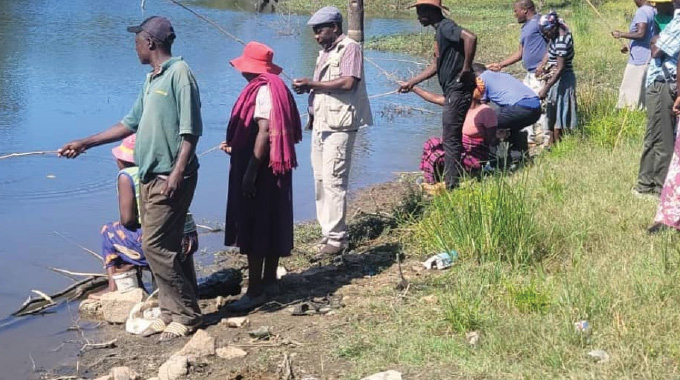
Patrick Chitumba , Midlands Bureau Chief
IN the heart of Zvishavane’s Masunda area, ripples of hope and excitement are spreading over the waters of Vengesa Dam.
Thanks to the Presidential Community Fisheries Programme, a fresh wave of opportunity has arrived — in the form of 10 000 fingerlings recently released into the dam.
The initiative is part of the broader Presidential Rural Development Programme under the Rural Development 8.0 thrust, which seeks to transform rural communities into vibrant economic hubs. For the people of Masunda, it’s more than just a fisheries project — it’s a lifeline.
The smiles on the faces of Masunda villagers tell a story of hope restored and futures reimagined. For them, the sound of water splashing as fingerlings enter the dam is more than just noise. It’s a symbol of a new beginning.
Launched in 2021 by President Mnangagwa, the Presidential Community Fisheries Programme was designed as part of a wider national strategy to accelerate rural industrialisation, ensure household food and nutrition security and empower communities through climate-resilient livelihoods. It is being implemented alongside other projects such as Pfumvudza/Intwasa, Presidential Goat Pass-On Scheme, Poultry Programme and the establishment of village and youth business units.
The programme takes advantage of the country’s vast inland water resources, with over 10 000 small to medium dams scattered across the country, many of which have been underutilised for decades. By restocking these water bodies with fingerlings, the Government seeks to unlock their economic potential while promoting sustainable resource use and environmental stewardship.
In Zvishavane’s Masunda area, Vengesa Dam has now become part of this national transformation story.
Chief Masunda hailed the initiative as a game-changer for the community, particularly for the youth.
“Fish farming integrated with other farming activities will greatly improve family income generation initiatives. I am confident that projects of this nature play a key role in mitigating the effects of drugs and substance abuse by our youths,” he said.
Chief Masunda lauded the Government for tapping into the potential of the community’s natural resources, particularly the strategically located Vengesa Dam, which is within the community’s reach.
“This project to us, as the people from Masunda area in Zvishavane demonstrates Government’s commitment to driving positive change and inclusive growth in rural areas. It exemplifies the Second Republic’s dedication to fostering positive transformation and inclusive growth through its Rural Industrialisation 8.0 initiative,” he said.
One of the beneficiaries, Mr Tanaka Shumba, expressed gratitude to the Government for what he described as a life-changing intervention.
“We want to thank President Mnangagwa for remembering our community. This fishery project proves that the President walks the talk. Life was tough before this, but now, we are seeing light and we are hopeful,” he said.
Another beneficiary, Mrs Agatha Semwayo echoed the same sentiment, adding that the programme also champions gender equality in local development.
“This programme is about building a future where everyone has a chance to succeed. We are committed to ensuring that gender equality is at the forefront of local economic development,” she said.
The Presidential Community Fisheries Programme is more than just a response to hunger. It is part of a holistic approach that includes support for poultry, cotton, goats and village business units, aimed at empowering every corner of rural Zimbabwe.
Key agencies like the Agricultural Marketing Authority are stepping in to ensure that once the fish are harvested, farmers can access reliable markets and fair pricing, which is a crucial step in making the projects sustainable.
With Zimbabwe targeting to increase fish production from 20 000 tonnes to 60 000 tonnes per year by 2030, the scheme is critical to meeting national development objectives under Vision 2030, which aims to transform Zimbabwe into a prosperous and empowered upper-middle-income society.
The Presidential Community Fisheries Scheme is aimed at enhancing food and nutrition security at community level.
The model enables rural communities to exploit the water resources within their vicinity to create a self-sufficient and food surplus economy. Over 2 million free tilapia (Nile breams) fingerlings have been distributed across the country since August last year under the Presidential Community Fisheries Scheme.
On that trajectory, the set target of 2,2 million fingerlings by May will likely be met sooner.
Fish stocking is done during warm conditions from August and halted during winter starting in the first week of May when temperatures drop, with tilapia-breams being considered the most ideal species for intensive production.
The initiative aims to boost fish production, enhance food security and improve livelihoods, especially in rural areas.
At least 1 220 dams were certified for stocking, while all irrigation business units, youth business units, school business units, village business units and registered individuals are benefiting from the programme.
With support from the United Nations’ Food and Agriculture Organisation (FAO), communities have been receiving training from agricultural experts in practicing sustainable fish production in ponds and dams.
Lands, Agriculture, Fisheries, Water and Rural Development Deputy Minister Davis Marapira said the distribution of the fingerlings was ongoing.
“Fingerlings distribution is going on well in all provinces. The President wants everyone to be food and nutrition secure and he sent us to the communities with these projects so that people of Zimbabwe do not depend on donor hand-outs, but rather become income generators. Our thrust is to ensure that we create rural communities that are industrialised,” he said.
Deputy Minister Marapira said the Presidential Community Fisheries Scheme is a key pillar in efforts to empower communities and ensure sustainable food production.