Online Reporter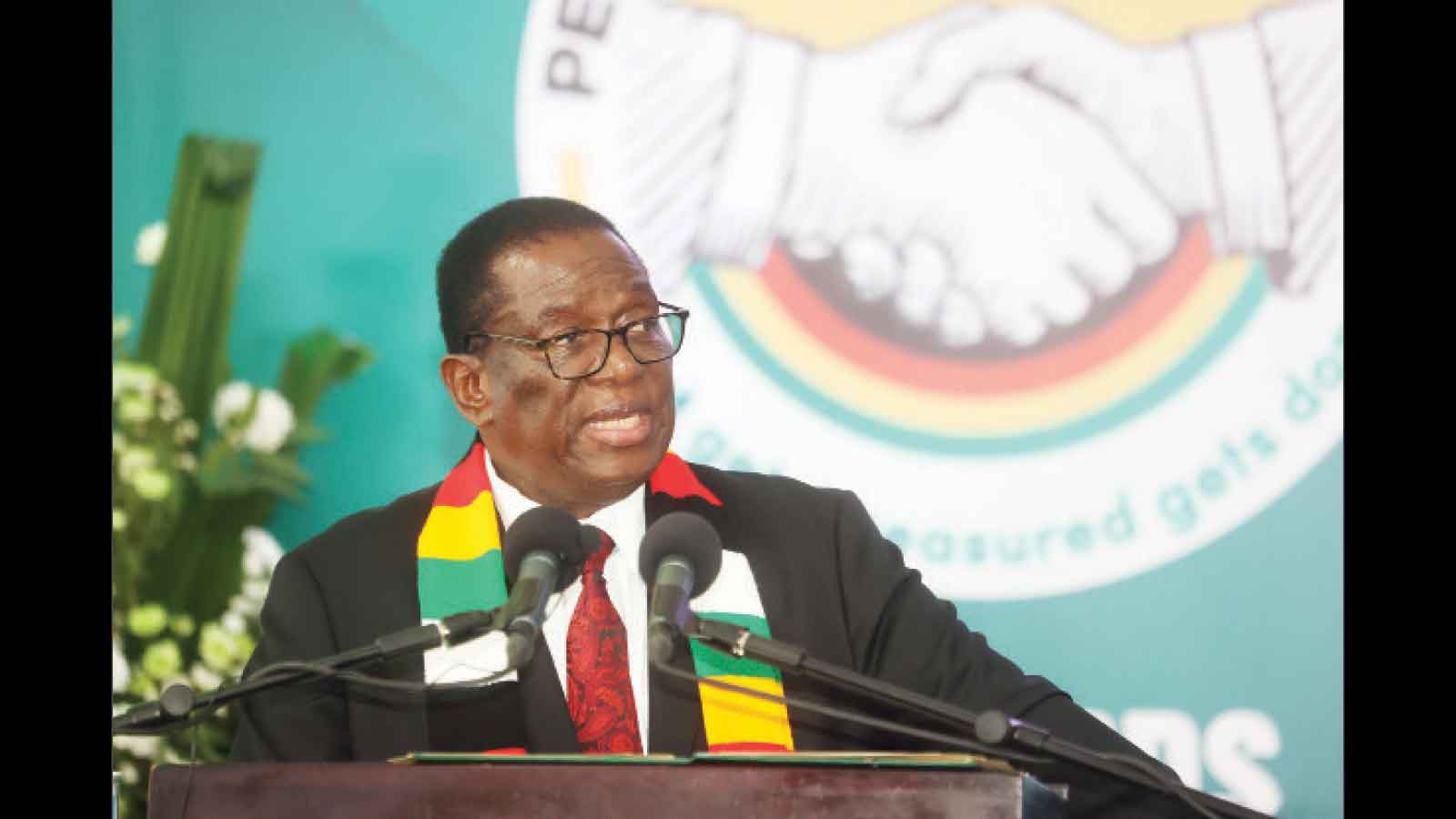
Kuda Bwititi in BEIJING
THERE is a compelling global resonance to President Mnangagwa’s rallying call of “Nyika inovakwa nevene vayo” — a nation is built by its own people. It is a phrase born in Zimbabwe, but its significance need not end there.
Deputy Minister of Local Government and Public Works Albert Tawanda Mavunga articulated this while delivering a presentation at a Global South seminar in Beijing last week.
As Zimbabwe prepares to assume its non-permanent seat on the United Nations Security Council for the 2027-2028 term, the President’s defining national vision can no longer be ignored on the world stage.
At a time when countries across the Global South are confronting economic dependency, geopolitical competition, debt pressures and a rapidly changing global economy, the principle deserves to be considered as more than a national slogan.
It has the potential to become a development philosophy for an entire hemisphere of nations.
The central message is not that the Global South should turn its back on the rest of the world, but that no country can permanently outsource responsibility for its own development.
Foreign investment can build a factory, international finance can fund a road, a development agency can support a programme and a multinational corporation can introduce technology, but none of these can indefinitely substitute for a nation’s capacity to organise, produce, innovate and solve problems for itself.
A nation must ultimately possess the capabilities that make its development sustainable. That is the aspect of President Mnangagwa’s mantra that should resonate far beyond Zimbabwe.
For generations, much of the Global South has occupied a familiar position in the international economy, supplying commodities while importing finished products.
Africa exports minerals and imports manufactured goods. Agricultural economies export raw produce while importing processed food. Countries rich in natural resources often remain dependent on technologies, machinery and expertise produced elsewhere.
The problem is not trade itself.
The problem arises when trade becomes a permanent division of labour in which some countries repeatedly supply raw materials while others capture most of the value created from them.
“Nyika inovakwa nevene vayo” challenges that arrangement at its foundation.
If a nation owns the resources, its people should increasingly possess the knowledge, industries and institutions necessary to transform those resources into greater domestic value.
When a country produces lithium, copper, platinum or other strategic minerals, the ambition cannot end with extracting them from the ground.
Similarly, if it grows coffee, cotton, cocoa or other agricultural commodities, the economic story should not necessarily end at the port.
The objective must be to move from extraction to production, from consumption to creation and from dependency to capability.
Self-reliance does not mean isolation.
No serious modern economy can produce everything it needs. Countries will continue to require foreign capital, international markets, technology, expertise and partnerships.
The question is what those relationships produce over the long term.
A genuinely strategic partnership should not merely help a country survive another year; it should help it become more capable of determining its own economic future.
That is the difference between assistance and capacity-building.
The most valuable resource is the citizen
There is a dimension to the President’s mantra that can easily be overlooked.
The phrase does not say that a nation is built by its Government. It says it is built by its people.
That places responsibility not only on political leaders, but also on citizens, businesses, scientists, farmers, workers and entrepreneurs.
A Government can construct infrastructure, but people must use it productively.
A university can educate graduates, but an economy must create opportunities for their knowledge to be applied.
A country can possess enormous mineral wealth, but its people need the skills to participate in the industries that emerge around those resources.
The most consequential investment a developing country can therefore make is in the productive capabilities of its people.
This is particularly urgent given the Global South’s youthful population.
The millions of young Africans, Asians, Latin Americans and Caribbean citizens entering the workforce each year should not be viewed primarily as a demographic challenge.
They represent a potential industrial, technological and entrepreneurial force.
However, that potential will remain unrealised if economies are structured mainly around exporting commodities, importing finished products and creating too few opportunities for skilled work.
The answer is not simply to tell young people to start businesses. It is to build economies in which businesses can actually grow.
That means investing in electricity, broadband connectivity, transport, finance, education, research, markets and predictable institutions.
People build nations, but nations must also create the conditions that enable their people to do so.
For the Global South, this philosophy could also reshape the way international partnerships are approached.
Instead of asking only, “How much money is coming in?”, governments could ask, “What capabilities are being built?”
Instead of measuring an investment solely by its headline value, countries could examine its impact on domestic suppliers, skills development, technology transfer, manufacturing capacity and long-term productive growth.
This does not mean shutting out multinational companies, but engaging them strategically.
The strongest developing economies will not necessarily be those that reject globalisation.
Rather, they may be those that learn how to extract greater domestic value from it.
That requires confidence, which is precisely what the mantra offers.
From national philosophy to Global South doctrine
There is an important historical lesson here.
Many of today’s industrialised economies, particularly China, did not become prosperous simply by waiting for external actors to develop them.
Their governments, businesses, universities and citizens invested over decades in infrastructure, education, technology, manufacturing and institutions.
The precise paths differed enormously. There is no single development model that every country can replicate.
Yet the underlying principle remains relevant: countries need domestic capabilities if they are to achieve durable economic sovereignty.
That is why the idea that “a nation is built by its own people” can speak to countries far beyond Zimbabwe.
It can become a conversation about African industrialisation, Asian technological independence, Latin American value chains, Caribbean resilience and the ability of developing countries to engage with the rest of the world from a position of increasing productive strength.
Perhaps most importantly, it can change the psychology of development.
For too long, the language of development has sometimes portrayed the Global South as a collection of problems awaiting solutions from elsewhere.
The alternative is to recognise the Global South as a source of solutions in its own right.
The world should not be asked to stop helping.
Rather, the Global South should become increasingly capable of helping itself and increasingly capable of contributing solutions to the world.
The question is not whether the international community will assist the Global South. It will.
There will always be loans, grants, investments, partnerships, conferences, development programmes and foreign expertise.
The deeper question is: What will the Global South be able to do for itself after the partnership ends?
That is the true test of meaningful development.
Development should therefore be measured not only by what enters a country, but by what that country becomes capable of doing.
That is the deeper challenge contained in the phrase: Nyika inovakwa nevene vayo — a nation is built by its own people.
For the Global South, the message is not to reject the world, but to engage with it while bringing something of its own to the table.
The world can provide partners, capital, technology and markets, but ultimately the responsibility for building a nation cannot be outsourced.
That is the real power of President Mnangagwa’s mantra. And perhaps its most important message is not for Zimbabwe alone.
It is for every country in the Global South that seeks to move from being a participant in someone else’s economic system to becoming an architect of its own.
A nation is built by its own people.
The next chapter of the Global South may well be about proving what those people can build.