Chronicle Editor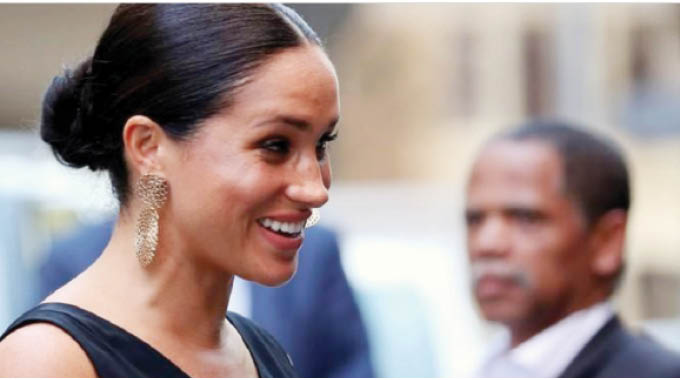
CAPE TOWN — Meghan, the wife of Britain’s Prince Harry, has tied a ribbon at the site in Cape Town where a student was murdered last month, in a gesture of solidarity with those who have taken a stand against gender-based violence.
Uyinene Mrwetyana was raped and murdered in a Cape Town post office, one of a spate of killings and rapes that has been the catalyst for protests against gender-based violence in South Africa, a country with one of the world’s highest murder rates.
About 3 000 women in South Africa were murdered in 2018 — or one every three hours — which is more than five times higher than the global average, the World Health Organisation says.
South African women have been wearing black and marching on parliament, the stock exchange and through the streets, with thousands using the hashtag #AmINext to call for reform.
A picture of Meghan tying the yellow ribbon at the site where Mrwetyana was killed was posted on Instagram on Saturday, along with a short text that said she and Harry had “been following what had happened from afar and were both eager to learn more” during their trip to South Africa.
“The Duchess (of Sussex) has taken private visits and meetings over the last two days to deepen her understanding of the current situation and continue to advocate for the rights of women and girls,” it said.
Meghan also spoke with the murdered girl’s mother, it said.
President Cyril Ramaphosa this month outlined a five-point emergency plan to tackle gender-based violence, including enhancing the legal and policy framework and ensuring adequate care and support for victims.
Harry, Meghan and their four-month-old son Archie landed in South Africa on Monday last week for their first overseas tour as a family, which has featured engagements including visits to poor townships and a meeting with Nobel Peace Prize laureate Desmond Tutu.
Harry then travelled alone to Botswana and Angola, where he visited a landmine clearance project that featured in some of the most famous photographs of his late mother, Princess Diana.
On Saturday Harry met Angolan President Joao Lourenco at the presidential palace in Luanda. He was also due to visit a hospital to see the work of a project spearheaded by the first lady, Ana Dias Lourenco.
The project focuses on preventing the transmission of HIV/Aids from mothers to their babies in a country where high fertility, a young population and lack of awareness are driving infection rates up.
Yesterday Prince Harry arrived in Malawi, the final stop of the solo leg of his southern Africa tour before rejoining his family in South Africa, where wife Meghan held a meeting on Saturday with female activists.
The Duke of Sussex left the duchess and his four-month-old son Archie — who stole the spotlight when he sat on his mother’s lap while his parents chatted with Nobel Peace Prize laureate Desmond Tutu in Cape Town — to visit Botswana, Angola and Malawi.
While Harry has visited Malawi several times privately, this trip will mark his first visit in an official capacity.
On arrival in the capital Lilongwe on Sunday, he was expected to visit a college and interact with young women whose education is supported by funds from Britain.
After that, he met President Peter Mutharika, who he knows after meeting on a number of occasions beforehand, and later attend a reception hosted by the British High Commissioner.
Yesterday, it was announced that a day earlier Meghan had met with a group of female leaders and activists including Sophia Williams-De Bruyn, who in 1956 at age 18 led 20 000 women in an anti-apartheid march on the Union Buildings, the seat of government, in Pretoria. She is the last living leader of the march.
“I was recently reminded that the first one up the mountain often gets knocked down the hardest, but makes way for everyone behind them,” the statement quoted Meghan as saying to the women, adding that all young female campaigners must keep at it.
Gender-based violence, she said, was a global problem and the solution had to come from everybody, regardless of factors like race, gender or politics. — AFP


 Online Reporter