admin
admin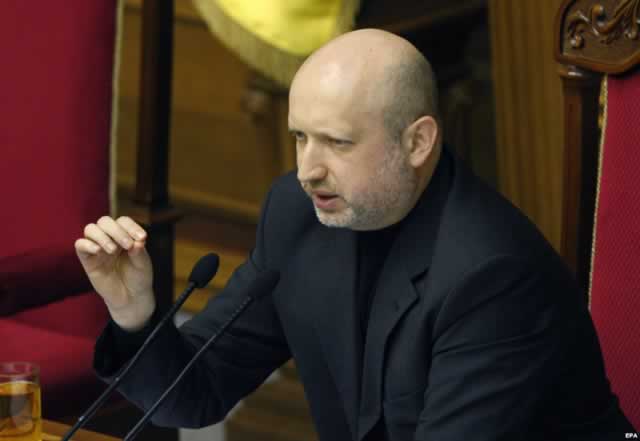

PRO-MOSCOW protesters in eastern Ukraine seized arms in one city and declared a separatist republic in another, in moves Kiev described yesterday as part of a Russian-orchestrated plan to justify an invasion to dismember the country. Kiev said the overnight seizure of public buildings in three cities in eastern Ukraine’s mainly Russian-speaking industrial heartland were a replay of events in Crimea, the Black Sea peninsula Moscow seized and annexed last month.
“An anti-Ukrainian plan is being put into operation . . . under which foreign troops will cross the border and seize the territory of the country,” Prime Minister Arseny Yatseniuk said in public remarks to his cabinet.
“We will not allow this.”
Pro-Russian protesters seized official buildings in the eastern cities of Kharkiv, Luhansk and Donetsk on Sunday night, demanding that referendums be held on whether to join Russia like the one that preceded Moscow’s takeover of Crimea.
Acting President Oleksander Turchinov, in a televised address to the nation, said Moscow was attempting to repeat “the Crimea scenario”. He added that “anti-terrorist measures” would be deployed against those who had taken up arms.
Police said they cleared the protesters from the building in Kharkiv, but in Luhansk the demonstrators had seized weapons.
In Donetsk, home base of deposed Moscow-backed President Viktor Yanukovich, about 120 pro-Russia activists calling themselves the “Republican People’s Soviet of Donetsk” seized the chamber of the regional assembly.
An unidentified bearded man read out “the act of the proclamation of an independent state, Donetsk People’s Republic” in front of a white, blue and red Russian flag.
“In the event of aggressive action from the illegitimate Kiev authorities, we will appeal to the Russian Federation to bring in a peacekeeping contingent,” ran the proclamation.
The activists later read out the text by loud hailer to a cheering crowd of about 1,000 people outside the building.
Russian President Vladimir Putin announced on March 1, a week after Yanukovich was overthrown, that Moscow had the right to take military action in Ukraine to protect Russian speakers, creating the biggest confrontation between Moscow and the West since the Cold War.
The United States and EU imposed mild financial sanctions on a number of Russian officials over the seizure of Crimea but have threatened much tougher measures if Russian troops, now massed on the frontier, enter other parts of Ukraine.
Western European governments have hesitated to alienate Russia further, fearing for supplies of Russian natural gas, much of which reaches EU buyers via pipelines across Ukraine.
In Vienna, Russia did not attend a meeting on Ukraine of the Organisation for Security and Cooperation in Europe. The U.S. envoy to the OSCE, Daniel Baer, said tens of thousands of Russian troops were massed on the Ukrainian border, and any call by pro-Moscow activists for them to intervene was “tightly coordinated with the Russian government”.
Ukrainian Interior Minister Arsen Avakov said on Monday the main regional administration building in Kharkiv had been cleared of “separatists”. But police in Luhansk said protesters occupying the state security building there had seized weapons.
Highway police had closed off roads into the city.
“Unidentified people who are in the building have broken into the building’s arsenal and have seized weapons,” police said in a statement. Nine people had been hurt in the disturbances in Luhansk.
Mainly Russian-speaking eastern Ukraine, densely populated and producing much of the country’s industrial output, has seen a sharp rise in tension since Yanukovich fled the country, and Kiev has long said it believes Moscow is behind the unrest.
Pro-Russian protesters briefly held public buildings in the east early last month and three people were killed in clashes in mid-March. But trouble had subsided until Sunday.
Unlike in Crimea, where ethnic Russians form a majority, most people in the east and south are ethnically Ukrainian but speak Russian as a first language. Influential business owners in eastern regions who once supported Yanukovich have mostly thrown their weight behind the government in Kiev, and the unrest there is a test of their ability to assert their control. — Reuters.


 Online Reporter