
Patrick Chitumba [email protected]
ZIMBABWE and the whole of Africa must not be passive consumers of Artificial Intelligence (AI), but creators and leaders of innovation to reap the full benefits of the technology-driven revolution, Professor Arthur Mutambara has said.
Speaking at a high-level public lecture hosted by Midlands State University in Gweru on Tuesday, Prof Mutambara told academics, students, policymakers and industry leaders that Africa’s future in AI depends on developing local capacity to build systems that shape global discourse.
The robotics expert challenged young Africans to create, not just consume, Artificial Intelligence. Running under the theme: “Embracing the Artificial Intelligence Revolution in Africa: Understanding Both the Promise and the Peril”, the thought-provoking public lecture brought together academics, students, policymakers, industry leaders and technology enthusiasts for critical conversations on the opportunities and challenges shaping the future of Artificial Intelligence in Africa.
“AI has benefits in every sector. AI is bringing about a revolution in agriculture, transforming healthcare, enhancing financial services, improving education and strengthening the public sector,” said Prof Mutambara.
“There is no sector where there are no benefits, and that is the promise of AI,” he added.
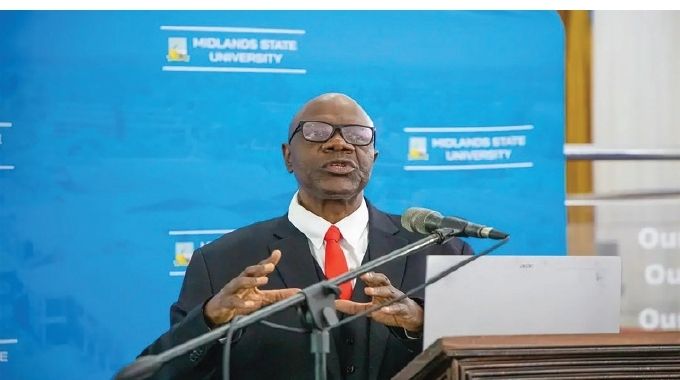
Prof Mutambara cautioned that these gains would be lost if Africa remained a market for foreign technology rather than a producer.
“We must create AI in Africa. We cannot just be consumers of AI. We must have agency in the AI revolution, build AI systems and contribute to AI thought leadership, “ he explained.
Prof Mutambara, a globally recognised Zimbabwean scholar in engineering, AI and innovation policy, argued that African universities and Governments must prioritise skills, data ecosystems and ethical frameworks to ensure the technology serves African realities.
He commended the Midlands State University for its approach, noting that the institution had made AI and entrepreneurship compulsory for all students under its Education 5.0 philosophy.
“MSU is forcing every student to do entrepreneurship, digital computing and AI. I salute you for that because you are already answering the question of new jobs, “ he said.
MSU Vice Chancellor Prof Victor Ngonidzashe Muzvidziwa said the university had reconfigured its programmes to meet the demands of the fourth industrial revolution and the digital economy.
“It is now more urgent than ever for higher education institutions to engage meaningfully with developments in Artificial Intelligence,” Prof Muzvidziwa said.
He said MSU will continue to position itself as a leading institution in advancing Artificial Intelligence, digital innovation and technology-driven education in support of national development and the transformation towards a digitalised economy.
“MSU would continue to position itself as a leader in AI and digital innovation to support Zimbabwe’s transition towards a digitalised economy. It is now more urgent than ever for higher education institutions to engage meaningfully with developments in Artificial Intelligence,” said Prof Muzvidziwa.
Since adopting the Education 5.0 philosophy, Midlands State University has deliberately reconfigured its academic programmes to respond to the demands of the fourth industrial revolution, digital transformation, knowledge economies and innovation-driven development.
At present, Midlands State University is offering Artificial Intelligence as a compulsory module for all students aimed at equipping learners with strong theoretical and practical competencies in AI, while cultivating critical awareness of the ethical risks and challenges associated with emerging technologies.
The lecture also included an interactive question-and-answer session. Tawanda Antonio, a Form 6 student from Fletcher High School, thanked MSU for including secondary learners, saying the insights would help him design an offline AI model for his project.
Delivering the vote of thanks, MSU SRC president Kim Sharon Mutangabende said the lecture had stimulated meaningful debate on AI, ethics, innovation and Africa’s technological future.