admin
admin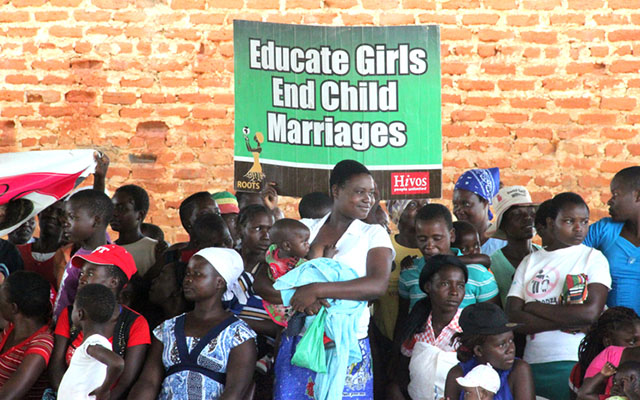
Sifelani Tsiko in Guruve
The “Catch Them Young” programme being implemented under the Spotlight Initiative by various partners in Hurungwe, Guruve, Mbire and Muzarabani districts is helping to train and support young children to pursue education and desist from early childhood marriages.
Child marriages have reached worrying levels in various parts of the country and the raging Covid-19 has compounded the crisis.
“Here in Guruve the problem of young girls who leave school to get married is worrying us a lot. At our school, here at Muzika Primary School we are running the ‘Catch Them Young’ programme to educate children on the importance of education and how they avoid child abuse and getting married,” said Portia Moffat, a gender champion and activist in Guruve.
“We give them lessons at school through drama, poetry and music. I’m glad that cases of school drop outs are going down as young children become aware of the dangers of early child marriages.
“Parents here are embracing the messages and helping to report cases in villages dotted around the school.”
To address problems related to early child marriages and child sexual abuses in Hurungwe, Guruve, Mbire and Muzarabani a consortia comprising Caritas, the Lower Guruve Development Association (LGDA) and other community-based organisations (CBOs) are spearheading programmes to raise awareness on the impact of GBV on women and girls.
The programmes running under the Spotlight Initiative supported through a partnership between the European Union and the United Nations are aimed at ending violence against women and girls and harmful practices.
Zimbabwe is among the 20 countries in Africa, Latin America, Asia- Pacific and the Caribbean which are participating in the four-year programme which started in 2019 and ends in June 2021 for the first phase.
The country was supported by the EU to the tune US$30 million for the first phase to help Zimbabwe meet some of its Sustainable Development Goals (SDG 3 and 5) on empowering women and girls to realise their full potential in a violent free, gender-responsive and inclusive environment.
At Kondo Secondary School in Guruve, 52 girls were impregnated in 2019 alone and the Covid-19 environment has complicated the plight of young girls.
“The young girls do not receive adequate support and many young girls are dying during childbirth. Through this Spotlight Initiative we are working closely with villagers to fight against child marriages,” said Tavirai Marega, a programmes officer for the Lower Guruve Development Association.
“We are hopeful if education can reach all communities, we will see a positive change in our communities. We still need to scale up the programme to end this culture of marrying young girls,” he said.
“As it is, children are getting pregnant while still very young and the men usually do not take them to a clinic when they give birth for fear of being arrested. As a result young girls die while giving birth.”
LGDA trained a number of villagers to become gender champions in Guruve, Mbire and Muzarabani.
The champions have assisted greatly in raising awareness and supporting local communities to report child abuse cases and to follow-up cases with the police.
However, due to Covid-19, there was a backlog at the courts leaving perpetrators on bail and still posing threats to young girls.
Local communities in the four districts, north of Zimbabwe have sensitised about the dangers of selling off young girls into early marriage or abusing young girls.
Zimbabwe is not the only country grappling with child marriages.
It is a global problem facing various nations across the world.
According to the UN’s children’s agency, UNICEF, every year 12 million girls are married before they turn 18 years old.
There are 650 million girls and women alive today who were married before they were 18 years, the organisation says.
UN Women country office says the Spotlight Initiative will help Zimbabwe to meet its Sustainable Development Goals (SDG 5.3) which aims to end child marriage by 2030.
Poverty, culture, tradition and other factors are the major drivers of child marriages.
Young girls are married off or drawn into prostitution to earn a living for themselves and their siblings.
All this deprives young girls of education, exposes them to domestic violence, cruel and inhuman treatment.
Young girls become vulnerable to risks of contracting HIV and other diseases or health complications.
This has impact on girls’ access to health, education, and opportunities in life.
Zimbabwe has child marriage laws that provide girls with legal protection but despite the existence of the laws child marriages are still a problem.
The problem still persist as young girls are given into marriage with the consent of their parents and guardians.
In January 2016, the Constitutional Court of Zimbabwe ruled that “no person, girl or boy should be married before the age of 18.”
“With more campaigns against child marriages it is possible that communities will embrace change and speak out against child marriages,” said Marega.
“Change is coming. Protection of these girls is everyone’s responsibility. Economic hardships and poverty must not be an excuse anymore for marrying off young girls.”



 Online Reporter