admin
admin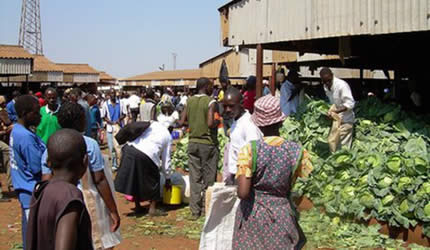
Mutare.
At Mbare, 97 percent of the agriculture commodities are produced locally.
While tobacco marketing receives extravagant attention from the mainstream media and policymakers, urban informal agricultural markets are quietly supporting food security and sustainable revenue streams for many smallholders and traders.
In February 2013 alone, 4 765 farmers sold diverse agricultural commodities at Mbare farmers’ market with women constituting 38 percent of these actors.
From February-March 2013, the volume of commodities also increased by 25 percent with more field crops (groundnuts, roundnuts, green maize) coming onto the market.
Besides volume on the market, perishability had a significant influence on highly perishable products such as leaf vegetables and tomatoes. Tomato prices fluctuated between US$3 and US$7 per box. On the other hand, potatoes ranged between US$10 and US$12 depending on variety and quality.
Field crops that have come onto the market include water melons, roundnuts (nyimo) and groundnuts (nzungu). Some roundnuts come from as far as Zambia while South Africa is a source of some types of onions and apples.
Evidence shows that customers prefer South African apples on the basis of quality and taste, among other factors. Mangoes went out of season in mid-March 2013 and by that time the price had increased to US$6 per bucket as compared to US$2 per bucket during the glut period in January 2013. Oranges are now coming onto the market at US$5 per pocket.
Some emerging issues
The wholesale market is the backbone of agricultural value chains at Mbare.
Comprising at least 1 500 traders, the wholesale market caters for at least 5 000 farmers per month.
Another critical issue is that, due to low cash in circulation, buyers often determine the value of commodities since farmers compete to get the little available cash. This creates a situation where farmers seem to buy cash with agriculture commodities when it is supposed to be the other way round. Low cash in circulation, therefore, suppresses prices to the disadvantage of farmers and traders.
l Charles Dhewa is the Chief Executive Officer of Knowledge Transfer Africa (Pvt) Ltd (www.knowledgetransafrica.com), which has a knowledge sharing facility called eMkambo (www.emkambo.co.zw).



 Online Reporter