

 Online Reporter
Nyore Madzianike-Senior Reporter
THE country’s provinces registered notable economic growth and visible infrastructure transformation during the implementation of National Development Strategy 1 between 2021 and 2025, with mining and agriculture emerging as the dominant drivers of Gross Domestic Product growth in most regions.
The progress, underpinned by devolution funding, a Whole-of-Government approach and the Second Republic’s firm commitment to infrastructure-led development, translated into improved service delivery, increased productive capacity and rising incomes countrywide.
In separate interviews, Ministers of State for Provincial Affairs and Devolution said targeted investments in roads, irrigation, energy, mining and social infrastructure were central to unlocking economic activity in the provinces.
This, they said, is in line with President Mnangagwa’s Vision 2030 of attaining an upper-middle-income economy.
Harare and Bulawayo stand as exceptional cases as the two metropolises’ economies are largely driven by manufacturing and service sectors. The capital’s GDP was ZWG187,08 billion, while the second largest city’s GDP accounted for ZWG107,34 billion.
According to ZIMSTAT manufacturing industry accounted for 22,2 percent share of Harare’s provincial GDP, while wholesale, retail trade and repair of motorcycles accounted for 16,3 percent for 2024. Financial and insurance activities contributed 16 percent while public administration accounted for 4,8 percent of the 2024 provincial GDP.
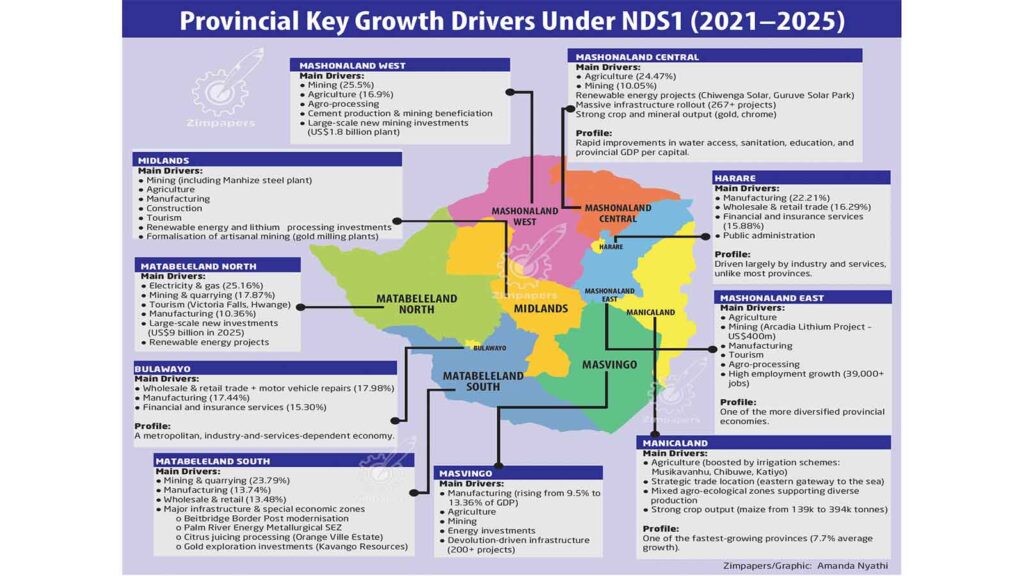
According to ZIMSTATS, the key drivers of Bulawayo’s DGP growth were the wholesale and retail trade, repair of motor vehicles and the motorcycle industry, which contributed 18 percent in 2024.
Manufacturing activities accounted for 17,4 percent of the province’s 2024 GDP at constant prices, while the financial and insurance activities industry accounted for 15,3 percent.
In Mashonaland West, infrastructure development catalysed industrial revival and private sector investment, with the province recording sustained growth anchored on mining and agriculture.
The province also made strides in agro-processing, cement production and mining beneficiation, including the commissioning of a US$1,8 billion mining plant by President Mnangagwa.
Mashonaland West Minister of State for Provincial Affairs and Devolution Miriam Chombo said mining contributed 25,5 percent to provincial GDP, while agriculture accounted for 16,9 percent. She said the province recorded overall GDP growth of about 5,2 percent, underpinned by strong maize, wheat, tobacco and mining production.
Manicaland emerged as one of the fastest-growing provinces, leveraging its agricultural endowments and strategic location as Zimbabwe’s eastern gateway to the sea.
Minister of State for Manicaland Provincial Affairs and Devolution Misheck Mugadza attributed the province’s performance to sound national policies under the Second Republic and focused implementation of NDS programmes.
He said Manicaland was ranked fifth nationally, having achieved an average growth rate of 7,7 percent.
The province leveraged its unique comparative advantages, including all five agro-ecological regions and its proximity to regional markets.
“You will notice that in 2021, the GDP contribution to Manicaland was US$1,46 million. In 2024, we were now at US$3,4 million, which was a 10 percent contribution to the GDP. In 2024, we were given an average growth rate of 7,7 percent and we got ranked, at that stage, fifth in the country. This is, to us, quite impressive, but this is all coming because Manicaland is a very lucky province.
“We are the Eastern gateway to the sea. We are that province with all five agro-ecological regions, from Region 1 to Region 5. We have what others do not have,” he said.
Agriculture was boosted by high-impact irrigation projects implemented under NDS1 across several districts, driving increases in crop output and household incomes.
Minister Mugadza said agricultural output surged, with maize production rising from 139 000 tonnes in 2021 to 394 000 tonnes in the last season. “We have had high-impact irrigation projects like in Musikavanhu, Chibuwe and Katiyo Valley.
“This is changing the lives of hundreds of families and collectively they have transformed livelihoods for more than 1 800 households, including youths and women,” he said.
In Midlands Province, mining and agriculture also anchored growth, complemented by manufacturing, construction and tourism.
The province recorded GDP growth of 4,7 percent, positioning it among the fastest-growing provincial economies.
Provincial Affairs and Devolution Minister Cde Owen Ncube said inclusive and decentralised development under the New Dispensation was driving economic recovery.
“The Midlands Province is a proud beneficiary of inclusive landmark and impactful programmes implemented by the New Dispensation, which align with the mantra of leaving no one and no place behind,” he said.
Ease of doing business reforms attracted major private sector investments, including the Dinson Iron and Steel Plant in Manhize, lithium processing facilities and solar energy projects.
Artisanal and small-scale miners were formalised through gold milling plants, promoting responsible mining and local economic growth.
“The province has the second fastest growing GDP at 4,7 percent anchored on huge private sector-led investments in mining, agriculture, manufacturing, construction, tourism, creating jobs, incomes and improving livelihoods underpinned by the Provincial Economic Development Plan that guides our economic growth and recovery.
“The plan is inspired by vast mineral resources, enabling infrastructure and other comparative advantages that include a human capital base and the province’s strategic location.
“The province targets to grow the economy at an average of 7 percent per annum for the period 2021 – 2030,” he said.
Mashonaland Central registered strong gains across infrastructure, social services and productive sectors, implementing over 267 infrastructure and utilities projects during the NDS1 period.
These covered roads, water and sanitation, energy, education, health and irrigation.
The province’s access to potable water improved from 56 percent in 2021 to 84 percent in 2025, while sanitation coverage rose from 35 percent to 64 percent. Education outcomes also improved, with Grade Seven pass rates increasing from 24,6 percent to 34,95 percent.
Mashonaland Central invested heavily in renewable energy, including the Chiwenga Solar Project and Guruve Solar Park, which now supply power to the national grid.
The province contributes six percent to national GDP, with agriculture accounting for 24,47 percent of provincial output and mining at 10,05 percent.
Provincial GDP per capita nearly doubled from US$773 in 2021 to about US$1 573 in 2025, while unemployment fell by 16,9 percent.
“In 2025, all major crops demonstrated strong recovery and productivity gains due to a bumper harvest.
“Maize output rose by 576 percent from the previous season, cotton by 400 percent, wheat by 7,5 percent and tobacco by four percent. Gold production almost doubled from about 2,5 tonnes in 2020 to over 4,5 tonnes in 2025, while chrome output rose markedly, strengthening Zimbabwe’s mineral export earnings. Large-scale gold production reached 4 190,30kgs by September 2025, marking a 16 percent increase from the previous year.
“Similarly, chrome output rose to 72 699 tonnes, a remarkable 136 percent increase, demonstrating the province’s robust mining potential and strategic importance to national mineral production and national GDP,” he said.
Mashonaland East recorded average GDP growth of more than five percent despite climate-induced shocks such as the 2024 El Niño drought.
Provincial GDP rose from about US$2,9 billion in 2021 to US$3,5 billion in 2025, contributing around seven percent to national GDP.
Growth was driven by agriculture, mining, manufacturing and tourism, supported by value-addition investments including the US$400 million Arcadia Lithium Project in Goromonzi and agro-processing industries.
More than 39 000 jobs were created during the NDS1 period in the province.
“Notable progress has been made in employment creation, with the latest NSSA statistics indicating that more than 39 323 jobs were generated in the province across all sectors during the NDS1 period.
“Employment levels remained high, averaging about 80 percent according to ZimStats figures.
“New employment is now being generated in industry and services sectors accounting for 18 percent and 75 percent of new jobs respectively, while the remainder is in agriculture (seven percent), which was in line with NDS theme of value addition, beneficiation and structural transformation,” said Mash East Provincial Minister Itayi Ndudzo.
Masvingo Province posted steady gains, with manufacturing’s contribution to provincial GDP rising from 9,5 percent in 2021 to 13,36 percent by 2024.
The province’s share of national GDP averaged above seven percent between 2021 and 2024.
Driven by devolution funding, Masvingo completed over 200 projects after receiving more than $2,8 billion since 2021.
“During the NDS1 period, which was crafted by the Second Republic, the focus was greatly on expanding the productive sectors through capital formation and the development of economic enablers, such as infrastructure and the digital economy.
“Driven by devolution funding, agriculture, mining, and energy investments, Masvingo has deliberately programmed towards expanding its productive capacity to ensure no one and no place is left behind.
“The advent of Devolution has been a catalyst for accelerated development within local communities.
“By empowering local authorities, the province has addressed long-standing gaps in service delivery and infrastructure,” said Masvingo Provincial Minister Ezra Chadzamira.
In Matabeleland South province, major contributors to provincial GDP were the mining and quarrying industry, which jointly accounted for 23,79 percent of the GDP.
The manufacturing industry recorded 13,74 percent while the wholesale and retail trade stood at 13,48 percent.
“The Province showed notable progress under the National Development Strategy 1 (NDS1) 2021–2025, transforming from a traditionally arid cattle-ranching region into a hub for infrastructure, mining, tourism and irrigation-led agriculture driven Province,” said Mat South Acting Secretary for Provincial Affairs and Devolution, Mr Richmond Ncube.
Mr Ncube said the province boasts of the US$300m Beitbridge Border Post Modernisation and the Palm River Energy Metallurgical Special Economic Zone, a self-contained mining and metallurgical zone producing ferrochrome, coke and electricity with a potential of $3,6 billion investment.
It also boasts of Orange Ville Estate — a citrus juicing plant of approximately $30 million investment, with $20 million having been realised to date.
Kavango Resources PLC — a gold mining and exploration company which was listed on the Victoria Falls Stock Exchange in 2025 and has a capital outlay of $16 million, with $2 million investments currently realised in exploration.
Various irrigation schemes have also contributed to the provincial growth.
As of December 2025, Matabeleland North recorded a GDP estimated at approximately US$3 billion, supported by strong activity in agriculture, mining, tourism and related value chains.
New investments were estimated at US$9 billion within a single year, signalling growing confidence in the province’s long-term role as a driver of national economic growth.
These investments span mining expansions, tourism facilities in Victoria Falls and Hwange, renewable and conventional energy projects, as well as agro-based and value addition initiatives.
According to ZIMSTATS, electricity and gas contributed 25,16 percent of Matabeleland North GDP, while mining and quarrying accounted for 17,87 percent of the 2024 GDP KP.
Manufacturing activities accounted for a 10.36 percent share of the 2024 GDP KP, according to ZIMSTAT.



 Bongani Ndlovu