admin
admin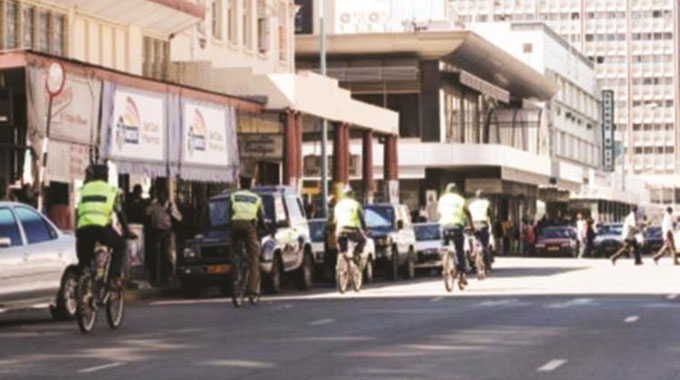
Pardon Gotora
Urban Scape
Police presence both in our neighbourhoods and on our roads brings a certain cushion to our mind-sets, but we can still do more to improve on public safety in our towns and cities.
On July 2, 2006, I was mugged around 6pm in Chitungwiza while commuting from Makoni Shopping Centre to Zengeza 5 Extension.
My bus station was a stone’s throw from where I stayed.
For those familiar with the road that links Machipisa and Makoni, there is a bus-stop popularly known as paMadrum.
The first line of houses from paMadrum going into Zengeza 5 Extension, is where I was heading to. During winter, the days are shorter and by 6pm, it was already getting dark.
I jumped out of the commuter omnibus where there was light and plunged into darkness immediately thereafter.
There were only three trees along the pathway, two avocados and one mango tree.
Unbeknown to me, two “gentlemen” were, waiting for me by the trees using the tree-trunks as cover.
Looking at the time and the distance I was to walk home, I was 100 percent sure that my safety was guaranteed despite that my vision was still obscured because of the sudden contrast between light in the kombi and the darkness on the street.
But alas, the moment I set my foot on the first tree, the next thing I felt was an arm round my neck and down we both went.
The other “gentlemen” was now advising the “wrestler” to stab me. I had no time to scream or yell, but was determined on wriggling my way out of this quagmire.
Thank God, I managed to wrestle my way out without losing most of my valuables and unharmed.
I only lost a woollen hat and a pair of spectacles, which I recovered in the morning when I did my own in-loco inspection. The spectacles needed a bit of repairs because the lenses were detached and the frame was deformed.
On reflection, I later noticed that if there were street lights and some tower lights, it was going to be easier to notice that there were people in front of me and I could trade with a bit of caution.
On a daily basis, people are mugged at night, some are conned through various treacheries.
The muggings can be reduced if city council and municipalities value public safety.
The city fathers adopted a maintenance-free” attitude towards our existing public lighting infrastructure. The focus comes on construction of new infrastructure at the expense of the already existing ones.
This implies that our prioritisation needs refocusing.
Some of the street lights and tower lights only require some bulbs because the tower is still intact. It is not uncommon to find some lights turned on during daytime because the switch system is dysfunctional, but who needs lighting during daytime?
At some point, there was an initiative of solar-powered street lighting, and an attempt was made in the central business district of Harare and along the Airport Road.
It seems the project remained a pilot up to today. Since no one had thought of securing the infrastructure, most of the installed equipment was vandalised.
As a people, we are so cunning that we go to the extent of cutting and stealing the pole itself simply because of the aluminium material used to manufacture it and we come back complaining to the powers that be that they are doing a disservice.
Equally, the society needs realignment in terms of roles and responsibilities.
Our streets are a threat to public safety.
As I alluded to earlier on, we have no maintenance culture, we do repairs, which are costly in nature.
It has become a norm to drive on potholed roads and it is not safe for the pedestrian walking on the sidewalks as motorists meander trying to avoid the detours.
The state of our road infrastructure damages vehicle suspension.
You combine these factors with reckless driving that we witness every day and public safety only becomes endangered species.
On numerous occasions I have witnessed city council employees cleaning the streets and placing the solid waste into the storm water drains.
I wonder where on earth they think this will go.
One would be tempted to scrutinise the kind of induction one goes through when employed by the city.
Ironically, the bins are clearly marked “keep the city clean”, surprisingly a storm water drain is “not part of the city” because it is underground.
A combination of sand, leaves, plastic and bottles do not qualify to be considered as compost, let alone in storm water drains.
The jacaranda blossoming signifies that the rain season is upon us. All that solid waste will definitely block the flow of rain water.
The roads become flooded, which is a hazard to both pedestrians and motorists, including the street cleaners themselves.
Flooded streets become breeding grounds for insects such as mosquitoes which transmit vector-borne diseases such as malaria.
That becomes a public health concern, again a slap on public safety.
Public safety should not be considered as a secondary item on the development agenda.
It is time we focus our energy on public lighting and trafficable roads, among other amenities. Security at public places definitely needs reinforcement.
Feedback: [email protected]



 Online Reporter