admin
admin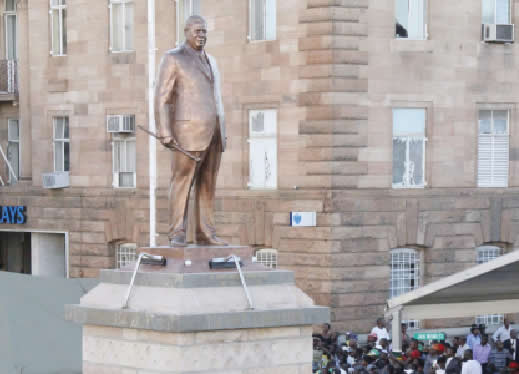
Cont Mhlanga
I LOVE it like all those that do! Finally, the City of Bulawayo has a street narrative that tells our freedom story in more than a thousand words.
I asked a group of tourists from Finland visiting Bulawayo when I picked them up for a cultural tour of the city what they wanted to see and the answer was: “Take us to the statue. We saw it on the news when we were in Harare.”
This reminded me of when I visited Manhattan in New York for the first time and I asked my hosts to take me to the Statue of Liberty that has become America’s heritage and identity. In 2011, around 4.24 million people visited the Statue of Liberty. Talk of tourism business and I will show it to you in a statue!
When we got to the Father Zimbabwe Freedom Statue, a young man was carrying a little boy on his shoulders so that he could have a good view of the statue over the crowd. The little boy was wearing his Fidel Castro designer cap with a Joshua Nkomo badge on it that they had just bought from his foundation tent at the makeshift mall. I asked him who that was, pointing to the statue? “Father Zimbabwe,” smiled the little one. Need I say more?
But hold on, yima kancane, it took Minister Kembo Mohadi and his government 33 years to remove Cecil John Rhodes from that intersection and replace him with Joshua Nkomo just to tell our own freedom story. Unbelievable!
This is where we have a handicap as Africans. We find it challenging to celebrate our own. Bulawayo has legendary personalities all of whom remain uncelebrated. It is mind blowing that this city does not have a single statue of King Mzilikazi anywhere in the public domain. This is a man who created a nation and his own descendents cannot even celebrate him with a statue.
King Lobengula is another one. We can’t even sell cattle and goats and put his statue on a street with his name. Yet we foolishly call Bulawayo the City of Kings when we cannot even show anyone a statue of a single king. Sengathi nje sidakwa butshwala benyoni. What is our problem?
I am sure if it were not for Ashton and his white administrators, nothing would be named after these legends in the city of Bulawayo. To tell that it is white citizens who bothered to use the names; take note that all places that have Mzilikazi or Lobengula do not have King before them, yet all those that are named after the British kings have King to go with the name. Ours is just Mzilikazi Primary School when theirs is King George Children’s Home.
It is the same with our queens. For our queen it is just Lozikeyi Primary School and not Queen Lozikeyi, but for them it is Queen Elizabeth Children’s Home. Have we corrected this in the past 33 years? Not at all! We think it is fine as it is because it is about us. Sekungathi sidakwa butshwala benyoni nje ukwenza kwethu.
When we built the city’s wonderful administration building in the city centre, we failed to give it a name and called it “Tower Block,” Was it because we could not find anyone of our own to honour or all white people who were not shy to honour African legends had left council and government? “Tower Block”, as if this is some extraordinary tower building! Go around the world and see real tower blocks and they still have names given to them. This Tower Block nonsense must go. Rename that building Thenjiwe Lesabe House for God’s sake, and let us get on with celebrating our own. Hatshi sengathi sidakwa butshwala benyoni nje.
Gorden Moyo and his MDC-T “government in waiting” want Barbourfields Stadium to be renamed Mandela Stadium. My foot! How can a Bulawayo person even think of a thing like that? At this rate, Moyo and his friends will be a government in waiting for some long time to come.
The Town Clerk and the Mayor have just announced that they will be leading citizens to celebrate 120 years of the existence of Bulawayo in November 2014. Again, we choose to celebrate Cecil John Rhodes’s ‘bricks’ and ignore Bulawayo city as a “community”.
In fact, Bulawayo will be celebrating 143 years in April 2014 having been founded by King Lobengula in 1871 through the name change of his capital Gibixhegu that he had built in 1870 when he was crowned King at Mhlahlandlela.
Rhodes found Bulawayo a prominent city, the King’s Palace alone (Isigodlo) had a population of around 25,000 residents – more than the population of most of the city’s suburbs and townships today and Rhodes respected and accepted it as such, KoBulawayo.
This population excluded those that lived within the greater area of ESigodlweni. Within the boundaries of that same city just a few kilometers south of the King’s Palace (ESigodlweni), Rhodes pegged his layout of his city centre. This is what we are choosing to celebrate, ‘a city centre’, throwing away 23 years of our own heritage associated with Bulawayo that even Rhodes recognised! What a contradiction!
Sengani nje sidakwa butshwala benyoni ngempela.
Who then do we expect to celebrate 143 years of Bulawayo’s existence? Mr Town Clerk, let us celebrate both Bulawayo the bricks of 1894 and Bulawayo the community city of 1871 because that is what makes this city a special one than any other city in this world. It should not take us another 33 years to make us realise that we gain more by celebrating both the Afrocentric and the Eurocentric Bulawayo.
Another serious handicap in Bulawayo is how we ignore to celebrate our female legends just because some shallow gender organisation leadership, who read from wrong books, have made us believe that our culture and traditions oppressed women. Industrialisation is what brought women oppression and gender violence to our societies not our culture and traditions. Our culture and traditions produced super powerful women until industrialiasation arrived.
This city of Bulawayo we love so much today would not have been created if it was not for the brave, courageous, radical outspoken Princess Zinkabi, King Lobengula’s step sister, who challenged her brother to the throne of the Ndebele State and wanted him killed so that she could take over the governance of the state. She got support from her husband, Mbiko Masuku, and she mobilised a massive anti-Lobengula political campaign that climaxed with the Battle of Zwangendaba in June 1890.
So strong and determined was Princes Zinkabi that even when her husband and supporters fell at the Battle of Zwangendaba, King Lobengula went back to his Gibixhegu town and changed its name to KoBulawayo just because his own sister wanted his seat and wanted him dead.
Because of her campaign, King Lobengula continued to kill his next of kin until the poets called him “umaguqa ezingazini zabafowabo”. So forceful was Princess Zinkabi’s campaign that till today, the Khumalos remain heavily divided with those of the non-Lobengula family tree refusing to accept that King Lobengula means anything to the Ndebele state.
Just because we did not find details of this internal family politics in missionary or some hunter’s diaries and journals then we are not going to celebrate these female legends. How did we expect missionaries and hunters to be privy to such high internal politics, I wonder?
The whole Ndebele state referred to the city of Bulawayo as “komfazi otshaya indoda” in respect of Queen Lozikeyi’s strength and aggressive attitude. Very few men would square up blow-to-blow with her and win. Wayelahla indoda phansi ngempama izithambise. They sang her praises as “umaphosa umkhonto kudabuke isibhakabhaka”. She personally inspected every regiment before it left for war. Do we care about her? No. We run to donors singing songs that our culture oppressed women! Ah sengathi sidakwa butshwala benyoni sibili.
Our Princess Famona, daughter of King Lobengula and radical anti-apartheid activist and fighter of racist laws in this city, is forgotten.
She is today a nobody.
The brave Gogo Jane Ngwenya is the first black woman in this country to join a political party. She is the first black woman to be arrested and politically detained at Grey Street Prison with an 11-month-old baby on her lap. Do we tell her story and celebrate her? No. I can go on and on.
At times, I wonder what those people who lead gender programmes and talk girl child empowerment draw their lessons from if we still do not have statues and narratives of such female legends across the city of Bulawayo. We even have female artists that can get them done locally!
My point is that the city of Bulawayo is the historic heartland of Zimbabwe and by now should be the most decorated city with our national narratives in the form of public art. What we marvel today as the statue of Father Zimbabwe is nothing but public art of a legend. Overnight, it has created enterprises. Young entrepreneurs are making business and that is how it should be.
There is no better way of building national pride, promote self and national identity, attract the movement of people to and within a city than the promotion and commissioning of public art. Unfortunately, it will take us another 33 years to realise that and to add only the city’s second statue.
Let me close by responding to Paul Siwela and a few others who feel that by placing Nkomo’s statue in Bulawayo it means that he has been reduced to a local hero. It is extremely mischievous to imply that only things that are placed in Harare or take place in Harare deserve to be national and anything tacking place in Bulawayo or in Matabeleland for that matter is little and regional. It does not matter where Mqabuko’s statue is placed, as long as it is on Zimbabwean soil he will remain national and Father Zimbabwe.
Now, some selfish people are plotting to put his statue in Harare so that they can stop people from travelling to Bulawayo to see this one. I am convinced that someone out there has an agenda to see Bulawayo dead! Let everyone travel to Bulawayo to see this one. This statue is yet to become big business for this city!
Bulawayo is not lesser than Harare when it comes to the liberation struggle of this country. In fact Bulawayo is the pioneer in that regard and all those who started their politics in Bulawayo and are national heroes today must have their statues in some place in Bulawayo.
Cont Mhlanga is a playwright and founder of Amakhosi Theatre Productions


 Online Reporter