Online Reporter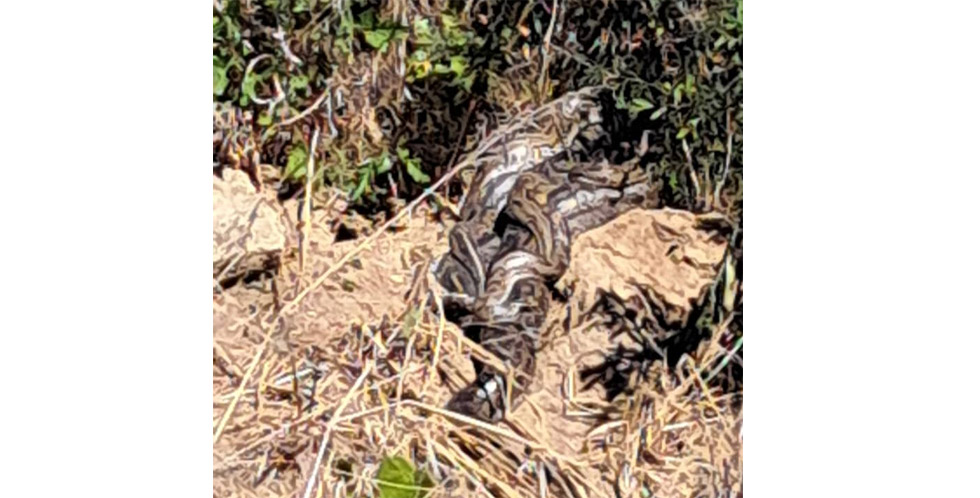
Lovemore Kadzura
Post Reporter
RESIDENTS of Darlington Extension in Mutare are living in perpetual fear due to the presence of a den of gigantic pythons barely metres from their homes, prompting urgent calls for their removal.
A visit to the area by The Manica Post yesterday (Thursday) revealed five enormous and shiny reptiles basking in the sun, having made an anthill their habitat, just a stone’s throw from nearby houses along the Mutare-Beira Railway Line.
Frightened residents have expressed concerns that the serpents may soon invade their houses. Local resident, Mr Binali Yard said he had never seen such huge snakes in one place before, and appealed to authorities to intervene urgently.
“My family is the most exposed, with the snakes just 30 metres away from my house. The fact that I rear chickens, which attract snakes, complicates matters.
We fear they may visit us one day. These are no ordinary snakes, but very large reptiles, with the smallest measuring around 2,5 metres long. Both adults and children are not safe from this threat. We spot them daily,” said Mr Yard.
He said they informed the Zimbabwe Parks and Wildlife Management Authority (ZimParks) about their dire situation, but claimed that the authorities had not responded to their distress call.
Another resident, Mr Philosopher Maoneke said they are afraid that children, who are now on holiday and usually play around the area, will be exposed to the attacks by the snakes.
“I first spotted these snakes last week when people had gathered to view them.
I stay about 200 metres from where the snakes are. I have never seen such big
snakes at one place. They sometimes come out of the hole basking in the sun.
“A snake is not something desirable to stay close to. We are asking for the responsible authorities to remove them as a matter of urgency. People here rear chickens, which attracts snakes into homes. Schools are now closed, and we fear that our children will go and play at the area and will be attacked.
“We contacted ZimParks for assistance, but they requested that we pay them US$30,
claiming that the snakes were in a bush not at a house,” said Mr Maoneke.
The Department of Museums and National Monuments later seconded expert snake handlers, led by the curatorial assistant, Mr Brighton Mahwite from the Zoology and Botany section, who could not retrieve the snakes claiming they were in a very deep hole.
Mr Mahwite said the only way to capture the snakes was to pour large quantities of water inside the hole so that they float and come out.
“We received a distress call from residents of this area who are spotting pythons within their vicinities. They are co-habiting in a very huge hole, and it is not easy to retrieve them. We require huge volumes of water to pour inside so that
the snakes float out.
“These pythons are sheltering here because the place provides a conducive environment for them, with a nearby dumpsite attracting animals such as monkeys, mice, rats, and guinea fowl, which become prey for the snakes. The varying sizes of the snakes indicate that they are breeding in this territory.
“Pythons can lay up to 60 eggs, with around half surviving. Their natural predators include pied crows and cats. Although people have spotted five snakes, there
could be more, as we are still in winter and pythons, being cold-blooded animals, are less active. As summer approaches, more snakes are likely to emerge, attracted by the abundance of food. During this time, residents may encounter pythons in their homes, particularly as they target chickens,” said Mr Mahwite.
He added that pythons do not eat daily, but feed twice a month.
A fully grown python requires about two fully grown broilers or a monkey to sustain
itself for two weeks.
“Given the proximity of these reptiles to humans, urgent relocation is necessary,
requiring collaboration between ZimParks, City of Mutare and the Department of Museums and National Monuments. Young children accessing this area to take pictures are putting themselves at risk, as the grass-covered terrain makes it easy for the snakes to launch surprise attacks. Additionally, the nearby stream provides a water source for the pythons, which drink considerable amounts,” said Mr Mahwite.