
Tawanda Musarurwa
Check Point Desk
ON a kitchen table in suburban Harare, a retired couple in their seventies spread out their receipts. Their combined monthly pension comes to about US$100, and it has to cater for their groceries, transport and monthly bills.
It is not enough to absorb rising fuel and transport costs. By the third week of the month, food portions are smaller; and by the fourth, trips into town stop altogether.
Any spike in the ongoing tensions in the Middle East has the potential to push their costs of living higher.
Other pensioners are likely in worse circumstances.
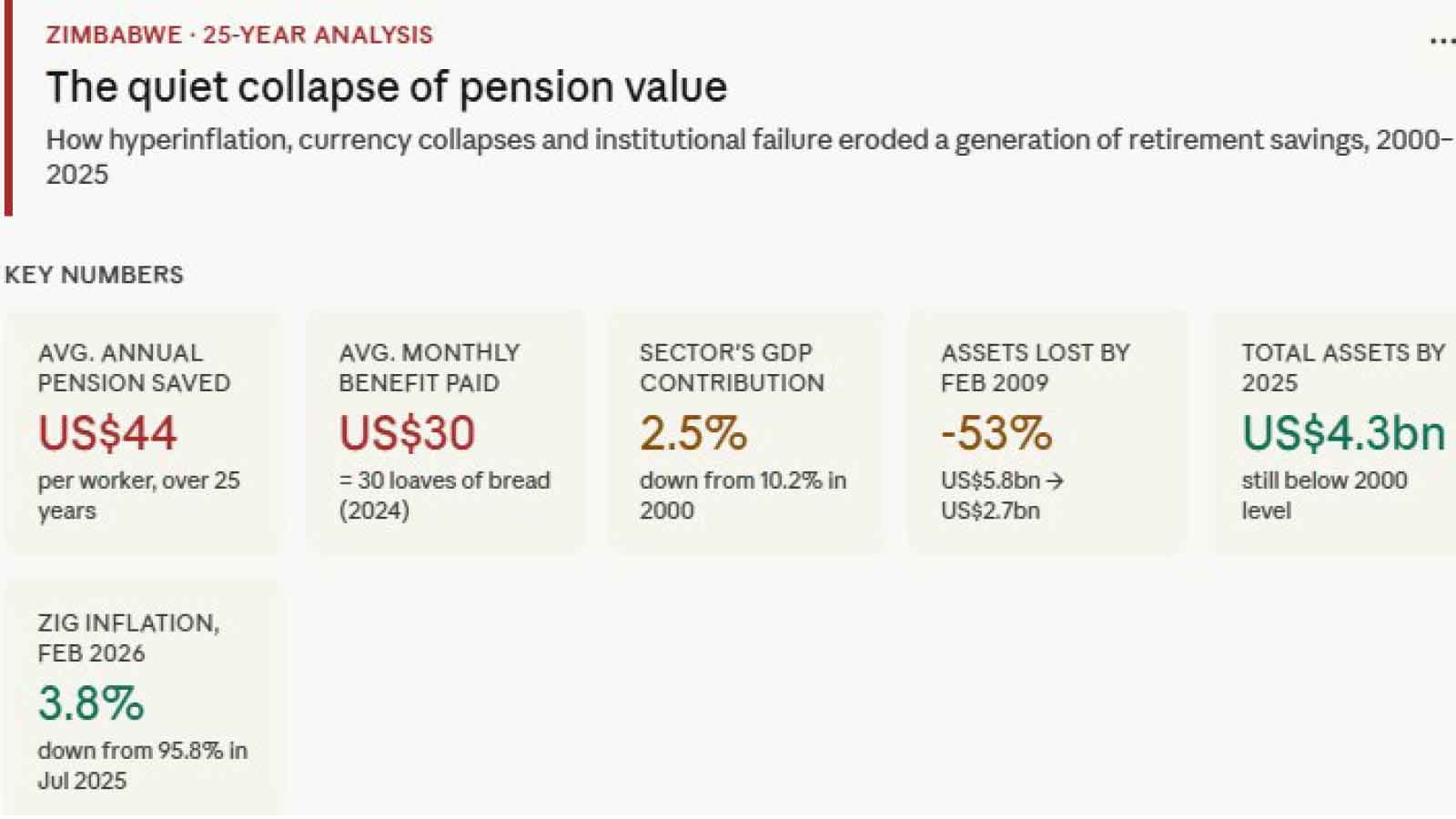
According to regulator, the Insurance and Pensions Commission (IPEC), “In 2024, the average benefits paid to pensioners were US$30 per month, translating to 30 loaves of bread.”
Last month, at a landmark Insurance and Pensions Symposium in Victoria Falls, actuaries, central bankers, World Bank officials and IPEC converged to put hard numbers on one of the most sustained destructions of retirement value anywhere in the world.
The numbers are staggering. However, buried inside the debris, there are also the first tentative signs of something being rebuilt.
2000: A semblance of normalcy
In 2000, total assets in the country’s insurance and pensions sector amounted to US$5,8 billion. Annual revenues – excluding short-term insurance – was US$872 million.
That represented 10,2 percent of gross domestic product (GDP), in an economy then valued at US$8,6 billion.
The local insurance and pensions sector was a mature system even by regional standards: defined-benefit (DB) pension plans, whole-life products and endowment policies.
But, by February 2009, when Zimbabwe abandoned its imploding currency and adopted a multi-currency regime, total surviving industry assets had been cut nearly in half, down to an estimated US$2,7 billion.
Revenues had collapsed to US$320 million annually.
Mr David Mureriwa of MAOS (Pvt) Ltd, a local actuarial and insurance consultancy, told symposium delegates that the period had “eroded the core value of long-term savings” and produced “deep mistrust toward formal financial institutions.”
That mistrust, once built, has proved extremely hard to dismantle.
There was a recovery of sorts. By 2014, assets had climbed back to US$3,9 billion and revenues hit US$1,05 billion – the highest point of the post-2000 era.
It looked like the system might find its footing, but it did not. The reintroduction of local currency instruments, renewed inflation and policy uncertainty drove a second collapse.
By 2020, total industry assets had fallen to US$1,9 billion – lower, in real terms, than even the post-hyperinflation trough. Revenues for the period amounted to US$340 million.
2020: Improvement on the surface
By 2023, the sector’s assets had increased to US$3,1 billion, rising to US$3,25 billion in 2024.
By the end of last year, the sector had US$4,3 billion in assets and US$1,32 billion in revenues. These are real improvements.
But the problem with recovery is that it depends on where it started. In 2000, the sector accounted for 10,2 percent of GDP. Currently, it contributes just 2,5 percent.
To restore its earlier proportional significance, the industry would need revenues exceeding US$5,5 billion. It is currently less than a quarter of the way there.
And then there is the single number that collapses decades of loss into something almost impossible to ignore.
Mr Mureriwa offered it almost in passing. Over the entire period, the average annual pension contribution invested on behalf of a Zimbabwean worker amounted to just US$44 a year.
The figure helps explain why average pensions today stand at just US$30 a month; the result of decades in which contributions averaged only US$44 annually.
A big reason the figure is so low is that many salaries were broken up into allowances and perks that are not counted when calculating pensions – something employers did to protect workers’ pay during years of currency instability, but which ended up reducing how much goes into retirement savings.
An industry reshapes
While the collapse did not freeze the sector, it warped it. As the value of currency became unpredictable, providers and consumers shifted away from cash promises toward things that could not be inflated away.
The most striking expression of this was the rise of funeral assurance.
By 2020, funeral products accounted for 86,21 percent of all life insurance premiums written in the country. That number would be extraordinary in any market, but in Zimbabwe it was rational.
Funeral assurance companies succeeded not through superior returns, but through hearses, burial logistics and parlour services – things you could actually use.
As Mr Mureriwa puts it, the sector’s success rested on “benefits in kind” that “protected against inflation rather than cash.”
By 2025, funeral products had moderated to 68 percent of the life premium mix, with group life at 14 percent and credit life at 8 percent.
Diversification is slowly returning, but the structural distortion persists.
Mr Rob Rusconi, a senior economist at the World Bank Group, puts Zimbabwe’s predicament into a global context.
In other markets – Canada, Denmark, the Netherlands and Australia, for example – pension assets represent between 100 percent and 200 percent of GDP.
Malaysia’s Employees Provident Fund alone holds US$211 billion, equivalent to 60 percent of that country’s economy.
Namibia’s Government Institutions Pension Fund manages assets equal to 60 percent of its GDP and actively finances domestic development. The local pensions sector, at roughly 8 percent of GDP against an economy of approximately US$50 billion, is, as Mr Rusconi put it, a system that could be “uniquely patient, focused on the needs of stakeholders and developmental in approach”.
South Africa’s experience
Mrs Astrid Ludin described how South Africa’s pension system – now holding assets equivalent to roughly 83 percent of GDP – was built through two decades of deliberate, sequenced reform, consisting of governance, cost reduction, preservation of savings and stronger member protections.
Said Mrs Ludin: “High fees can significantly erode retirement outcomes, poor investment decisions can undermine long-term savings and a lack of transparency prevents informed decision-making.”
While the value destruction that took place in Zimbabwe’s pension systems is largely attributed to the hyperinflation of circa 2008, there is the less talked about factor of bad design.
The Justice Smith Commission of Inquiry, which was appointed in 2015 to probe the conversion process (after the Zimbabwe dollar was abandoned around 2009 for a multicurrency system) concluded that “there was a huge loss of value to insurance policyholders and pensioners owing to failure by Government, the Insurance and Pensions Commission and the industry to set up a fair and equitable process of converting insurance and pension values from Zimbabwe dollars to US dollars.”
Players in the insurance and pensions sector were accused of poor corporate governance, arbitrary benefit calculations, shambolic record-keeping, including unsustainable and unjustifiable expenses.
From South Africa, the lesson for Zimbabwe was that rebuilding will require not just macroeconomic stability, but governance, transparency and a fundamental rethinking of how savings systems are designed.
The macro-economy
But, there is no doubt that hyperinflation was the single biggest cause of the value loss in the local pensions sector.
Reserve Bank of Zimbabwe (RBZ) deputy governor Dr Innocent Matshe presented data on the country’s most recent currency, the ZiG, introduced in 2024: Annual ZiG inflation peaked at 95,8 percent as recently as July 2025.
By January 2026, it had fallen to 4,1 percent and by February to 3,8 percent.
Dr Matshe called this “a first in the past thirty years” – a phrase that should land harder than it does, because it means price instability has been the default state for the entire period under review.
Foreign currency reserves have grown from 0,18 months of import cover in April 2024 to 1,5 months by December 2025. The internationally accepted benchmark is three to six months.
“Price stability,” Dr Matshe argued, “allows trustees to forecast liabilities and asset growth with greater certainty for the first time in years.”
That verb tense – “for the first time” – is the whole story in four words.
Statutory Instrument 44 of 2026, the most significant overhaul of the country’s insurance prudential framework in decades, attempts to solidify these gains legally.
Legal experts Messrs Takudzwa Mashingaidze and Nobert Phiri describe it as “a deliberate transition from a primarily rules-based supervisory approach toward a risk-based regulatory regime.”
New solvency requirements, capital thresholds and mandatory risk assessments; these are attempts to make balance sheet fragility structurally harder.
Smaller players, particularly in funeral assurance, will face the greatest strain, with consolidation likely. The arithmetic of the road back is sobering. Even at 2025’s improved figures, US$4,3 billion in assets sits below the US$5,8 billion recorded in 2000, after 25 years of nominal economic activity and population growth.
The GDP contribution has fallen from 10,2 percent to 2,5 percent.
The US$44 annual pension saving is not a safety net; it is barely a gesture toward one.
The elderly Harare couple will almost certainly not see restitution. But the data now exist to ensure that what was lost is no longer invisible.