admin
admin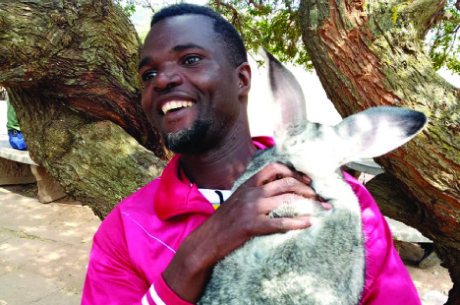
Tendai Gukutikwa
Post Reporter
HIS dream is to flood the Zimbabwean market with rabbit meat, rabbit pizza, rabbit sausages as well as rabbit fur Bible covers.
He will not stop as his mantra is: Tsuro kubasa, usatambe pabasa.
Mr Jackson Yotamu (32) is a serial award-winner for farming rabbits.
So far he has received a total of 13 awards because of his well-bred and healthy rabbits.
Mr Yotamu of Jacfortunes Rabbitry recently received a gold medal in the Zimbabwe Federation of Young Farmers Pacesetters Awards.
2022 was a good year for him as he received at least 12 awards, with 10 being at the Zimbabwe Agricultural Show.
At that particular show, his rabbits scooped him the following prizes, best Chinchilla buck, best Chinchilla doe, best Chinchilla pair, best Netherlands dwarf buck, Best Netherlands dwarf doe, Best Flemish giant buck, second prize Flemish doe, Best New Zealand white doe, Best New Zealand white buck and second prize New Zealand white doe.
Mr Yotamu has countless medals to his name because of rabbit rearing and he is still counting.
He said the secret to his award-winning rabbits is the love he has for them and the fact that he feeds them at regular intervals, while keeping their hutch.
“On a daily basis, I make sure that my rabbits are fed in the morning before 7am and each rabbit get its share of rabbit pellets and hay for the day. I also make sure that the water containers are emptied and fresh water is supplied in the buckets since we use drinking nipples. If there is a batch to be mated, I use that opportunity to mate them.
“If they are expecting does, I insert nest boxes in their compartments. I check the health of each and every animal and how active it is on that particular day and do not leave that work to my employees. I love my animals as I love myself,” he said.
He adds value to his product by making Bible covers from the rabbits’ fur.
A pilot project of making rabbit sausages and pizza that he did recently has been well received by various restaurants.
“I have tested the market and the results have forced me to set-up the business. We also make key holders using rabbit tails which we sell to people in my area. From next year, I will start the packaging of rabbit urine to be used as foliar fertiliser by farmers. I want to make sure that I do not throw anything from my rabbits away,” he said.
Asked on how much one would need to start and support a rabbit rearing project, Mr Yotamu laughs and said it is the easiest business that one could start.
He said the business sustains itself and one can start it with only two rabbits.
“Rabbit farming is one business that does not require a lot of capital since one can start small and expand with time. It sustains itself in terms of feed and growth.
“You can start with two rabbits and they can quickly multiply since at any given time one can receive more than seven kittens. Rabbits eat about 150g per rabbit each day. You can have rabbits while you are formally employed because they do not consume much of your time and attention,” he said.
Mr Yotamu said to reach slaughter weight, which is about 2,5-3kg, it takes 12 weeks.
By then, the cost of production will be around US$3 depending on the breed.
He, however, said prices of feed have forced some upcoming farmers to quit the production of rabbits as it keeps increasing.
“There are a number of factors that have caused farmers to stop, but feed is the main factor. To curtail these kinds of challenges, a rabbit farmer needs to have fast growing breeds so that they use little feed to produce meat at the shortest time possible because if you do not have fast growing breeds, you will use more feed and this will reduce your profit.
“I buy feed, but for hay, I utilise the available grass at the farm, thereby cutting costs,” he said.
He also said there is no viable market for rabbits in the country and farmers end up selling their animals for less than their worth in order to make ends meet.
Mr Yotamu sells a rabbit for US$7.
“A rabbit for meat will need 10-12 weeks for it to be slaughtered and by then it should have reached between 2,5 to 3kg. If it is just for breeding, then it should be ready to be sold at six-weeks-old,” he said.
As someone who has been in the rabbit farming industry for quite a long time, Mr Yotamu assists upcoming farmers by teaching them the basics of rabbit farming.
He conducts workshops on rabbit farming across the country.
“I also offer on-the-farm education whereby visitors come to my farms in Penhalonga and Harare and do work-related learning.
“As Jacfortunes Rabbitry, we will not rest until rabbit meat floods all supermarkets and eating outlets. To those who think employment is the only way to go, then you need to try rabbit farming. I urge those still at school to join the rabbit industry while still young and enjoy the benefits of farming,” he said.
Mr Yotamu has also just started a fish farming project and expects to scoop more awards through the project.


 Online Reporter