Chronicle Editor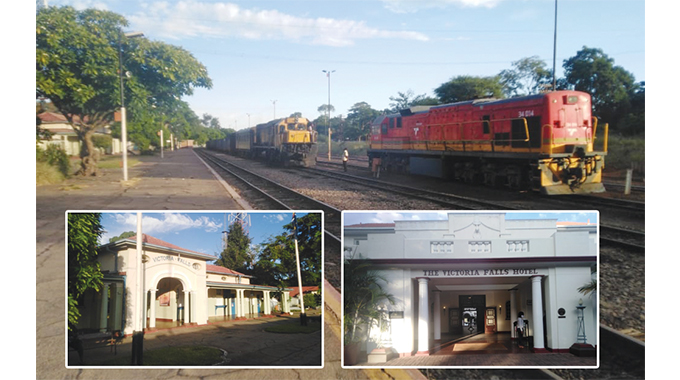
Leonard Ncube, Victoria Falls Reporter
THE arrival of the railway line to Victoria Falls in 1904 marked the beginning of tourism at the city which has developed into independent Zimbabwe’s tourism capital.
The resort town may have waited for more than a century to become a city but its significance to the country and the world at large dates back, especially to 1904 when the first train which was driven by two women reached Victoria Falls, after which construction of the Victoria Falls Bridge and a wooden Victoria Falls Hotel started.
Hundreds started flocking the area to enjoy the magnificent view of the Falls.
The first European to visit Victoria Falls was David Livingstone on November 16, 1855 when he arrived at the present-day town after a 14-day journey along the river using a canoe from Chobe River from where he set off after seeing the thundering smoke.
He named the falls Victoria Falls in honour of the British monarch Queen Victoria.
Livingstone, whose statue makes one of the tourist attractions within the Falls, reportedly said, “Of flights as beautiful as this, Angels in their flights must have gazed” after seeing the magnificent natural wonder.
Until today, helicopter flights are offered as a tourist activity in Victoria Falls and are called “Flights of Angels”.
While he is said to have discovered the Victoria Falls, Livingstone found the San, Tonga, Tokaleya, Lozi and Kololo in the area and to them the Victoria Falls was called Mosi-oa-Tunya, meaning the Smoke that Thunders.
Zambezi River is the fourth longest river in Africa after Nile, Congo and Niger, as it flows for about 2,574km through six countries namely Zambia, Angola, Namibia, Botswana, Zimbabwe and Mozambique.
The modern-day train parties, especially the Blue Train and Rovos from South Africa, are a continuation of what started in June 1905 when a party of 37 friends arrived in Victoria Falls aboard a train from Cape Town and remains the first known group of tourists.
National Railways of Zimbabwe curator Mr Gordon Murray narrates the history of the railway line whose importance to the country, particularly Victoria Falls is unparalleled.
The railway line reached Bulawayo from South Africa via Botswana on October 19, 1897, three months before the Beira line reached Mutare.
The Bulawayo railway station was officially opened on November 4, 1897 before construction of the Bulawayo-Victoria Falls railway started in in 1902.
The rail was part of Cecil John Rhodes’ transnational Cape to Cairo vision.
Initially it was to go via Harare into Zambia but the discovery of coal in Hwange changed the plans.
Mr Murray said the first coal train was launched on December 1, 1903.
“The first train arrived in Victoria Falls in 1904 and was driven by two women; Veale and Pauling, who was daughter to George Pauling the railway line engineer. Construction of the bridge had to wait until 1904 for the rail to bring equipment and structures. The bridge was then built in three parts from either side of the gorge and was finally joined on April 1, 1905, with the official opening by Professor George Darwin, son to naturalist Charles Darwin on September 12, 1905,” he said.
The railway line initially moved between Victoria Falls Hotel and the gorge and was moved to its present location after it was washed away by a storm in 1909.
There was also a police station behind the present-day hotel on the edge of the gorge and a flag pole still stands on the site.
Mr Murray said a small engine named Jack Tar was used to transport steel and other equipment across the gorge during construction of the bridge and rail on the Zambian side, then Northern Rhodesia.
“They took it up to the Falls and took it across the gorge on a metal bungee cable. It was used to carry all equipment across the gorge. It was also used to proceed with construction of the rail on the Zambian side,” explained Mr Murray.
The railway line reached Congo in 1910 while Jack Tar was brought back and is kept at the NRZ Museum in Bulawayo, said Mr Murray.
“When the railway line reached Victoria Falls, they realised they needed a hotel and the Railway Company built a wooden structure for workers to have meals and drinks in 1904,” says Mr Murray about how Victoria Falls Hotel came into being.
The hotel has grown into a five-star facility offering unique services mostly to international clients including celebrities, world politicians and royal families.
The initial bridge design had two railway lines and was altered in 1929 to have the existing one lane, a road and two sidewalks.
Mr Murray says the Victoria Falls Bridge was the only such structure in the world at the time.
Its designer was George Andrew Hobson, a British engineer a French man Georges Imbult put it together.
Cleverland Bridge and Engineering Company of England built the bridge for 70 000 pounds.
Jack Soper who worked as a toll man at the bridge collecting fees later became the founder of the curio business which is one of the key components of tourism in present day Victoria Falls.
The bridge is passage to the region although passenger trains failed to resume after being stopped when the bridge was closed at the height of the liberation war in 1969.
The iconic bridge which is still jointly owned by National Railways of Zimbabwe and Zambia Railway and managed by Emerged Railway Properties was reopened in 1980.
Mr Murray said there was a rift between Rhodes and his brother Frank who wanted it built 10km upstream where Old Drift Lodge is located but the former coloniser wanted it at the waterfall for travellers to enjoy the sprays.
The construction of bridge and hotel was followed by construction of single quarters in Chinotimba suburb to cater for workers who were mostly foreigners from Angola, Zambia, Malawi and Mozambique.
What followed is growth of a small town and an influx of people from all over the world coming to view the Falls.
Victoria Falls was proclaimed a national monument in 1935 and two years later it was put under the control of the Historic Monument Commission (Victoria Falls Reserve) which became known as the Victoria Falls National Park. In 1952 the Victoria Falls National Park came under management of the Zimbabwe National Parks, now Zimbabwe Parks and Wildlife Management Authority (ZimParks).
The long road to becoming the country’s conference capital started in 1947 when Victoria Falls hosted the first meeting of the formation of the Federation of Rhodesia and Nyasaland at Victoria Falls Hotel. The conference to mark the end of the Federation was held at the same venue resulting in separation of Livingstone and Victoria Falls in 1963.
The town has grown to be a preferred venue for international conferences, with events such as the Commonwealth Heads of Government meeting, United Nations World Tourism Organisation General Assembly and the 6th session of the Africa Regional Forum on Sustainable Development (AFRFSD) among many others being hosted there.
Victoria Falls was granted a Local Board status in 1965 before being declared a Town Council in 1971.
By then Government retained control of all state land within the council area and the current boundaries were made in 1974, she said.
The town was upgraded into a municipality in September 1999 and was then given power to manage land through a Deed of Grant.
Victoria Falls was declared a World Heritage site in 1989. In 2018 the town was designated a Special Economic Zone (SEZ) as it is pivotal to the development plan for the greater Victoria Falls-Hwange Binga SEZ.
Last October Victoria Falls became the only town in the country to have a foreign currency stock market following launch of the Victoria Falls Stock Exchange.
Victoria Falls is the centre of the Okavango and Zambezi basin known as Kavango-Zambezi Trans-frontier Conservation Area (KAZA) and tourists who make a pilgrimage around the region would generally not end their trip without visiting the Falls.
It will be a unique city with no high-rise buildings because of its conservation status and sensitive natural environment, as it is surrounded by Chamabondo, Zambezi and Hwange National Parks habouring all kinds of animals including the Big Five.
One of the senior citizens, Reverend Africa Jubane, also a Zapu member during the war, said he boarded the train for the first time in 1954 going to Zambia.
He said people from both Northern and Southern Rhodesia benefited especially from an evening train that departed Bulawayo in the evening going to Kitwe in Zambia, while there were two-day trips between Bulawayo and Hwange. — @ncubeleon


 Online Reporter