Online Reporter
Sione Amidu [email protected]
MATABELELAND SOUTH is expanding rehabilitation facilities and stepping up community-based interventions as part of its sustained campaign against drug and substance abuse, a scourge that continues to affect many communities across the province and beyond.
The renewed efforts signal a strong commitment by both Government and stakeholders to confront the problem through a comprehensive and multi-sectoral approach that prioritises prevention, treatment and reintegration.
The province has made notable progress in treatment, law enforcement and community support, with authorities reporting encouraging developments across various fronts. These gains reflect ongoing collaboration between Government departments, law enforcement agencies, health institutions and community-based organisations working collectively to curb the impact of drug and substance misuse.
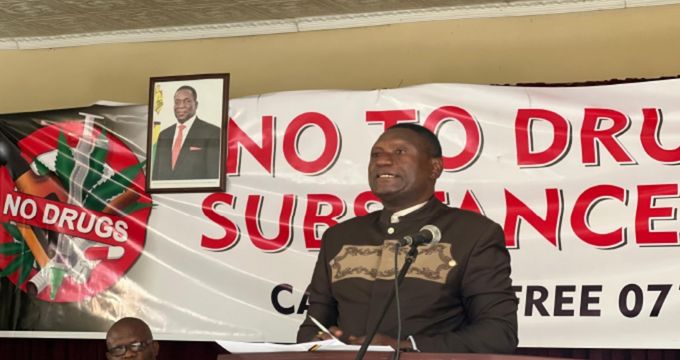
Addressing stakeholders during a recent weekly briefing, Matabeleland South’s Minister of State for Provincial Affairs and Devolution, Albert Nguluvhe, said the province had recorded significant successes in various intervention initiatives aimed at reducing the scourge of drug and substance abuse since the beginning of this year. He emphasised that the fight against drug abuse remains a top priority due to its far-reaching social and economic consequences.
“The strides we are making are in line with the vision and firm commitment of our leader President Dr Cde ED Mnangagwa, whose leadership under the Second Republic has placed the fight against drug and substance abuse among the top national priorities,” said Minister Nguluvhe.
“At the centre of the current phase are upgrades to treatment facilities in Gwanda and Plumtree. Plans are underway to rehabilitate and upgrade the Old TB Centre in Gwanda and the O.I Clinic in Plumtree to expand capacity and improve service delivery. In addition, the National Task Force on Drug and Substance Abuse has pledged USD $286 000 towards the renovations, with funds to be released once available”.
He said infrastructure development was already underway at the proposed Gwanda Rehabilitation Centre, marking a significant milestone in expanding the province’s capacity to offer specialised treatment services closer to affected communities. The development is expected to ease pressure on existing facilities while improving accessibility to care.
The Minister added that authorities have also identified a hall adjacent to the rehabilitation centre which is being turned into a Vocational Training Centre to support the youth and those who would have successfully undergone through the rehabilitation processes. This initiative is designed to equip recovering individuals with practical skills that can help them reintegrate into society and rebuild their lives sustainably.
So far he said a borehole has been drilled at the Gwanda facility to ensure sustainable access to water, while a site proposal for a Village Business Unit (VBU) is also being established in the same area. These developments are part of a broader strategy to create a self-sustaining rehabilitation environment that supports both recovery and economic empowerment.
“As a province so far, we have raised ZWG $2,072.73 and USD $24,241.38 to boost our efforts to combat drug and substance abuse. Since the start of the year, 131 clients have been admitted for treatment and provided with psychosocial support before referral for reintegration services.
“To strengthen outreach, a total of 27 artisanal peer educators were trained in Gwanda by the Ministry of Health and Child Care and awareness campaigns ongoing with the support of other institutions like churches across the province,” Minister Nguluvhe.
The Minister also said that law enforcement operations were being intensified to support existing health interventions, highlighting the importance of addressing both prevention and enforcement in tackling the drug menace. He said authorities were working closely with the police and other security agencies to disrupt the supply chains of illicit substances.
He said since the beginning of the year a total of 398 people were arrested for drug-related offences — among them 229 men and 169 women. These figures underscore the scale of the problem, as well as the determination of law enforcement agencies to bring offenders to justice.
“Of these, 233 were referred to court, with 148 men and 85 women being prosecuted and the courts convicted 161 individuals, including 84 men and 77 women,” said Minister Nguluvhe.
He said to minimise the spread of drug and substance peddling, authorities were targeting suppliers in their law enforcement programmes, focusing on dismantling networks responsible for distributing harmful substances within communities.
So far, the Minister added, 119 people were arrested after being identified as suppliers of drugs and related products, demonstrating the province’s firm stance against those fuelling the crisis.
An additional 165 offenders who were arrested for related offences deposited admission of guilt fines at the station level, reflecting ongoing efforts to ensure accountability while easing pressure on the courts.
“On the demand side, the province has focused on skills training and peer support to create alternatives to drug use. Three survivors enrolled for skills training under Young Africa, with two graduating in solar installation. Seven female survivors were trained under the Msasa Project in basic counselling and first-line support, and are now working through Mobile One Stop Centres in Madabe, Nguwanyana and Sanzukwi in Mangwe District,” said Minister Nguluvhe.
At Guyu Youth Service Centre, 21 youths identified as survivors are currently undergoing training, including participants from Mangwe and Beitbridge. These programmes are aimed at empowering young people with skills that enhance their employability, thereby reducing the risk of relapse into substance abuse.
He said such programmes were critical in restoring dignity, building resilience and creating alternative livelihoods for affected individuals. By equipping survivors with practical skills and support systems, the province is fostering long-term recovery and social reintegration.
Minister Nguluvhe also reported that in terms of reintegration efforts, authorities had assisted a total of 131 clients discharged from treatment centres, ensuring that recovery does not end at discharge but continues within supportive community structures.
“Among these, 28 have received structured reintegration services across Beitbridge, Gwanda, Insiza, Matobo and Umzingwane,” he said.
“Community engagement has also played a role with the Beitbridge community recently hosting at Lutumba Growth Point a musical festival to champion the fight against drug and substance abuse, marking the third edition of the event.
“We have also strengthened monitoring and coordination programmes across all the seven districts.”
He said to bolster efforts, joint engagements between the Provincial and National Task Forces are continuously being held, with the most recent meeting taking place in Matobo district during the Independence Celebrations outreach programme. These engagements are critical in ensuring alignment of strategies and sharing of best practices.
He emphasised the need for collaborative efforts from line stakeholders in the fight against drug and substance abuse, stressing that the challenge requires a united and sustained response from Government, communities, institutions and individuals alike.