dyton mupawaenda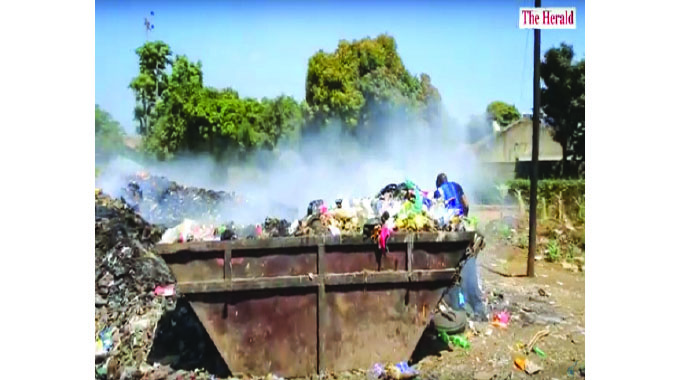
Remember Deketeke-Herald Correspondent
For 13-year -old Makanaka (not her real name) of Budiriro 1, west of the capital, wearing a mask is now part of her life despite the relaxation of Covid-19 measures a few years back.
A waste management crisis in Budiriro 1 and other suburbs in Harare has seen garbage piling up in the streets and open landfills.
Makanaka and her parents live near an open garbage dump close to Budiriro 1 shopping centre.
The burning of waste has gravely affected all aspects of their lives.
She experiences difficulty in breathing due to air pollution. The potential health effects of open burning of waste are dire for Makanaka and other people who live close to open burning garbage spot.
She wears a mask not for fun but to shield herself from the intensity of the smell coming out the burning garbage.
Makanaka is coughing all the time, unable to breathe and sometimes it causes headaches and skin irritation on her.
Her health problems are consistent with the frequent and sustained inhalation of smoke from the open burning of waste.
Life has been hell for her for the past months as their house is so close to the open burning dumpsite.
“Piles of rubbish are burning and smoke goes straight into our house. The smell of the smoke is strong and I have to put on a mask to breathe,” she says.
“It’s so bad and its now difficult for us to play outside. My friends have moved out and are now staying with relatives elsewhere.”
Residents living near a waste fire that has been burning for days are angry saying their homes now smell of smoke.
“The situation is very bad for us. We are suffering here. Our homes now smell smoke and we are unhappy that the fire has burned for so long. We are always coughing here, the smell is very strong and we can’t breathe. We are poor and we have nowhere to go,” says Catherine Muremba, a Budiriro 1 resident.
“We have called EMA (Environmental Management Agency) and they referred us to the council. The council in turn, referred us back to EMA. We are now confused. We are stranded with no one to report to.”
The council is now aware of the problem. It agreed to remove the garbage every three days to reduce the potential hazards of the burning waste.
Lack of fuel and garbage trucks has hampered the removal of the waste.
“And because of this, we are forced to wear masks the whole day to avoid suffering from respiratory and skin diseases,” says Muremba.
Some of the waste at the dumpsite includes used sanitary wear, food waste, used pampers, dead pets, plastic, e–waste, bottles, metal items and other stuff.
The council fire services department has also been unable to extinguish the fire.
“At one-point the council came and removed this garbage and promised that they will do that regularly but they have failed on their provision,” says Trymore Dakara of Budiriro 1.
“The only message I have to the city council is that they must remove this garbage from here and save us from this death trap. The fires must be extinguished first before the garbage is collected. We need help. We pay our rates and the council must act to save us from pollution.”
Harare Mayor Jacob Mafume says Budiriro 1 and Glen View have always been on the radar as areas that need special attention in terms of refuse collection.
“Harare City Council is trying to finish purchasing trailers for the recently commissioned tractors and Budiriro and Glen View will be some of the first places to receive these tractors to make sure that service delivery is speeded up,” he says.
“My office will see that we communicate with the district office of Budiriro and see what they are doing wrong in terms of refuse collection and how we can help.”
The burning of uncollected rubbish is rife in Budiriro and other suburbs in Harare. Some inconsiderate residents burn their waste, polluting the air and putting neighbours at the risk of inhaling poisonous fumes harmful to health.
Burning of rubbish is prohibited under EMA laws and City of Harare by-laws because it pollutes the air and affects the quality of living.
Residents complain bitterly that the burning rubbish poses a grave danger to those with respiratory conditions and allergies.
The problem of open garbage burning has become rampant in the past few years as refuse collection services have virtually collapsed or if they are available they are not consistent.
Open waste burning has put the health of Harare residents at serious risk as no action has been taken to contain the proliferation of the burning of garbage in most parts of the capital where inconsistent garbage collection by the municipality has seen people opting to burn waste.
EMA is a statutory body responsible for ensuring the sustainable management of natural resources and protection of the environment, prevention of pollution and environmental degradation.
It was established under the Environmental Management Act (Chapter 20:27) and operationalised through statutory instrument 103 of 2003.
Health experts say air pollution could lead to emphysema (accumulation of smoke in lungs), chronic bronchitis, lung cancer, heart attacks and stroke.
While control measures to end pollution exist, lack of resources and monitoring often affect efforts to stop pollution in the capital and other parts of the country.
Pollution largely emanates from uncollected garbage that continues to pile at shopping centres, public open spaces, street corners and in the central business districts in urban centres.
Deaths from pollutants remain a major problem in Africa and some other developing countries.
Air pollution is killing 9 million people a year, with Africa the hardest hit, according to a global mortality and pollution level report released by the Lancet Commission on Pollution and Health in 2022.
Tainted water and soil and dirty indoor air was the major cause of most pollution – related deaths in Africa, according to the study.
The World Health Organisation (WHO) estimates that air pollution is responsible for more than seven million premature deaths every year around the world causing pulmonary and heart diseases, lung cancer and respiratory infections.
Almost all of the world’s population – 99 percent – breathes air that is dirtier than levels recommended by the WHO.



 Online Reporter