Chronicle Editor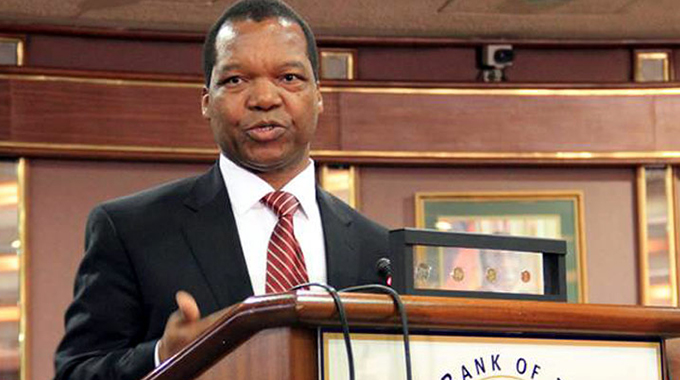
Business Reporter
THE Reserve Bank of Zimbabwe has further trimmed the lending rate to 15 percent from 25 percent per annum with effect from today, as part of monetary policy measures to stimulate economic activity.
The apex bank has also reduced the interest rate on Medium-Term Bank Accommodation (MBA) facility from 15 to 10 percent per annum to ensure the economy remains on a growth trajectory following the devastating effects of Covid-19.
“The bank policy rate will be reviewed downwards from 25 percent to 15 percent per annum with effect from May 1, 2020, with the expectation that banks will do the same to provide affordable financial facilities to their customers during these challenging times,” Reserve Bank of Zimbabwe (RBZ) Governor Dr John Mangudya said in a statement on Wednesday.
Prior to the latest policy interventions, banking institutions were lending mostly between 45 and 25 percent, for individual and short-term loans, while others were quoting interest rates just below the industry benchmark rate, specifically for corporate loan facilities.
The policy shift follows the recent central bank’s Monetary Policy Committee (MPC) meeting held where a number of issues and necessary policy interventions were deliberated on in light of the global pandemic.
He said the MPC noted the compelling need to reinforce the first-round of economic policy responses to Covid-19 pandemic.
The interest rate applicable to the MBA facility will be reduced from the current 15 percent to 10 percent per annum with effect from May 1, 2020.
The MBA facility was also increased by an additional $500 million to $3 billion to support the private sector.
As part of the interventions to supporting productivity by the private sector, Dr Mangudya said an additional $2 billion will be raised from the market through money supply neutral financial instruments to augment the MBA facility to $5 billion.
“Banks that access the MBA facility are encouraged to on-lend at interest rates not exceeding 20 percent.
“The above measures will provide further impetus to the resuscitation of production in the economy,” he said.



 Online Reporter