Online Reporter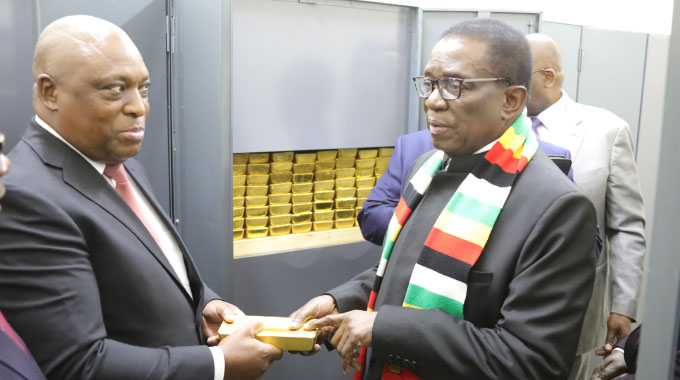
Tapiwanashe Mangwiro, Senior Business Reporter
PRESIDENT MNANGAGWA yesterday conducted a critical inspection of the Reserve Bank of Zimbabwe’s (RBZ) vaults, directly confirming the physical gold reserves underpinning the nation’s new currency, Zimbabwe Gold (ZiG).
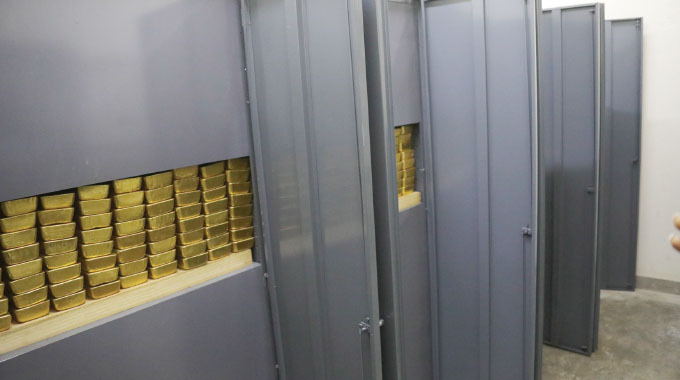
The President was shown 3 400 kilogrammes of bullion, a stockpile accumulated over the past two years entirely from royalties paid by the country’s mining sector, signalling a tangible foundation for ZiG’s stability.
The visit followed an invitation from the central bank.
As of April 5, 2024, Zimbabwe’s gold reserves stood at just 1 500kg. The central bank began building its gold reserves following a directive from President Mnangagwa, with the ultimate goal of introducing a more stable, gold-backed currency that commands market credibility.
Prior to this, Zimbabwe had endured prolonged periods of inflation and macroeconomic instability, which made economic planning difficult and discouraged investment.
Since the introduction of the ZiG last year, Zimbabwe has arguably experienced its longest stretch of economic stability in recent years — an achievement noted positively by an International Monetary Fund (IMF) staff mission that visited the country recently for its routine economic evaluation.
Speaking after inspecting the bullion stockpile, President Mnangagwa commended the RBZ’s efforts to build gold reserves to back the local currency.
“Two years ago, we had no gold or cash reserves, and it felt wrong. I then instructed the central bank to build reserves so that we could have a gold-backed currency. There are some out there who have squandered their reserves and are now backing their currencies with theory, but we need hard physical gold to sustain our local currency,” he said.
President Mnangagwa said a gold-backed ZiG would earn well-deserved respect and help stabilise the economy through greater predictability and confidence.
Writing on his X handle later in the day, the President said: “This morning, I visited the RBZ vaults to inspect our gold reserves accumulated over the past two years following my directive to build a gold-backed foundation for our currency. I am pleased to note that Zimbabwe has now surpassed the 3-tonne benchmark, placing us sixth in Africa in gold holdings.

“In an increasingly uncertain global environment, gold remains a secure and strategic asset.
“As a significant gold producer, Zimbabwe is well-positioned to safeguard our economic stability and sovereignty.”
RBZ Governor Dr John Mushayavanhu said the bank had followed the President’s directive and was steadily building up gold reserves.
“We heeded the instruction of the President, and miners have responded positively — especially the artisanal and small-scale sector, which is now our biggest gold producer,” he said.
As of June 13, 2025, Dr Mushayavanhu reported that the bank held foreign currency reserves equivalent to US$701 million or ZiG18,9 billion—fully covering the ZiG17 billion in circulation.
He revealed that the vaults contained 326 standard gold bars, each weighing 10kg, with a minimum purity of 99,5 percent.
“The total net weight of these bars is about 3 300 kilogrammes,” he said, excluding an additional 120kg still held at the Fidelity Gold Refinery pending certification.
“This physical stock is fundamental to maintaining the credibility and stability of the ZiG, as we have seen reflected in recent market performance,” Dr Mushayavanhu said.
The physical gold reserve has grown by 126 percent over the past 14 months and has appreciated in value. In April 2024, 1 500kg of gold were valued at US$148 million, translating to US$98,881 per kg.
Today, that same weight is worth approximately US$163 million — a 10 percent gain driven solely by rising international gold prices.
l To Page 9
“By sitting in the vault for over 12 months, the gold has generated a return on investment that is worthwhile,” Dr Mushayavanhu said.
President Mnangagwa also took the opportunity to commend small-scale miners for embracing formalisation.
“We decided to decriminalise artisanal mining (makorokoza) and integrate these operators into the system. Now we are reaping the rewards—they are outperforming some primary producers. I am not saying the larger mines are not contributing; they too are paying more through other taxes, but the inclusivity of our approach has borne fruit.”
The RBZ’s drive to accumulate gold began with the introduction of the ZiG—a fully structured, market-determined currency that replaced the RTGS dollar, which had lost three-quarters of its value by April 2024.
Economist Tinevimbo Shava said central banks hold gold primarily as insurance against instability and currency volatility.
“Unlike paper money, gold retains intrinsic value and is universally recognised, making it a trusted store of wealth during crises. It also diversifies foreign-exchange reserves, balancing exposure when major currencies like the US dollar fluctuate.”
Mr Shava said that in countries with fragile histories of inflation, gold restores confidence in the financial system—especially when it underpins a local currency like the ZiG.
“Gold enhances a central bank’s credibility, supports monetary policy and emergency liquidity, and carries no counterparty risk. With its finite supply and global liquidity, gold remains a strategic reserve asset and a cornerstone of economic resilience and trust,” he said.