Chronicle Editor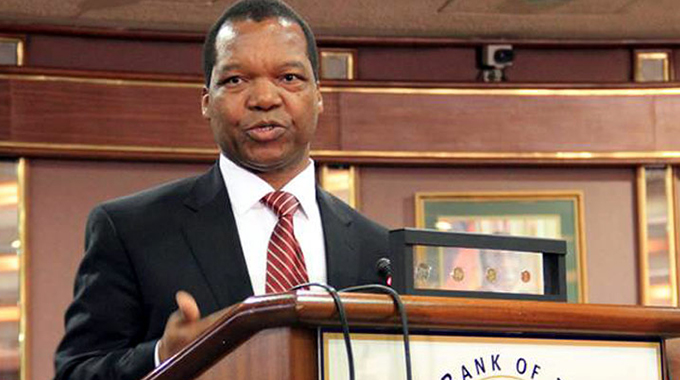
Business Reporter
THE Reserve Bank of Zimbabwe (RBZ) says it will maintain a tight monetary stance targeting reserve money growth not exceeding 15 percent by the end of the year.
The measure is meant to enhance exchange rate stability as well as tame inflationary pressures, which are often linked to growth in money supply.
In the 2020 Monetary Policy Statement presented last month, RBZ Governor Dr John Mangudya reiterated that the growth in money supply or more specifically reserve money last year, was as a result of subsidies on fuel, electricity, grain and Government expenditure.
“The bank remains committed to the implementation of the monetary targeting framework under its tight monetary stance and is targeting reserve money growth of 10-15 percent by the end of 2020,” said Dr Mangudya yesterday.
Reserve money refers to the currency in circulation plus commercial banks’ deposits with the central bank and other deposits to the same. As a result of the tight monetary policy stance and stability in the exchange rate, he said the month-on-month inflation for January 2020 declined to 2,23 percent from 16,56 percent in December 2019.
“And the forecast is that it will remain in the single digit levels for the rest of the year,” he said.
The apex bank recently indicated that the level of liquidity or money supply in the economy as measured by total banks’ deposit stood at ZW$34,5 billion as at December 31, 2019.
The figure is composed of ZW$22 billion (64 percent) in local currency and ZW$12,5 billion (US$785 million) or 36 percent in foreign currency.
Dr Mangudya noted that this liquidity was under key focus as the bank was mandated to manage it to ensure it does not cause inflation and/or bring volatility to the exchange rate.
Meanwhile, the RBZ boss has dismissed reports by some sections of the media insinuating that Zimbabwe is secretly printing money with a view to subsidise gold miners. Dr Mangudya said the concerned media reports, which were also circulating on social media were malicious and misleading.
“The article is circulated to tarnish the image of the bank and ultimately that of the country and its leadership, through misinforming the public.
“The bank notes with concern that the article seeks to fabricate an International Monetary Fund (IMF) executive board’s report on the Article IV Consultation for Zimbabwe, which development is quite unfortunate and disrespectful of the IMF as an institution and the Republic of Zimbabwe as a member of the IMF,” he said.
Dr Mangudya said it was also mischievous to allude to “secret money printing”, saying there was no secrecy in the payment of gold incentive scheme by the State through the financial institution.
He said in order to ensure the continued flow of gold through the formal channels and thus mitigating the leakages and side-marketing of gold, Government, through the bank provides incentives to the gold sector to increase foreign exchange through the interbank foreign exchange system.
“The gold incentive scheme, which is funded through the budget, has not been discontinued as alleged in the Article.
“The decline of the value of the local currency was largely due to various factors including low business and customer confidence, low production levels within the economy and the impact of macroeconomic shocks such as drought and Cyclone Idai,” said Dr Mangudya.


 Online Reporter