Chronicle Editor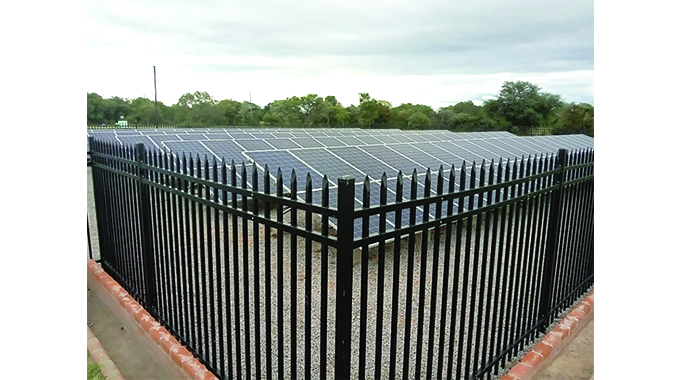
Nqobile Tshili – [email protected]
THE Rural Electrification Agency (REA) is working on establishing community solar projects in each of the country’s eight rural provinces having successfully launched one in Bemba, Tsholotsho, Matabeleland North where villagers now have power in their homesteads.
REA launched a pilot project in the remote community last year and even villagers living in thatched houses are accessing electricity.
In the past REA mainly connected institutions to the national grid, but community solar project enables ordinary citizens to have access to power.
Community members buy the electricity.
The agency has said access to electricity is uplifting rural livelihoods and is in sync with Government’s development agenda of transforming the country into an upper middle income by 2030.
In an interview, on the sidelines of the 63rd edition of the Zimbabwe International Trade Fair last week, REA spokesperson Mr Johannes Nyamayedenga said more community solar plants will be implemented across the country.
“We are rolling it out across the rural provinces. We have two categories of solar systems, we have what we call the institutional solar plants and the community solar plant. The Bemba one was a community solar plant and pilot project. Since we lit up the plant, we are experiencing electricity throughout the day,” said Mr Nyamayedenga.
“Communities are benefitting without interruptions, the business centre, primary schools, community garden and there is also a rural health centre.”
He said the solar project has also enabled a steady supply of water to the community which now runs an irrigation project.
“We extended the grid network to a garden which was started by the Ministry of Agriculture (Lands, Agriculture, Fisheries, Water and Rural Development). It is an irrigation project so we supplied the electricity there so that they will be able to draw water from the borehole into the tank and irrigate their field,” he said.
“In addition, there is a cattle track where animals come and drink water, so we deliberately electrified that cattle track where the communities take turns to take their cattle to drink water.”
Mr Nyamayedenga said the provision of electricity in rural communities is a step towards rural industrialisation as Government enunciated.
He said electricity access uplifts rural communities from being marginalised.
“When we are providing energy in the rural areas of Zimbabwe, in the form of conventional grid electricity, solar and biogas we are trying to develop rural areas. We want to empower villagers who have been marginalised for many years so that they can live a comfortable life by eking a living in their home areas because they have access to energy,” he said.
“I’m talking about the Bemba, it’s a solar plant but we ended up having an irrigation project where local people can be engaged in farming all year round. Those areas are dry and rains are erratic but now they will be growing maize, vegetables all year round and they are developing themselves.”
Mr Nyamayedenga said even the delivery of education has greatly been improved through the electrification of schools and homesteads.
He said information communication technology subjects are being taught in rural school as electricity enables connectivity.
“In terms of education, energy has managed to improve the lifestyle of pupils, many of them in rural areas didn’t have access to electricity and as a result they could not do other important subjects even the pass rates have been very very low. But through access to electricity things are changing for the better. They are now doing science subjects, experiments they have access to computers,” he said.
Speaking during the same interview, REA Matabeleland North manager Engineer Vincent Sande said the agency has completed all its solar projects for the year.
“All the rural provinces have one community solar project and for Matabeleland North Bemba was the one which was a pilot project for REA. Under Matabeleland North we were given three institutional ones which were Kokoloza (in Lupane), Chunga and Siabuwa (in Binga). So actually, we can say in terms of solar implementation under the rural electrification provisions Matabeleland North for 2023 we are 100 percent,” said Eng Sande. -@nqotshili


 Online Reporter